


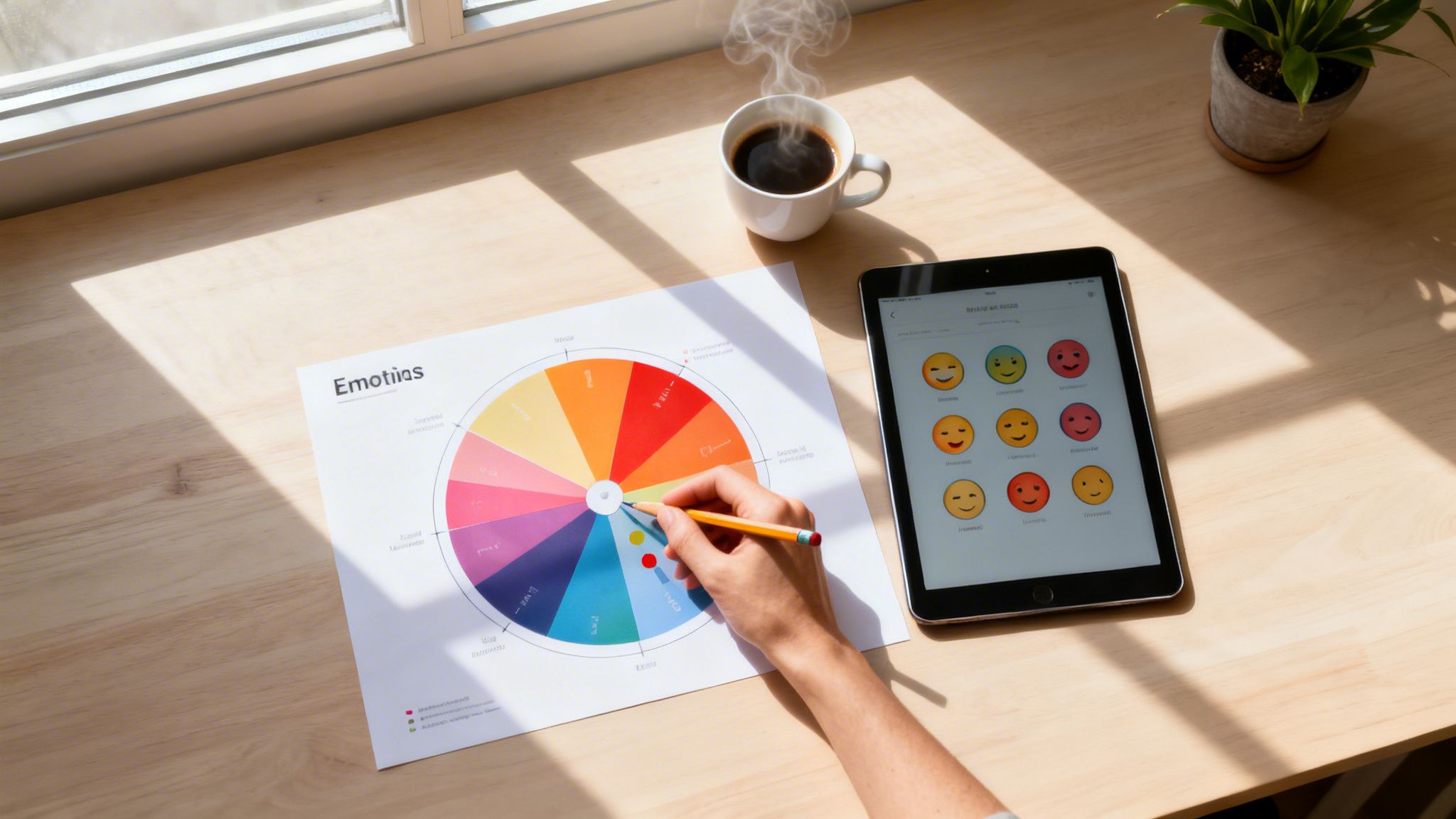
An emotions chart is a visual guide that helps you make sense of what you’re feeling. Think of it as a map for your inner world, translating tangled, complex emotional states into clear, organized categories. It’s a tool designed to give you clarity in the moment and build a deeper understanding of yourself over time.
Before we dive deeper, here’s a quick look at the fundamentals.
Emotions Chart At a Glance
| Key Aspect | Brief Explanation |
|---|---|
| What It Is | A visual reference (like a wheel, list, or grid) that categorizes and names different emotions. |
| Who It’s For | Anyone—from professionals and leaders to students and individuals in therapy. |
| Primary Goal | To build emotional literacy—the ability to accurately identify and name what you are feeling. |
| Key Benefit | It turns vague feelings into specific information you can use for self-awareness and better decision-making. |
This simple framework can be a game-changer for navigating both your personal and professional life.
Why an Emotions Chart Is a Key Tool for Success
In a world where technical skills can be automated, our uniquely human abilities are what truly set us apart. An emotions chart has moved beyond the therapist’s office to become a practical tool for anyone looking to lead, innovate, and connect more effectively. It offers a straightforward way to build what we call emotional intelligence.
I often describe it as a “weather map for your mind.” A meteorologist uses maps to understand atmospheric patterns, seeing the difference between a minor shower and a major storm. In the same way, an emotions chart helps you spot your own internal patterns. This skill is the foundation for shifting from being reactively tossed around by your feelings to proactively navigating them with clarity.
Building Your Emotional Literacy
At its heart, an emotions chart is about improving your emotional literacy—your ability to recognize and accurately label your feelings. We’ve all had those moments of feeling “bad” or “off.” A chart helps you get specific. Is that “bad” feeling actually disappointment? Or is it frustration? Maybe it’s a flicker of anxiety?
Simply naming the emotion is the first and most critical step toward understanding it. Without that label, feelings can feel like an overwhelming, knotted mess inside.
An emotions chart isn’t about controlling or suppressing your feelings. It’s about understanding them. By giving a name to what you feel, you take away its power to control you and instead gain the power to learn from it.
This small act turns a fuzzy, abstract feeling into something more concrete you can actually work with. It’s the difference between saying the weather is “unpleasant” and knowing it’s “raining, with 15 mph winds from the north.” The first is just a complaint; the second is actionable information you can use to grab a jacket.
The Professional Advantage in 2026
This kind of awareness is becoming more and more critical at work. As routine tasks are handled by AI, our success increasingly hinges on skills like collaboration, creative problem-solving, and empathetic leadership—all of which are rooted in emotional intelligence.
In fact, a groundbreaking 2026 State of EQ Report found that these human skills are now the strongest predictor of performance in modern organizations. According to the report, companies with high emotional intelligence (EQ) see 58% higher performance metrics, especially in AI-integrated environments. Why? Because leaders who can read the emotional landscape—often with the help of tools like an emotions chart—are better at navigating uncertainty and can boost their team’s engagement by up to 37%. You can dig into the complete findings from TalentSmartEQ and see just how much EQ is shaping today’s workplaces.
By getting comfortable with an emotions chart, you start to develop indispensable skills:
- Make Better Decisions: You’ll learn to spot how feelings like fear or over-excitement might be clouding your judgment.
- Strengthen Relationships: You can communicate your own needs more clearly and listen to others with far greater empathy.
- Enhance Resilience: It helps you recognize the early warning signs of stress or burnout, giving you a chance to act before you’re overwhelmed.
Ultimately, getting to know your own emotional world isn’t a “soft skill” anymore. It’s a fundamental competency for anyone who wants to thrive.
Exploring Different Types of Emotions Charts
When you first start exploring emotional awareness, you’ll quickly realize that an emotions chart isn’t a one-size-fits-all tool. Think of it like choosing a map for a trip. A simple road map gets you from city to city, but for a mountain hike, you need a detailed topographical map. The best chart for you depends entirely on where you want to go with your self-awareness.
Some charts are designed for quick, simple identification, while others offer a much deeper, more nuanced look into how our feelings are connected. Let’s walk through the most common and effective types so you can find the right fit.
The Plutchik Wheel of Emotions
You’ve probably seen this one before. Developed by psychologist Robert Plutchik, this model is like a color wheel for your feelings. It’s built around eight primary emotions: joy, trust, fear, surprise, sadness, disgust, anger, and anticipation.
The real magic of Plutchik’s Wheel is how it shows these core emotions can blend, like primary colors, to create more complex feelings. For example, the model suggests that combining joy and trust creates love, while mixing anticipation and joy leads to optimism. It’s a fantastic tool for breaking down a confusing emotional state into its basic ingredients.
- Best for: Analytical thinkers who want to understand the relationships and combinations between different feelings.
- Application: A manager feeling a mix of frustration and disappointment could use the wheel to see this combination points toward disapproval or remorse. This clarity helps them have a more specific and productive conversation with their team.
The Feelings Wheel
The Feelings Wheel is often a favorite in coaching and therapy because it’s so intuitive. It starts with a handful of core feelings in the center—like happy, sad, angry, or scared—and radiates outward into more specific, nuanced words. The whole point is to move from a general feeling to a precise one.
You might start by knowing you feel “angry.” By following the spokes of the wheel outward, you can pinpoint that the specific flavor of your anger is actually “resentful,” “irritated,” or “frustrated.” Its straightforward design makes it incredibly easy to use, especially if you’re just starting to build your emotional vocabulary. This type of emotions chart is all about helping you name your experience with greater accuracy.
The power of the Feelings Wheel lies in its directness. It doesn’t require deep analysis of emotional blending; instead, it provides a clear pathway from a vague internal state to a specific, descriptive word.
Grid-Based Emotions Charts
If you’re someone who prefers a more logical, data-driven approach, a grid-based chart might be perfect for you. These models, sometimes called circumplex models, map emotions across two simple axes:
- Valence: How pleasant or unpleasant the feeling is.
- Arousal: How much energy or activation the feeling creates.
For example, excitement would be in the top-right quadrant (high pleasantness, high energy), while contentment would be in the bottom-right (high pleasantness, low energy). On the other side, anxiety is high-energy but unpleasant (top-left), and sadness is low-energy and unpleasant (bottom-left).
This hierarchy shows how building this kind of emotional awareness is foundational to better performance and engagement.
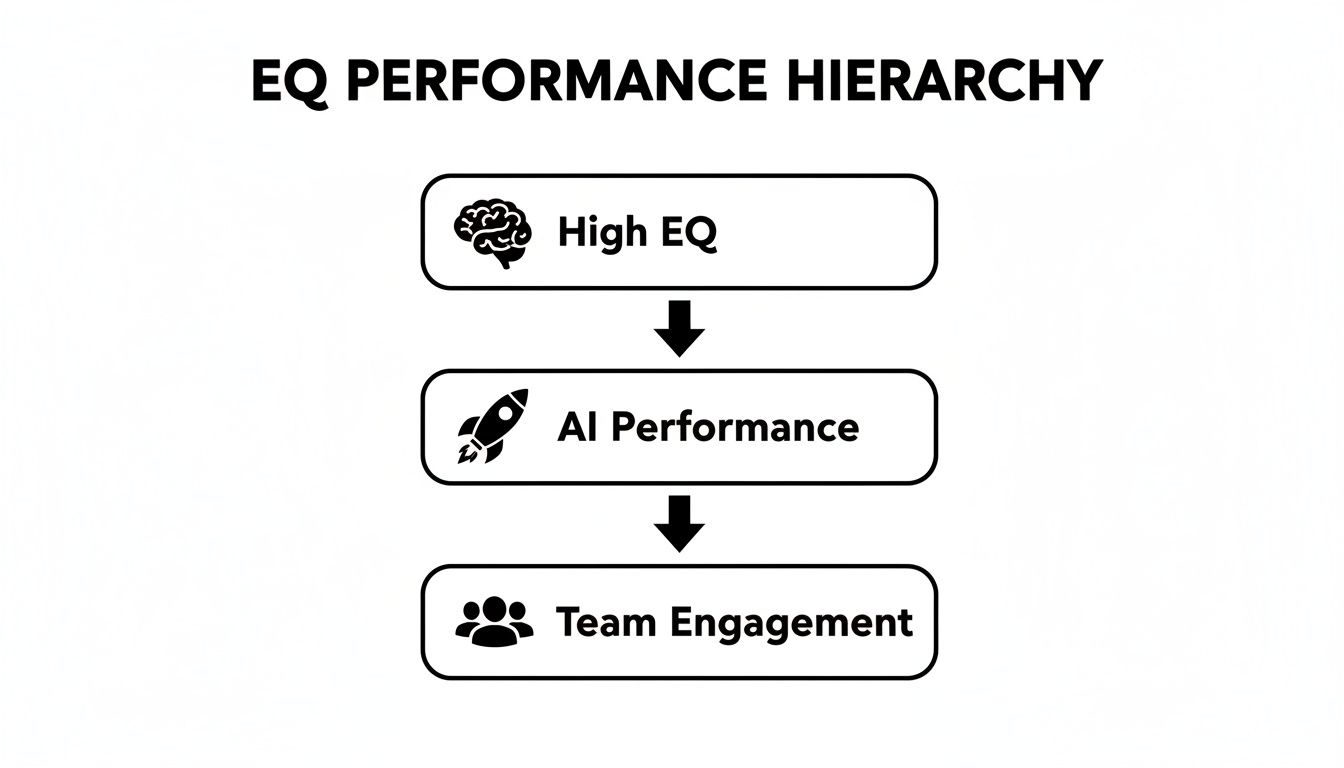
As the diagram illustrates, high EQ is the engine that drives both individual performance and team engagement. This logical grid layout is perfect for not only identifying your current state but also understanding how to shift it. If you’re feeling anxious, the chart gives you a clear goal: lower your energy and increase the pleasantness to move toward a state of calm.
The Science-Backed Benefits of Using an Emotions Chart
An emotions chart might look simple, but don’t let its basic design fool you. There’s some serious brain science behind why it works so well, and regularly using one can fundamentally change how your mind handles stress.
It all comes down to a concept psychologists often call “naming it to tame it.” Think about when a strong, mysterious feeling washes over you—a sudden spike of anxiety or a hot flash of anger. That’s your amygdala, the brain’s primitive alarm system, kicking into high gear and screaming “Threat!” When it’s in control, rational thought pretty much goes out the window.
But the simple act of looking at a chart and putting a name to that feeling—”Oh, this isn’t just ‘bad,’ this is ‘apprehension'”—flips a switch. You engage your prefrontal cortex, the logical, problem-solving part of your brain. By labeling the emotion, you’re essentially telling the alarm system to stand down so the calm, rational manager can take over.
From Brain Science to Real-World Results
So what does this brain-level change actually look like day-to-day? When you can quiet your emotional brain, you can think more clearly and make much better decisions. This is an absolute game-changer for anyone in a demanding role.
Instead of firing back an impulsive reply to a stressful email, you can pause, identify that you’re feeling “defensive” or “overwhelmed,” and choose a more strategic response. That tiny gap between feeling something and reacting to it is where emotional regulation lives. It’s a skill, and like any skill, it gets stronger with practice.
The consistent use of an emotions chart does more than just identify feelings; it builds new neural pathways. You are literally training your brain to become less reactive and more responsive, turning emotional awareness into an automatic habit.
This practice delivers some powerful, real-world results:
- Better Decision-Making: When you recognize how feelings like fear or even over-excitement can cloud your judgment, you learn to ground your choices in logic and your core values, not just a passing mood.
- Smarter Stress Management: A chart helps you spot the early warning signs of burnout, like persistent irritation or cynicism. This gives you a chance to step back and make a change before you hit a wall.
- Clearer Communication: Knowing exactly what you’re feeling allows you to tell others what you need with more confidence and precision. This cuts down on misunderstandings and is a cornerstone of therapies like Cognitive Behavioral Therapy. You can learn more by checking out our guide on powerful cognitive behavioral therapy techniques.
The Growing Market for Emotional Intelligence
It’s not just individuals catching on; the professional world is investing heavily in these skills. The global Emotional Intelligence market, which includes resources like the emotions chart, swelled to USD 8,914.2 million in 2024. Projections show it continuing to expand rapidly, with Europe alone making up over 30% of the market share. If you’re curious, you can explore the full emotional intelligence market report for a deeper dive.
This boom signals a major shift in thinking. Emotional intelligence is no longer seen as a “soft skill” but as a core competency for success. Your ability to understand and manage your own emotional landscape directly predicts your performance, resilience, and leadership potential. Using an emotions chart is one of the most practical and accessible ways to start building this crucial skill.
How to Create and Use Your Personalized Emotions Chart
Alright, so you know what an emotions chart is. But the real magic happens when you stop just reading about them and start using one for yourself. This is where you turn abstract feelings into clear, useful information.
Forget hunting for the “perfect” template online. The goal here is to craft a tool that actually speaks your emotional language, one that fits seamlessly into your life.
Choosing Your Format
First things first, you need to decide where you’re going to track your emotions. There’s no single right answer—the best tool is simply the one you’ll actually use. The key is to make it as effortless as possible.

Here are a few popular starting points:
- A Simple Journal: A dedicated notebook gives you a physical, intentional space. This tactile approach is great for free-form notes, doodles, and just getting thoughts out of your head and onto paper.
- Digital Apps: If you live on your phone, an app might be the way to go. Many are designed specifically for mood tracking, often with helpful reminders and automated charts to visualize your progress.
- A Spreadsheet: For the data lovers out there, a basic spreadsheet is surprisingly powerful. It gives you a structured way to log feelings, potential triggers, and intensity levels, making it easy to sort and analyze your data over time.
Once you’ve picked your format, it’s time to make it your own. This is where you go from a generic list of feelings to a truly personal emotions chart. Start with the basics—joy, sadness, anger, fear—but then dig deeper. What do those words really mean to you? Maybe your “anger” shows up as “irritation,” “resentment,” or feeling “short-fused.” Get specific.
Building a Sustainable Tracking Habit
An emotions chart gathering dust on your desk won’t do you any good. Consistency is everything. The trick is to weave this new practice into your day, not try to carve out a huge chunk of new time for it.
The most powerful habit is not the one that feels most ambitious, but the one you actually stick with. A two-minute check-in every day is far more effective than a one-hour deep dive once a month.
The best way to make a habit stick is to “tack” it onto something you already do. For example, fill out your chart for two minutes while your coffee brews, during your bus ride, or right before you shut down your computer for the day. Over time, these small check-ins build a rich, insightful picture of your emotional landscape. If you find persistent unease is a common theme, exploring some natural ways to reduce anxiety can be a powerful complement to your charting practice.
Analyzing Your Chart for Deeper Insights
After a week or two, you’ll have collected enough data to start looking for patterns. This is the moment your chart transforms from a simple logbook into your personal guide for self-awareness. It’s time to play detective.
Start by asking a few key questions:
- What emotions show up most often? Are you frequently logging feelings of contentment, stress, or frustration?
- Are there time-of-day patterns? Maybe anxiety reliably spikes on Sunday nights, or you feel a burst of creative energy on Tuesday mornings.
- Who are you with when you feel a certain way? You might notice that specific people, meetings, or social events correlate with particular feelings.
- What events seem to be triggers? Look for the connections between what was happening around you and how you felt.
Here’s a look at how a simple daily charting routine can put this all into practice.
Your Daily Emotion Charting Routine
This simple, three-step process helps integrate emotion charting into your day without feeling like a chore.
| Time of Day | Action Step | Pro Tip |
|---|---|---|
| Morning (8 AM) | Perform a quick 2-minute check-in. Identify your primary emotion and log it. | Pair this with an existing habit, like drinking your first glass of water, to make it automatic. |
| Midday (1 PM) | Do another check-in after lunch. Note any emotional shifts since the morning. | Briefly jot down what happened right before the check-in (e.g., “difficult meeting,” “praise from boss”). |
| Evening (9 PM) | Conduct a final review of the day. Scan your entries and add a one-sentence reflection on any patterns you noticed. | This is the best time to connect the dots. Ask yourself: “What caused the shift from ‘calm’ to ‘annoyed’ today?” |
By following a simple structure like this, you’re not just passively recording feelings—you’re actively engaging with them. You start to understand the “why” behind what you feel, which is the first step toward navigating your life with more awareness and intention.
Real-World Examples of Emotions Charts in Action
Theory is one thing, but how does an emotions chart actually work in the messy reality of daily life? Its real power comes to light when you apply it to specific challenges, turning that vague feeling of being “off” into a clear, actionable insight.
To show you what I mean, let’s walk through three different stories. We’ll look at a project manager teetering on the edge of burnout, a student wrestling with exam anxiety, and a new coach trying to help a client get unstuck. These examples really highlight how a simple chart can become a practical, powerful ally.

In each case, you’ll see how the chart helped identify the core problem and led to a positive change.
The Overwhelmed Project Manager
First, meet Sarah. She’s a project manager juggling impossible deadlines, demanding clients, and a scattered remote team. For weeks, she just felt “stressed”—a heavy, undefined cloud that was wrecking her sleep and focus. Because the feeling was so general, she had no idea how to even start fixing it.
Her big problem was this chronic, vague stress that was leading to classic burnout signs, like constant irritability and an inability to concentrate.
So, Sarah started using a simple grid-based emotions chart, taking a moment to log her feelings three times a day. She tracked her energy level (high or low) and whether the feeling was pleasant or unpleasant. This simple act forced her to move beyond “stressed” and find more specific words for what was going on.
The results were eye-opening. After just two weeks, a pattern jumped out. The most intense negative feelings weren’t just stress; they were resentment and powerlessness. And they always spiked right after meetings where stakeholders would change the project scope without any discussion.
By naming the real emotion, she saw the problem wasn’t her workload—it was the lack of agency. Armed with that clarity, Sarah created a new process for handling scope changes. It gave her the data she needed to regain control and solve the right problem.
The Anxious Student
Next up is Leo, a college student staring down final exams. He knew he was “anxious,” but that label just made him feel more paralyzed. His anxiety would spiral into procrastination, which, of course, only made him more anxious. It was a vicious cycle.
His challenge was a generalized anxiety that was tanking his confidence and feeding his tendency to put off studying.
Leo turned to a Feelings Wheel, a type of emotions chart that helps you drill down from core emotions to more specific ones. The next time that familiar wave of “anxiety” hit, he used the wheel to dig deeper. He soon realized that what he’d been calling anxiety was actually a tangled mess of feeling inadequate, overwhelmed, and insecure.
By breaking down a monolithic feeling like “anxiety” into smaller, more manageable parts, you can address each one individually. You’re no longer fighting a monster; you’re just untangling a few knots.
This was a complete game-changer. “Feeling inadequate” was something he could fight by reviewing his notes from past assignments where he did well. “Feeling overwhelmed” could be managed by breaking his study plan into small, 30-minute chunks. The chart helped him turn a vague, massive fear into a series of small, solvable problems, allowing him to walk into his exams feeling prepared and focused.
The New Coach and Her Client
Finally, let’s look at Maya, a new life coach. Her client, Alex, felt completely “stuck” in his career but couldn’t explain why. Their sessions were friendly, but they weren’t getting anywhere because Alex couldn’t put a finger on his own frustrations.
The core issue was that the client couldn’t identify his underlying feelings, which kept the coaching process stalled at the surface level.
Maya decided to introduce a simple list-based emotions chart during their sessions. When Alex described a situation at work, she would gently ask him to point to any words on the chart that resonated. This took all the pressure off of him to find the “perfect” word to describe his experience.
It worked like a charm. The chart became a bridge for communication. Instead of saying a meeting was “fine,” Alex could now point to “disregarded” or “uninterested.” This small act of labeling opened the door to much deeper, more honest conversations.
He eventually connected the dots and realized that his feeling of being “stuck” was rooted in profound boredom and a complete lack of creative challenge in his role. That single insight became the foundation of their coaching work, leading them to explore new career paths that truly excited him. For Maya, the emotions chart became an indispensable tool for unlocking those critical client breakthroughs.
Connecting Your Emotions Chart to Long-Term Growth
It’s easy to see an emotions chart as just a quick tool for naming a feeling in the moment. But if you stick with it, it becomes something much more profound: a compass for your entire personal growth journey. It’s not the destination; it’s the guide.
Every time you pinpoint a feeling, you’re collecting a small piece of data about your inner world. Over time, this practice builds the three core pillars of emotional intelligence: stronger self-awareness, better emotional regulation, and sharper decision-making. You stop being a passenger tossed around by your feelings and start becoming the driver, one who actually knows the terrain and can steer with purpose. The chart is your map.
From Tracking to Proactive Shaping
The real magic happens when you move from simply noticing your emotions to using that information to actively shape your life. After a few weeks of consistent charting, you’ll start to see undeniable patterns. You’ll know exactly what triggers your stress, what activities genuinely fill you with joy, and which situations leave you feeling completely drained.
This is the point where you graduate from being a student of your emotions to becoming the architect of your own well-being. The data you’ve gathered is no longer just a curiosity—it’s actionable intelligence.
Your emotional patterns are not your destiny; they are your data. An emotions chart gives you the power to analyze that data and consciously design a life that aligns with your values and goals.
This proactive mindset lets you get ahead of challenges and create more opportunities for positive experiences. For example:
- If your chart reveals that back-to-back meetings consistently lead to frustration, you can start blocking off short breaks in your calendar.
- If you notice a reliable spike in contentment after spending time outside, you can make a walk in the park a non-negotiable part of your weekly routine.
- When you see that feeling “disregarded” is a recurring theme, you can prepare a few simple phrases to help you assert your needs more clearly in the future.
This is how you shift from reacting to your life to consciously creating it. You start making small, informed tweaks that add up over time, leading to significant and lasting personal growth.
Building Your Personal Growth Framework
Using an emotions chart is a powerful foundational practice, but it gains even more momentum when you plug it into a bigger plan for self-improvement. The clarity you get from tracking your feelings gives you the perfect starting point for setting goals that actually matter to you. It helps you answer the big question: “What do I truly want to change, and why?”
This self-knowledge is the bedrock of any successful personal development plan. As you continue your journey, think about how these emotional insights can inform a larger structure for your growth. To take the next step, our guide on how to create a personal growth plan provides a clear roadmap for turning your newfound self-awareness into a concrete action plan.
Ultimately, mastering your emotional world isn’t about feeling happy all the time. It’s about building the resilience, wisdom, and self-awareness to navigate all of life’s ups and downs with a sense of intention and grace. Your emotions chart is the first, and most important, step on that empowering path.
Frequently Asked Questions About Emotions Charts
Even after you get the hang of what an emotions chart is, a few practical questions usually pop up. Let’s walk through some of the most common ones so you can feel confident putting this tool to work.
How Quickly Can I Expect to See Results?
You’ll probably feel a small sense of relief right away. Just putting a name to a messy internal feeling brings instant clarity and a surprising feeling of being back in control. That initial “aha!” moment is the first, immediate payoff.
But the real magic happens over time. The truly deep insights—the ones that help you spot the patterns driving your behavior—take a bit more consistency. Noticing that a certain project always sparks anxiety, or that a weekly meeting leaves you feeling drained, usually takes a few weeks of daily check-ins. Think of it this way: the first day gives you a snapshot, but a few weeks of tracking give you the whole movie.
Can I Use an Emotions Chart for My Team at Work?
You absolutely can, but it needs to be handled with care. An emotions chart can be a brilliant tool for building psychological safety and opening up communication on a team, but only if it’s introduced thoughtfully. It has to be positioned as a voluntary tool for personal development, never a mandatory performance tracker.
If you want to introduce it successfully, try this:
- Frame it as a skill-builder for managing stress and improving individual focus.
- Make privacy the top priority. Reassure everyone that their personal chart is for their eyes only.
- Lead by example. You could share a general insight you’ve had, like, “I’ve realized I do my best creative thinking right after lunch.”
When approached this way, it helps people understand their own rhythms and communicate what they need to do their best work. That’s what leads to genuine collaboration.
What Is the Difference Between an Emotions Chart and a Mood Tracker?
This is a great question, and the difference is pretty important. While both are useful, they operate at different levels. A mood tracker is like asking, “How are you feeling today?” You might just say “good,” “bad,” or “meh.” It’s designed to capture your general emotional climate.
An emotions chart, on the other hand, makes you a bit of a meteorologist. It prompts you to get specific about the conditions: “Is that a feeling of disappointment, or is it more like frustration? Is there a bit of resentment mixed in?” It pushes you to identify the granular, specific feelings that make up your experience.
A mood tracker gives you a summary of your emotional state. An emotions chart provides the specific data points that lead to deeper self-awareness and actionable insights.
It’s this focus on specific, named emotions that allows you to finally connect the dots between your feelings and their triggers, which is where real change begins.
Ready to build more than just awareness? The tools and strategies at David Pexa are designed to help you turn insights into action. Explore practical guides and curated resources to upgrade how you think, feel, and perform at https://davidpexa.com.
