



We’ve all been there. You hold onto a faded concert t-shirt that’s full of holes, even though you have newer, nicer clothes. You’ll gladly pay a little extra for coffee at the shop where the barista remembers your order.
These choices aren’t always logical, but they feel right. This is emotional value in action—the unseen, subjective worth we attach to things based on how they make us feel, not just what they do. It’s a quiet but powerful force that shapes our habits, our relationships, and the daily decisions that define our lives.
What Is Emotional Value and Why Does It Matter
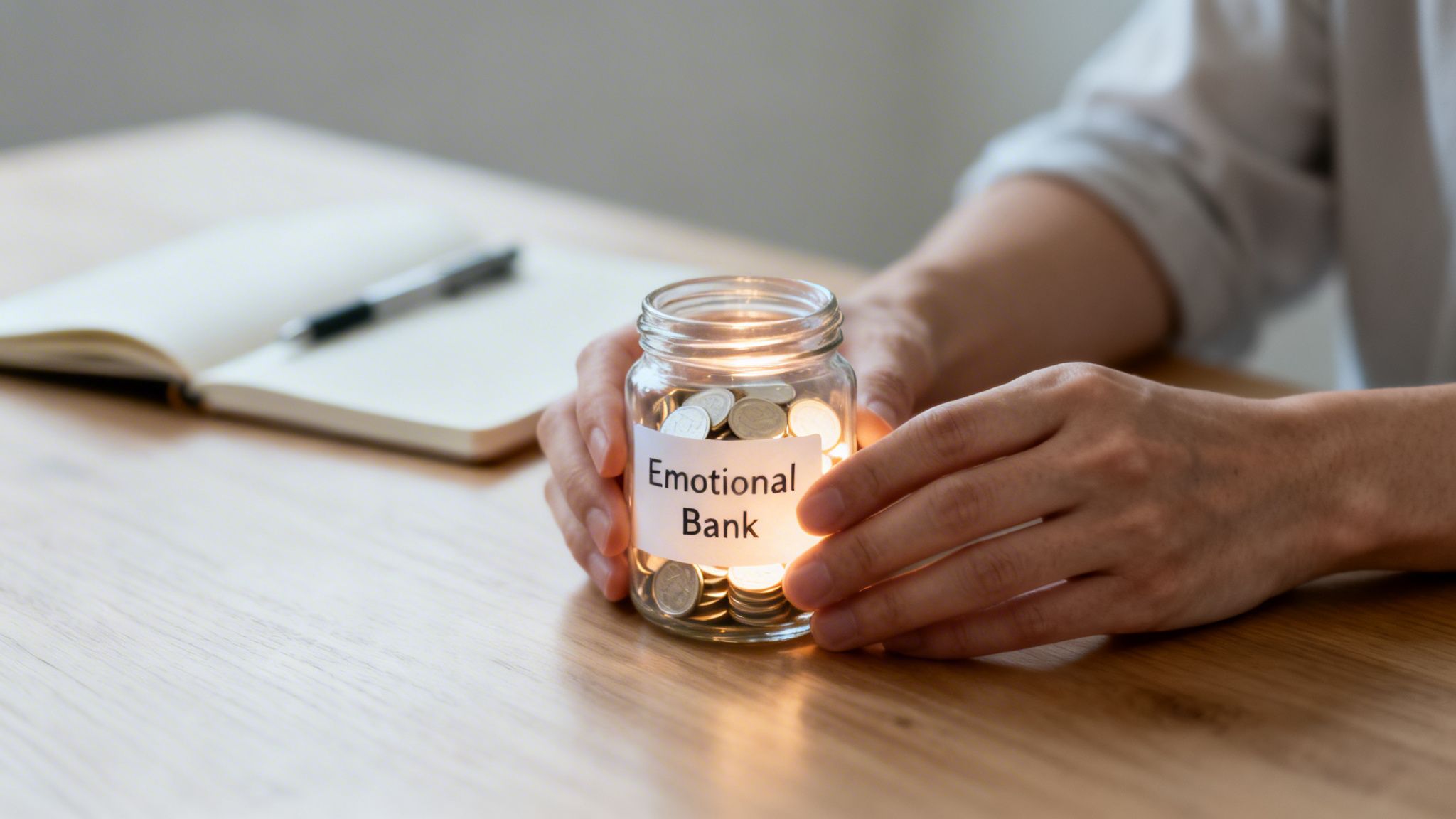
A great way to think about this is to imagine you have an emotional bank account. Every experience you have is either a deposit or a withdrawal. A genuine compliment from a colleague? That’s a deposit. A frustrating traffic jam on the way home? A definite withdrawal. Emotional value is the currency of this internal account.
This simple concept explains so much. It’s why we cherish a handwritten letter over a text message or why a job with a strong sense of purpose can feel more rewarding than a higher-paying one that leaves you empty. We are all instinctively trying to fill our emotional accounts with positive experiences.
The Real-World Impact of Emotional Value
And this isn’t just some feel-good idea; it has a real, measurable impact on our behavior. Look at the world of advertising. Brands have learned that connecting with our feelings is far more powerful than just rattling off a list of product features.
Research shows that ad campaigns built purely on emotional content perform almost twice as well as those that rely only on rational facts, with a 31% success rate compared to 16%. In fact, emotionally resonant ads are 3.1 times more likely to win major creative awards.
The same principles apply directly to your own life. The “worth” of an evening with friends isn’t just about passing the time; it’s about the feelings of connection, joy, and security it generates. The practical benefit is often just a footnote.
Emotional Value vs Functional Value
To really get a handle on this, it helps to break down how emotional value shows up compared to its more practical cousin, functional value. Functional value is about what something does—the ‘what’. Emotional value is about how it makes you feel—the ‘why it matters’.
The table below illustrates this contrast in a few everyday situations.
Emotional Value in Everyday Life
| Domain | Functional Value (The ‘What’) | Emotional Value (The ‘Why It Matters’) |
|---|---|---|
| Your Morning Coffee | A caffeinated beverage that increases alertness. | The comforting ritual, the sense of starting the day right, the familiar aroma. |
| A Work Project | Completing assigned tasks to meet a deadline. | The feeling of accomplishment, collaboration with a great team, pride in the final result. |
| An Old Friendship | Someone to socialize with and share news. | The deep trust, shared history, and feeling of being unconditionally accepted. |
| A Fitness Routine | Burning calories and improving cardiovascular health. | The stress relief, the surge of confidence, a sense of discipline and self-care. |
Seeing this difference clearly is the first step toward consciously managing your own well-being. Your feelings aren’t just random static; they are direct feedback on the value you’re getting from your life. This awareness is deeply connected to building a solid sense of self, which you can learn more about by exploring the differences between self-esteem and self-confidence.
When you start to recognize what truly makes deposits into your emotional bank, you can begin to build a life that isn’t just busy, but deeply fulfilling.

The Science Behind Your Feelings and Choices

There’s a reason you instinctively reach for one brand over another, even when it doesn’t seem to be the most logical choice. It’s not random. Deep inside your brain, a sophisticated system is constantly running in the background, calculating the emotional value of everything you encounter. Your feelings aren’t just noise; they’re data points that powerfully guide your behavior.
Think of your brain as a boardroom. The prefrontal cortex acts as the CEO—it’s the part that handles rational thought, long-term planning, and carefully weighs pros and cons. But sitting right at the table is the limbic system, an ancient and incredibly powerful “Emotional Board of Directors” that often has the final say.
This emotional system houses key players like the amygdala (your brain’s threat detector) and the nucleus accumbens (its reward center). When you do something satisfying, like finishing a tough workout or hearing a great song, your brain releases a hit of dopamine. This chemical messenger essentially sends a memo saying, “That was great! Let’s do that again.” This simple feedback loop is the foundation of our habits, creating strong, automated pathways that steer us toward what feels good.
The Brain on Autopilot
A huge chunk of this decision-making happens without you even noticing. Our brains are built for efficiency, so they develop mental shortcuts, or cognitive biases, to conserve precious mental energy. One of the most powerful of these is called the affect heuristic.
At its core, the affect heuristic is a simple rule your brain follows: if it feels good, it must be good. It’s why a sunny day might make you feel more optimistic about your finances, or why a warm smile from a salesperson can make you trust them and their product. Our immediate feeling about something often becomes a substitute for a more detailed, logical analysis.
This shortcut is a primary engine of emotional value. Instead of painstakingly researching every last detail, we often just go with the option that sparks the most positive feeling. It’s a “gut instinct,” but it’s one that has been fine-tuned by millions of years of evolution.
Consider how you choose a vacation spot. You might tell yourself it’s because of the affordable flights or the promise of good weather. But more often than not, the decision was sealed the moment you looked at the photos and felt the excitement and relaxation. Your emotional brain had already packed its bags long before your logical brain could finish its comparison spreadsheet.
How Memories Lock in Emotional Value
Your brain doesn’t just react to the present moment; it also keeps a detailed library of emotional associations tied to your memories. A single, powerful experience can forge a permanent link between an object, a place, or even a person and a strong feeling. It’s why the scent of a specific perfume can instantly transport you back to a cherished moment with someone you love.
This process involves a tight partnership between the hippocampus, your brain’s memory archivist, and the amygdala, its emotional highlighter.
- Positive Association: When you have a joyful experience, that positive feeling gets “tagged” to the memory. Encountering a related cue later on—a song, a photo, a taste—can reactivate that same wonderful feeling.
- Negative Association: The opposite is just as true. If you ever got food poisoning, you might feel a wave of revulsion just thinking about that food years later, even if you logically know it’s perfectly safe now.
This is emotional value at its most raw. The item itself doesn’t hold the value; your brain assigns the value based on your history of emotional data. That broken watch from your grandfather isn’t valuable because it tells time—it’s priceless because of the memories and feelings attached to it.
By understanding these inner workings, you can start to work with your brain’s natural tendencies—not against them—to more consciously shape your world.
How Emotional Value Secretly Shapes Your Habits
Ever wondered why you do the things you do every day? Your habits aren’t just a random set of actions. They’re actually quiet emotional negotiations you have with yourself all day long. Every choice, from hitting snooze to grabbing a certain snack, is driven by a powerful, often unnoticed, force: the hunt for good feelings, or what we call emotional value.
We’re all hardwired to take the path of least emotional resistance. It’s human nature. We gravitate toward things that bring us comfort, joy, or relief, and we instinctively sidestep anything that feels like stress, boredom, or anxiety. This isn’t a failure of willpower; it’s your brain strategically trying to manage its emotional budget.
This is exactly why you might find yourself scrolling through your phone instead of tackling that big project. The phone offers a quick, reliable dose of emotional ease (distraction, a little dopamine), while the project feels like it comes with an emotional price tag—mental effort and maybe even some frustration.
The Emotional Payoff Behind Every Habit
Every single habit you have, whether you label it “good” or “bad,” has a hidden emotional reward. It’s the feeling you get right after the act that wires the behavior into your brain, creating a powerful loop that keeps you coming back. The real trick is to look past the action itself and figure out the emotional itch it’s scratching.
- Procrastination: You’re not just avoiding a task. The real payoff is the immediate relief from the anxiety that task was causing.
- Morning Coffee: It’s more than just caffeine. It’s the feeling of comfort, control, and a moment of calm before the day’s chaos kicks in.
- Binge-Watching a Show: You’re not just being lazy. The reward is a total escape from daily stress, letting you get lost in a different world for a while.
Once you see these payoffs, you can start to understand your own behavior differently. Your habits aren’t signs of a flawed character. They’re just strategies—sometimes unhelpful ones—that your brain has learned to secure positive feelings or dodge negative ones.
The Emotional Cost That Makes Us Quit
Just as we chase emotional rewards, we also work surprisingly hard to avoid emotional costs. A new habit is often hard to stick with not because it’s physically difficult, but because the emotional entry fee feels way too high.
Take starting a new workout routine. You know the logical benefits are great—more energy, better health. But what about the emotional costs?
- Feeling vulnerable or judged in a new gym.
- The physical discomfort of pushing your body.
- The frustration of not being as fit as you want to be right now.
When the immediate emotional cost feels bigger than the distant future reward, we freeze. This is why building good habits is so tough. You’re not just fighting old patterns; you’re swimming against a strong emotional current that wants comfort now.
This isn’t just about personal habits; it’s a huge driver in business, too. The emotional bond a customer feels with a brand makes the “cost” of switching to a competitor feel too steep. It’s why customers who are emotionally connected have a 306% higher lifetime value. Research even shows that 71% of these loyal customers will happily promote the brand to their friends and family, as highlighted in this detailed emotional marketing report on gitnux.org.
If you genuinely want to change your behavior, you have to make the new habit more emotionally attractive than the old one. A great place to start is by learning how to build healthy habits with a focus on making them feel easier and more rewarding from day one. When you understand the emotional math behind your routines, you can start making choices that lead to lasting fulfillment, not just a moment of relief.
You can’t improve what you don’t understand. This is a classic business mantra, but it’s just as true for our own internal lives. Measuring your personal emotional value is about getting real with yourself—moving past vague notions of “feeling good” or “feeling bad” and actually looking at the data of your own daily experience.
What parts of your day leave you feeling energized and fulfilled? What activities, habits, or even people consistently leave you feeling drained? It’s time to stop guessing and start tracking.
Think about it: businesses are pouring billions into understanding how customers feel. The emotion analytics market is on track to hit USD 7.70 billion by 2031. Why? Because quantifying feelings provides incredible insights. If major companies are using this data to build better products, you can use the same approach to build a better life. You can learn more about the growth of emotion analytics on Mordor Intelligence.
The Emotional Value Audit
A great way to start is with an Emotional Value Audit. This isn’t just about journaling; it’s a structured exercise for scoring the emotional impact of everything you do. You’re systematically reviewing your life—from small daily habits to major relationships—to see what’s giving you a positive emotional return and what’s putting you in an emotional deficit.
This turns the fuzzy goal of “being happier” into a concrete, measurable project.
To help you get started, I’ve created a simple template. This “Personal Emotional Value Audit” will help you map out the emotional landscape of your day-to-day life. Just take a few minutes to fill it out honestly.

Your Personal Emotional Value Audit
| Life Area (e.g., Work Task, Relationship, Habit) | Primary Feeling(s) Evoked | Emotional Score (-5 to +5) | Action (Keep, Modify, or Reduce) |
|---|---|---|---|
| Example: Morning social media scroll | Anxiety, comparison | -3 | Reduce/Modify (e.g., set 10-min timer) |
| Example: Weekly team meeting | Boredom, frustration | -2 | Modify (e.g., propose a structured agenda) |
| Example: Walking the dog | Calm, connected | +4 | Keep/Amplify (e.g., try a new park) |
Once you see it all laid out, the patterns often become surprisingly clear. The goal isn’t just to spot the good and bad, but to have a clear roadmap for what to do next.
Turning Your Audit into Action
With your audit in hand, you can start making deliberate changes. The point isn’t to eliminate every single negative thing—some tough tasks are just part of life. The real aim is to consciously shift the overall balance toward a net positive.
Here’s a simple, three-part strategy:
-
Amplify the Highs: Look at anything you scored a +4 or +5. These are your non-negotiables for a good life. How can you protect this time or even do more of it? Schedule these activities into your calendar with the same priority you’d give a doctor’s appointment.
-
Tweak the Neutrals: What about the items hovering between -2 and +2? These are ripe for modification. If “doing the dishes” is a solid 0, could you pair it with listening to a great podcast to bump it up to a +2? This is called “habit stacking,” and it’s a game-changer for monotonous but necessary tasks.
-
Address the Drains: Be ruthless with anything scoring -3 or lower. Is this activity truly essential? If not, can you ditch it? If it is, how can you set boundaries, delegate it, or minimize the time you spend on it?
The power of this process lies in making the invisible visible. You stop operating on autopilot and start making deliberate choices based on what truly adds value to your life, not just what fills your calendar.
Understanding what drives your feelings helps you understand your habits. Our brains are wired to repeat behaviors that deliver a rewarding feeling, creating a powerful loop that can work for or against us.
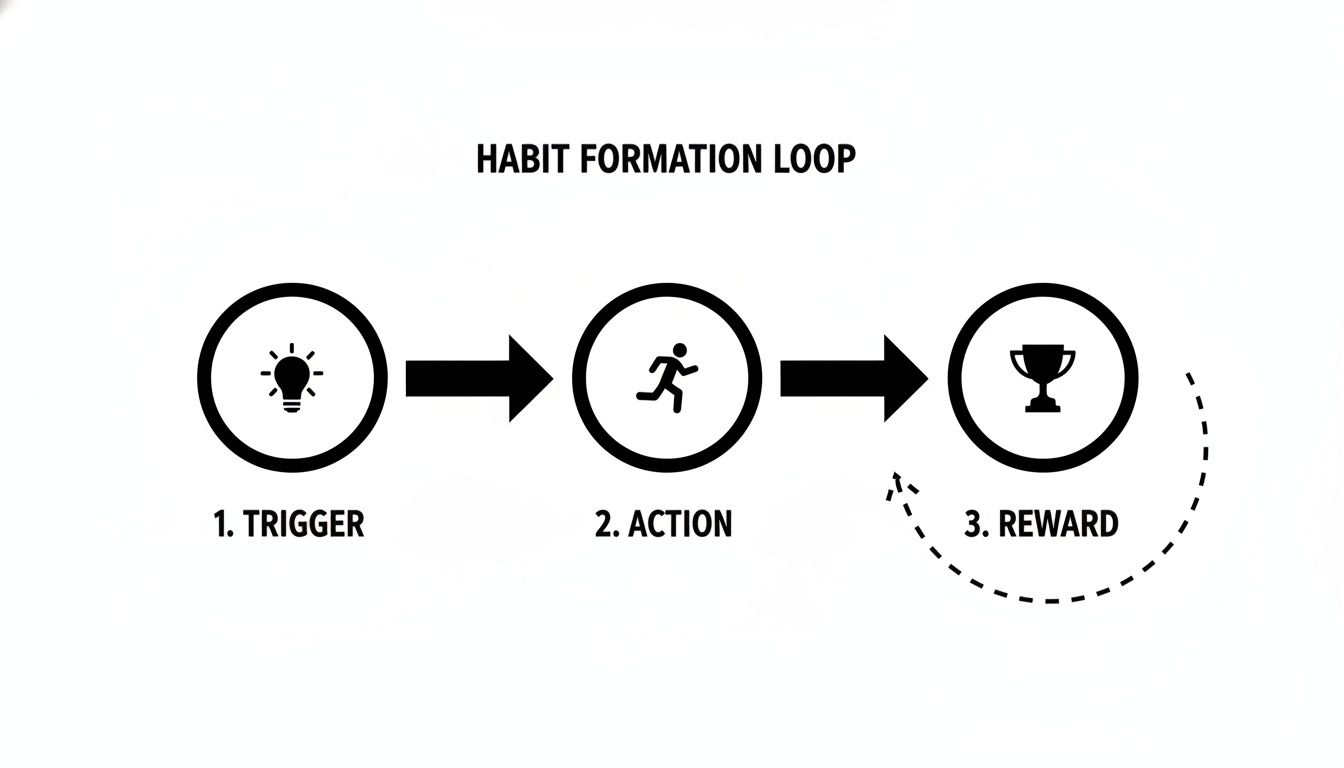
This simple Trigger > Action > Reward cycle is how habits get locked in. Your audit gives you a direct look at the “Reward” part of the equation. By identifying what truly feels rewarding, you gain the power to redesign your own habits, replacing draining loops with ones that genuinely serve you.
Strategies for Cultivating Higher Emotional Value
Alright, so you’ve got a handle on what emotional value is and how to spot it. Now for the fun part: how do you get more of it? It’s time to stop just tracking your emotional balance and start actively designing it, shifting your internal world from a state of deficit to one of genuine abundance.
This isn’t about plastering on a fake smile or forcing yourself to be happy. It’s much smarter than that. We’re talking about making small, intentional tweaks to your daily life that naturally create more positive feelings. Think of these strategies as your personal playbook for building a life that doesn’t just look good, but feels good.
Use Experience Stacking to Upgrade Your Tasks
One of the simplest and most effective methods I know is Experience Stacking. The idea is brilliant: you just pair a task you find boring or slightly draining with something that reliably gives you a little boost of joy, comfort, or fascination.
Suddenly, a tedious chore is transformed into a rewarding ritual. For example, maybe you can’t stand folding laundry because it feels like a total drag (an emotional withdrawal). But if you “stack” that task with listening to your favorite can’t-put-it-down audiobook (an emotional deposit), the entire experience changes.
How to Start Stacking Experiences:
- Find a “Meh” Task: Pick something you have to do but don’t love. Think commuting, cleaning the kitchen, or tackling your email inbox.
- Choose a Positive Pairing: What’s a simple pleasure you can enjoy at the same time? This could be anything from listening to a specific playlist, calling a friend you miss, or sipping a really good cup of coffee.
- Combine and Notice: Do both things together. Pay attention to how the feeling around that chore starts to shift. It might not happen overnight, but it will change.
This works because our brains are wired to create associations. Before you know it, that positive feeling from the enjoyable activity starts to rub off on the task itself, making it feel far less like a burden.
Reframe Your Habits and Change the Story
The story you tell yourself about an activity has a massive impact on how you feel doing it. Habit Reframing is all about consciously changing that inner narrative—shifting the focus from the emotional costs to the emotional benefits.
A classic example is networking. So many people dread it because their internal story is, “I have to go awkwardly ask strangers for favors.” That narrative is guaranteed to create anxiety and a feeling of being phony.
But what if you reframed it? What if networking became “an opportunity to find and connect with interesting people”? That new story changes everything. It shifts the goal from taking to sharing, sparking curiosity and genuine connection instead of dread. That simple perspective flip can completely transform the emotional value of the event.
This kind of internal storytelling is the key to making real, lasting changes. If you find yourself stuck, it’s often a negative story or a limiting belief holding you back. You can learn more about how to tear down those old narratives by overcoming limiting beliefs and building new, more empowering ones.

Intentionally Design Your Environments
Your surroundings are never neutral. Your physical and digital spaces are constantly sending signals to your brain, either adding to your stress or supporting your well-being. Intentional Design is about shaping these environments to work for you, not against you.
This means actively removing points of friction while adding cues that encourage calm, focus, and even a little bit of joy.
- Your Physical Space: A messy desk constantly screams “chaos!” and “overwhelm!” A clean, organized workspace with a small plant or a meaningful photo sends a completely different message: “calm” and “in control.”
- Your Digital Space: Is your phone a minefield of stressful news alerts and distracting notifications? That’s a recipe for low-grade anxiety. Trimming your home screen down to only essential, positive apps is a powerful way to quiet that digital noise.
These small environmental tweaks add up, creating a huge cumulative effect on how you feel day-to-day. And people are catching on. The U.S. personal development market, valued at USD 12.90 billion in 2025 and projected to hit USD 23.29 billion by 2035, is booming precisely because people want practical ways to improve their lives from the inside out. As you can explore in more detail on Mordor Intelligence, there’s a growing demand for tools that boost mental clarity and build better habits. By actively shaping your world, you stack the deck in favor of positive emotional value, every single day.
Your Emotional Value Blueprint for Life
Alright, we’ve journeyed through the what, why, and how of emotional value. Now comes the most important part: turning these ideas into a genuine, lasting practice. This is where you go from being a passenger in your own emotional life to sitting firmly in the architect’s chair.
This isn’t about a one-time fix or a temporary mood boost. It’s about building a core skill for a more intentional and fulfilling life. Think of this blueprint as your personal compass—something you can pull out anytime you feel adrift or simply want to bring more purpose to your decisions.
A Framework for Lasting Change
To really weave these concepts into the fabric of your life, you need a simple but solid framework. This isn’t about adding more to your to-do list; it’s about shifting your perspective. Here’s a recap of our journey, distilled into a clear path forward.
-
Keep the Core Idea Front and Center: Constantly remind yourself that emotional value is the real currency behind your choices. Your feelings aren’t just random noise; they are critical data points pointing you toward what you truly need.
-
Get Honest About What You’re Chasing: Check in with yourself regularly. Are you really after that promotion, or are you chasing the feeling of accomplishment it represents? Is it the relationship you want, or the feeling of deep connection? Knowing your true emotional drivers is everything.
-
Make Your Audits a Ritual: Continue to perform your Emotional Value Audits. This simple act makes the invisible visible. It’s the single most powerful tool for getting clear, actionable feedback on where your emotional energy is going.
-
Become an Active Designer of Your Day: Put strategies like Experience Stacking and Habit Reframing to work. Intentionally design your environment, your relationships, and your schedule to generate positive emotional returns. This is how you build a life that feels as good on the inside as it might look on the outside.
The secret is to start small. Don’t try to overhaul everything at once. Pick one draining task this week and find a way to reframe it. Find one high-value activity and guard that time fiercely.
This blueprint isn’t about chasing some mythical state of constant bliss. It’s about building momentum. It’s about gaining clarity. It’s about using your emotional insights to make slightly better choices, day after day, until you’ve built a life that isn’t just productive, but deeply resonant.
Frequently Asked Questions About Emotional Value
As you start exploring the concept of emotional value, a few practical questions naturally come up. Let’s walk through some of the most common ones to help you connect the theory to your real-world experience.
Is Emotional Value the Same as Sentimental Value?
That’s a great question, and while they’re related, there’s a key difference.
Think of sentimental value as being tied to specific objects because of the memories they hold. It’s the feeling you get from your grandfather’s old watch or a simple souvenir from a life-changing trip. These items are precious because of their personal history.
Emotional value, on the other hand, is a much bigger umbrella. It’s the net feeling you get from any experience, interaction, or product, whether it’s tied to a memory or not. For instance, the sense of calm you feel at a clean, organized desk has positive emotional value, but you probably wouldn’t call your desk sentimental.
Can Something Have Negative Emotional Value?
Absolutely. Just as some things fill you up, others can consistently leave you feeling drained. We all have these in our lives.
It might be that recurring weekly meeting that leaves you frustrated, a one-sided friendship that feels exhausting, or even the news app on your phone that reliably sparks anxiety. These experiences have a real cost.
Recognizing these sources of negative emotional value is the critical first step. It empowers you to make a conscious choice: reduce your exposure, change how you interact, or set boundaries to protect your energy. Acknowledging the “cost” is just as important as celebrating the “gain.”
How Can I Explain This to Someone Else?
When you’re trying to explain emotional value, a simple analogy can work wonders. My favorite is the “house on fire” scenario.
Ask a friend, “If your house was on fire and everyone was safe, what three items would you grab?”
Almost always, at least one of their answers will be something with very little monetary worth—old photos, a child’s drawing, or a gifted heirloom. This exercise instantly shows how we intuitively prioritize things based on the feelings they represent, not just their price tag or practical use. This very human drive to understand our inner motivations is a key reason the global personal development market is projected to hit USD 90.86 billion by 2035. You can explore more on this trend in the emotion analytics market on Mordor Intelligence.
At David Pexa, we focus on providing structured, actionable guidance to help you master your mindset and build a more fulfilling life. To turn these insights into lasting change, discover our curated resources and coaching frameworks by visiting https://davidpexa.com.
