



Here’s the most crucial distinction to make when you’re working on self-development: ego is external, fragile, and feeds on constant validation, while authentic confidence is internal, resilient, and grows from self-awareness. The path you choose here dictates whether you see success as a cutthroat, zero-sum game or a journey of collaborative growth.
Unpacking Ego and Confidence

To really get to the heart of this, we need to look past the surface-level behaviors and dig into what’s driving them. Think of ego as a protective shell, often built around deep-seated insecurity. It’s a performance meant to convince the world—and, more importantly, yourself—of your worth. Ego is loud, it’s defensive, and it absolutely needs to be the smartest person in any room.
Confidence, on the other hand, has a quiet strength. It doesn’t need to shout from the rooftops because it comes from a place of inner certainty and self-acceptance. A genuinely confident person is grounded in their skills but also keenly aware of their limitations, and they aren’t threatened by either.
The Core Motivations
An ego-driven mindset is powered by what’s happening on the outside—praise, titles, and where you stand in relation to others. Its main goal is to look successful and feel superior. This external focus makes it incredibly brittle. Criticism feels like a personal attack, and failure is a catastrophic blow to one’s entire sense of self. The ego is constantly asking, “How do I look compared to them?”
Authentic confidence is fueled by something else entirely: internal drivers like personal growth, genuine curiosity, and a sense of purpose. The focus shifts to the process, not just the trophy at the end. Someone with real confidence views challenges as learning opportunities and has no problem admitting they don’t have all the answers. The question changes from “How do I look?” to “What can I learn here?”
Confidence says, “I have something to offer.” Arrogance, driven by ego, says, “I’m the only one here who does.” You can spot the line when you see someone focused on contribution versus domination.
This difference between confidence and arrogance—a key symptom of an unchecked ego—is subtle but makes all the difference in your personal and professional relationships. You can dive deeper into this by exploring the nuances of confidence vs. arrogance.
Quick Comparison: Ego vs. Authentic Confidence
To put it all in perspective, it helps to see the behaviors side-by-side. This table offers a clear, at-a-glance summary of how ego and confidence show up in the real world.
| Attribute | Ego-Driven | Authentic Confidence |
|---|---|---|
| Source | External validation; comparison to others. | Internal self-knowledge and self-acceptance. |
| Reaction to Feedback | Becomes defensive, deflects, or blames. | Listens openly, seeks to understand, and uses it for growth. |
| View of Others’ Success | Feels threatened, envious, or overly competitive. | Feels inspired, happy for others, and seeks collaboration. |
| Communication Style | Dominates conversations, interrupts, needs to be right. | Speaks thoughtfully, listens actively, and values other opinions. |
| Response to Failure | Views it as a personal failing; hides mistakes. | Sees it as a learning opportunity; takes accountability. |
As you can see, the core difference isn’t about skill or talent, but about the source of your self-worth. One is a fragile identity built on what others think, while the other is a resilient foundation you build for yourself.
If you want to move from an ego-driven life to one grounded in real confidence, you first have to look under the hood. What’s going on psychologically? These aren’t just personality traits; they’re the direct result of your internal wiring—a system built from your past, your core beliefs, and your deepest human needs. Getting to the “why” behind ego and confidence is the only way to make a lasting change.
Ego almost always grows out of deep-seated insecurity. Think of it as a defense mechanism, a psychological suit of armor built to shield a very fragile sense of self. This constant need to project strength, to have all the answers, and to always be in control is a direct reaction to the fear of being seen as weak or not good enough.
This defensive stance creates a brittle and fragile exterior. The ego is constantly on high alert, scanning for anything that feels like a threat—a piece of criticism, a simple disagreement, or even someone else’s success. It operates on an exhausting, black-and-white principle: if I am not superior, I am inferior. There’s no room for nuance, which is why people driven by ego have such a hard time with feedback and find it nearly impossible to admit when they’re wrong.
The Trap of Being the Best
This relentless chase to be “the best” is a classic ego trap. It’s a finish line that moves every time you get close, locking you into a permanent state of dissatisfaction and struggle. This goes beyond healthy ambition; it’s about tying your entire identity to how you stack up against others. You only feel valuable when you are measurably on top.
Interestingly, this drive can come from very different places depending on your baseline self-esteem. A landmark analysis of 1,948 participants revealed that 57% of those with high self-esteem and 61% with low self-esteem felt that simply doing their best wasn’t enough—they had to be the best. While the numbers look similar, the motivations are worlds apart. For the high self-esteem group, it’s about ego-stroking. For the low self-esteem group, it’s a desperate scramble to prove their worth and stave off the feeling of being a failure. You can find more on how self-esteem shapes our relationship with power over at taketheleadwomen.com.
“The ego is never truly satisfied. It constantly seeks more, leading to a never-ending cycle of striving and a feeling of being on a hamster wheel.”
This bottomless need for external approval is a direct path to anxiety and burnout. Even when you win, the good feeling is short-lived because the insecurity that started it all is still there, completely untouched.
The Foundation of Authentic Confidence
Authentic confidence, on the other hand, is grown in completely different soil. It comes from a place of genuine self-acceptance and internal security. It doesn’t need applause from the outside world because its source of worth is stable and comes from within.
Several psychological pillars support this foundation:
- Self-Compassion: This is about treating yourself with the same kindness you’d give a friend, especially when you mess up or doubt yourself. It’s the off-switch for that harsh inner critic that fuels the ego.
- Resilience: Real confidence isn’t the belief that you’ll never fail. It’s the quiet knowledge that you can handle failure when it comes. It’s trusting in your ability to get back up, learn something, and keep going.
- A Growth Mindset: This is the belief that your skills and abilities aren’t fixed but can be developed through hard work and practice. It shifts your entire focus from proving you’re smart to genuinely wanting to get smarter.
A confident person’s goal isn’t to be the best but to do their best. It’s a subtle shift in language, but it changes everything. It reframes a challenge from a test of your worth into an opportunity to grow. If you’re looking to dig deeper into this, check out our guide on the essentials of understanding psychology.
This internal framework allows someone with genuine confidence to operate from a place of security. They can celebrate another person’s victory without feeling threatened, listen to feedback without getting defensive, and lead with empathy because their own identity isn’t hanging in the balance. Confidence isn’t a choice you make once; it’s the result of patiently building a more resilient and compassionate inner world.
How Ego and Confidence Manifest in the Workplace

The office is where the theory of ego vs. confidence gets real. It plays out in every meeting, feedback session, and team project, shaping everything from productivity to the overall vibe of a team. Learning to spot the difference helps you navigate your career and relationships with much greater skill.
You can often feel the difference the moment someone walks into a room. The ego-driven person is there to perform and protect their status. The confident person, on the other hand, is there to contribute. They’re secure in their value and don’t feel the need to constantly prove it.
Behavior in Team Meetings
Meetings are a perfect stage to see this difference in action. Someone operating from ego tends to interrupt, talk over others, or rephrase someone else’s point just to make it sound like their own. Their main goal isn’t to find the best answer; it’s to be seen as the smartest person at the table.
A truly confident teammate behaves completely differently. They listen more than they speak. They ask questions to clarify, not to challenge. They build on ideas instead of shutting them down and have no problem saying, “I don’t know, can you explain that?” They treat the meeting as a team sport, not a solo competition.
- Ego-Driven: Dominates the conversation, gets defensive when questioned, and treats any disagreement as a personal attack.
- Confident: Encourages others to speak up, especially the quieter ones, and keeps the discussion focused on the shared goal.
One approach kills creativity, while the other nurtures it. It’s the confident person’s approach that leads to better, more innovative solutions because it allows every perspective to be heard.
A confident professional stays curious. They ask how a process works or why a decision was made because they genuinely want to understand. An ego-driven person is more likely to tell you why your process is wrong without asking first.
Responding to Feedback and Criticism
This is where the rubber really meets the road. For someone driven by ego, constructive feedback feels like a personal insult. You can almost see the armor go up.
They’ll get defensive, make excuses, or even point fingers at someone else. Their entire reaction is about protecting a fragile self-image, which makes it almost impossible for them to actually hear the feedback and improve. Research has shown that people who need constant ego validation see negative feedback as a threat, not a gift.
A genuinely confident person has separated their identity from their job performance. They can take criticism on the chin because it doesn’t diminish their sense of self-worth.
How Confidence Shapes Feedback Reception:
- They Listen to Understand: Instead of planning their rebuttal, they listen intently to get to the heart of the issue.
- They Ask for Specifics: They’ll ask for concrete examples. This isn’t to argue, but to make sure they know exactly what to work on.
- They Express Gratitude: They understand that honest feedback is incredibly valuable and will often thank the person for taking the time to share it.
Being able to handle criticism well is a professional superpower. It puts you on the fast track for growth and builds incredible trust with leaders and peers.
Approach to Team Projects and Collaboration
On a group project, the contrast is just as clear. The ego-driven teammate is obsessed with their own role and who gets the credit. They might withhold key information, micromanage what everyone else is doing, or hog the spotlight during the final presentation.
Their constant need to be the “hero” creates bottlenecks and breeds resentment. For them, collaboration is just a means to an end—an opportunity to prove they’re the most valuable player.
A confident collaborator knows that a team win is a personal win. They share information openly, trust their colleagues to own their work, and are the first to give credit to others. Their focus is on the project’s success, because they know their good work will speak for itself. Because they’re secure, they can celebrate their teammates’ victories, which boosts morale and creates a far more positive and effective team.
Here’s a rewritten version of the section, designed to sound like it was written by an experienced human expert.
How Competition Changes the Perception of Confidence
The line between ego and confidence isn’t just drawn in your own mind—it’s constantly being redrawn by the people around you. The exact same behavior can land as either helpful expertise or a threatening power play. It all comes down to context.
Think about a collaborative setting, like a brainstorming session. Everyone’s pulling for the same outcome. When you put an idea on the table with conviction, people see it for what it is: competence. You sound like you know your stuff, and that helps the team.
But the moment the environment turns competitive, everything changes.
The Impact of Perceived Competition
When you’re in a zero-sum game—vying for that promotion, a key project, or a slice of the budget—the rules are different. Suddenly, that same confident assertion doesn’t sound helpful. It can easily be misinterpreted as a play for dominance. Your assertiveness is no longer a contribution; it’s a weapon.
This isn’t just a hunch; it’s a well-documented psychological phenomenon. A fascinating workplace study found that when someone felt they were competing with a person expressing confidence, their perception of that person’s competence was neutralized by a staggering 63%. Instead of seeing expertise, they just saw a threat. If you want to dig into the data, the research from the University of Michigan Ross School of Business dives deep into how competition warps our workplace dynamics.
This means that in competitive scenarios, your confidence can backfire. Instead of building trust and signaling ability, it can trigger defensiveness, skepticism, and a re-evaluation of your actual skills.
This is a critical insight for navigating high-stakes negotiations, office politics, and leadership challenges. You might genuinely believe you’re just showing you’re capable, but if the person across the table feels like they’re in a fight with you, they won’t see capability. They’ll start looking for ulterior motives and questioning whether you have the skills to back up your claims.
Reading the Room and Adjusting Your Approach
So what’s the takeaway? You have to develop what I call relational awareness. Before you speak, you need to quickly read the room and get a feel for the underlying dynamics. Is this a team sport, or is it a one-on-one matchup?
-
In a Collaborative Context: Lean in. Be direct, be clear, and share your knowledge with conviction. Your certainty is an asset that builds momentum and helps the group move forward.
-
In a Competitive Context: You need to be more strategic. It’s not about hiding your competence, but about packaging it differently. You have to balance it with a dose of humility to avoid putting the other person on the defensive.
For instance, instead of declaring, “Here’s the only way to solve this,” try framing it as an invitation. Something like, “I have an approach that worked for me in the past. What are your thoughts on how we could adapt it here?” This small shift changes everything. You’re no longer claiming superiority; you’re inviting cooperation. It’s much less likely to be perceived as a threat.
Mastering this ability to adjust your communication style is what separates good professionals from great ones. It allows you to build trust and influence no matter the situation, ensuring your genuine confidence is received exactly as you intend—as a mark of competence, not a play for dominance.
An Actionable Blueprint for Authentic Confidence
Knowing the difference between ego and confidence is one thing; actually living it is another. So, let’s get practical. Here is a straightforward toolkit to help you turn down the volume on your ego and build the kind of self-assurance that’s quiet, resilient, and real.
Think of this as a practice.## An Actionable Blueprint for Authentic Confidence
Knowing the difference between ego and confidence is one thing; actually living it is another. So, let’s get practical. Here is a straightforward toolkit to help you turn down the volume on your ego and build the kind of self-assurance that’s quiet, resilient, and real.
Think of this as a practice. Shifting away from an ego-driven default isn’t an overnight fix—it’s about stringing together small, consistent efforts that carve out new mental pathways over time.
Journaling Prompts for Self-Discovery
Your ego loves to operate in the dark, but it loses its power when you shine a light on it with honest self-reflection. Self-awareness is the ground floor of confidence. Grab a journal and use these prompts to get in touch with what truly drives you.
- Prompt 1: “What activities make me feel genuinely energized and alive, even if no one is watching?” This helps you sort out what you do for external validation (ego) versus what you do for internal fulfillment (confidence).
- Prompt 2: “When I get criticism, what’s my immediate gut reaction? What’s the fear hiding underneath it?” This is a great way to uncover the exact insecurities your ego is working overtime to protect.
- Prompt 3: “If I knew I couldn’t be judged or fail, what’s one thing I would do differently this week?” This question helps you tune into your authentic self, free from the noise of what you think you should be doing.
Spending just a few minutes with these questions each day builds a powerful habit of introspection. You’re laying down a new foundation for self-worth. It’s also important to remember that self-worth and self-esteem aren’t the same thing; you can dig deeper into the distinction between self-esteem and self-confidence in our other guide.
Managing Perfectionism to Build Resilience
Perfectionism is often the ego in disguise. It’s that insistent inner voice that says anything less than flawless is a complete failure. This all-or-nothing mindset is a huge roadblock to authentic confidence, which is actually built through the messy, imperfect process of trying and failing.
Taming that perfectionist streak is crucial. Research on workplace behavior has even shown that this drive for impossible standards is linked to mental exhaustion and can cause friction with colleagues. When you’re constantly striving for an unattainable ideal, you burn through the very energy you need to show up as a confident, balanced person. You can read more about the findings on perfectionism and its effects on workplace civility from this study.
Key Takeaway: Confidence isn’t about being perfect; it’s about being resilient. It’s the quiet knowledge that you can handle a mistake without it destroying your sense of self.
This process flow shows how our inner confidence must first pass through a “context check” before it’s perceived by others.
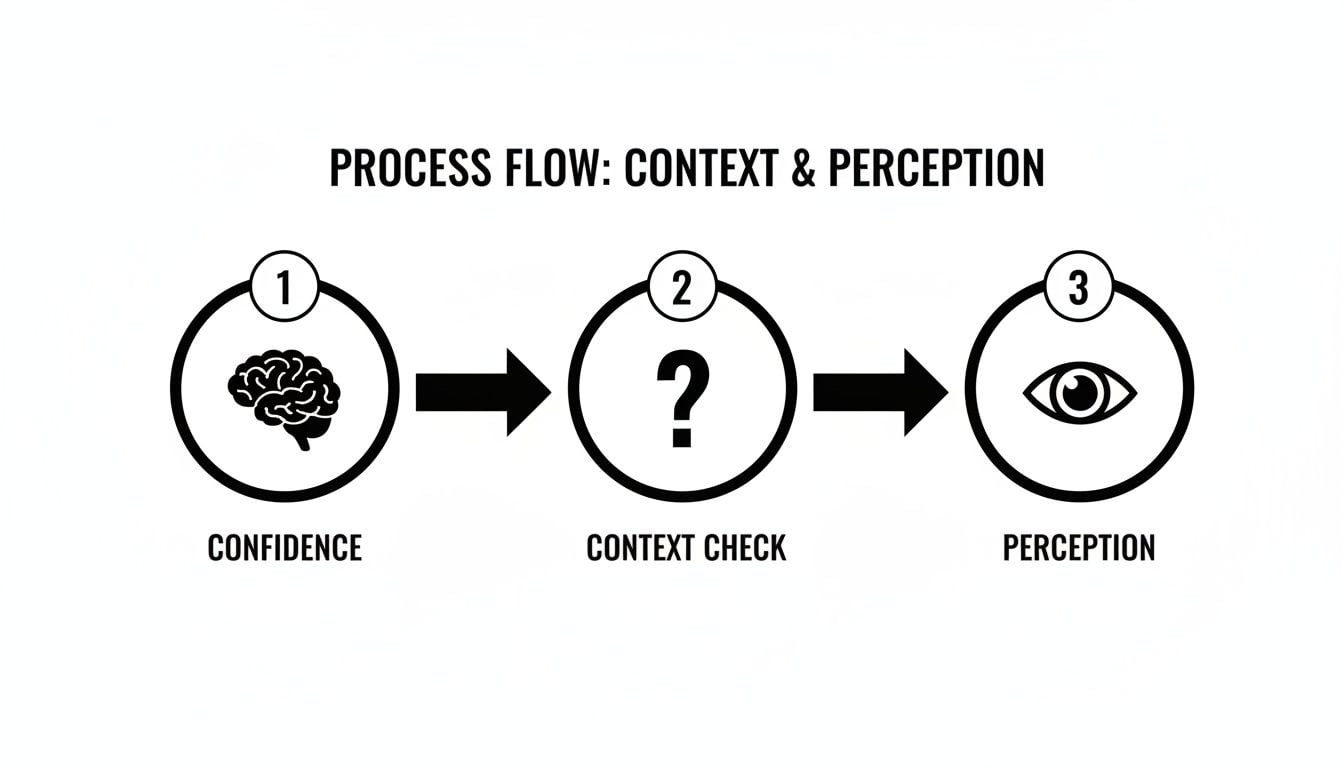
What this visual drives home is that feeling confident is only the start. How that confidence lands depends on a conscious, active assessment of the social and competitive environment you’re in.
Micro-Habits for Building Self-Efficacy
Self-efficacy is simply the belief that you can get things done. It’s a huge piece of the confidence puzzle, and you can build it with small, repeatable actions.
- Set and Achieve Micro-Goals: Forget “run a marathon” for now. Start with “put on running shoes and walk for 10 minutes.” Each tiny win sends a powerful message to your brain: “I am capable.”
- Track Your “Wins”: At the end of each day, write down three things you did well—no matter how small. This simple act trains your brain to hunt for evidence of your competence instead of fixating on your flaws.
- Practice Assertive Communication in Low-Stakes Scenarios: Start small. Order your coffee clearly and without apology. Say “no” politely but firmly to a small request you can’t meet. Building this muscle in safe situations prepares you for higher-stakes conversations.
A Framework for Handling Self-Doubt
Even the most confident people have moments of self-doubt. The difference lies in how they handle it. Instead of letting doubt trigger an ego-fueled panic, you can walk through it with this three-step framework.
| Step | Action | Purpose |
|---|---|---|
| 1. Acknowledge | Name the feeling without judgment. Tell yourself, “Okay, I’m feeling a wave of doubt right now.” | Naming it creates distance. You aren’t your doubt; you’re just the person experiencing it. |
| 2. Investigate | Get curious. Ask, “What if I fail? What would I do then?” or “What proof do I have that this fear is 100% true?” | This pulls you out of an emotional spiral and into logical problem-solving—a hallmark of true confidence. |
| 3. Reorient | Think of a past success, even a tiny one. Then, identify one small, actionable step you can take right now. | This breaks the paralysis of fear and puts you back in the driver’s seat, reinforcing your sense of capability. |
By using these strategies, you’re not just hoping for confidence—you’re building a system for it. You learn to listen to yourself, manage the ego’s perfectionist demands, and create a track record of competence that fosters deep, unshakable self-belief.
Frequently Asked Questions About Ego vs Confidence
It’s one thing to understand the difference between ego and confidence in theory, but it’s another thing entirely to navigate it in the real world. Here are some straightforward answers to the tricky questions people often ask about handling these dynamics at work and building genuine self-assurance.
How Do I Deal with a Colleague Who Has a Big Ego?
Working with someone who has a massive ego can be incredibly draining. The goal is to manage the interaction without letting their behavior tank your morale or derail the team.
First things first, resist the urge to get into an ego-driven showdown. Pushing back directly is exactly what they want because it feeds their need for attention and conflict. Instead of taking the bait, try the “gray rock” method. Be polite and professional, but give them nothing to latch onto emotionally. You become uninteresting, and the drama has nowhere to go.
Next, make objective reality your best friend. When you’re in a discussion, always bring the conversation back to hard data, project goals, and what’s verifiably true. It’s tough for an ego-driven person to argue with facts. You could say something like, “That’s an interesting thought. Let’s pull up the numbers from last quarter’s report and see how it fits in.”
Finally, you can sometimes use their ego to guide them toward a more productive outcome. If you frame your ideas in a way that makes them feel important or central to the process, they’re more likely to get on board. A simple phrase like, “I was hoping to get your eyes on this, since you have so much experience in this area,” can disarm their defensiveness and make them a surprisingly willing collaborator.
What Is the Difference Between Healthy Confidence and Arrogance?
The real difference between confidence and arrogance boils down to your core intention. It’s all about contribution versus domination.
Confidence says, “I have something valuable to offer.” Arrogance, which is a symptom of a large ego, says, “I’m the only one here who has anything valuable to offer.”
Here are a few ways to tell them apart in the wild:
- Curiosity: A truly confident person is almost always curious. They ask questions because they genuinely want to learn and understand other viewpoints. An arrogant person already assumes they have all the answers, so they spend their time telling, not asking.
- Celebrating Others: Someone with healthy confidence is happy to see a teammate succeed; they view it as a win for everyone. An arrogant person often feels a pang of threat when others do well and might even try to downplay or dismiss their achievements.
- Accountability: Confidence means owning all of your work—including your mistakes. A confident person will admit when they’re wrong and treat it as an opportunity to learn. Arrogance, on the other hand, deflects blame and makes excuses because admitting a flaw feels like a total failure.
At its heart, confidence is warm and inclusive; it draws people in. Arrogance is cold and exclusive; it pushes people away to maintain a fragile sense of superiority.
How Can I Rebuild My Confidence After a Professional Setback?
Bouncing back from a failure is a process that demands both kindness to yourself and some deliberate action. Your ego loves to spin a story of permanent defeat, but authentic confidence understands that a setback is just a single data point, not a final verdict on your worth.
Step 1: Acknowledge and Separate
First, you have to let yourself feel the disappointment without letting it define you. A project failed; you are not a failure. That distinction is everything. A great way to do this is to journal about what happened. Writing it down helps you process the emotions and look at the situation with more clarity.
Step 2: Focus on Learning
Now, shift your mindset from the sting of the setback to the lessons it contains. Get curious and ask yourself some objective questions:
- What, specifically, went wrong here?
- What part of this was in my control, and what wasn’t?
- What is the one thing I can do differently next time?
This reframes the experience from a source of shame into a source of growth. An ego-driven reaction is to hide the mistake. A confidence-building one is to analyze it.
Step 3: Secure a Small Win
Confidence is built on a foundation of competence. You need to give yourself a fresh piece of evidence that you are capable. Don’t try to conquer the world right away. Instead, find a small, manageable task that you know you can nail. Just getting it done provides a powerful psychological boost that begins to silence that inner critic and build momentum. That micro-win is a potent reminder of your ability.
At David Pexa, we provide structured, evidence-informed guidance to help you build the mindset and habits for a more effective and fulfilling life. Explore more actionable strategies at https://davidpexa.com.
