



It’s a fine line, isn’t it? That razor’s edge between confidence and arrogance. On the surface, they can sometimes look surprisingly similar, but at their core, they are worlds apart. One builds you up and brings people closer, while the other creates distance and, eventually, leads to a lonely summit.
The simplest way to think about it is this: confidence is a quiet, internal trust in your own abilities, earned through experience. Arrogance, on the other hand, is a loud performance designed to convince others (and yourself) of a value you’re not so sure you have.
The Real Difference Between Confidence And Arrogance

Getting a handle on this distinction is a game-changer for how you navigate your career and relationships. A genuinely confident person knows their strengths but, just as importantly, they aren’t afraid of their weaknesses. Their sense of worth comes from within—it’s forged from effort, learning from mistakes, and real-world accomplishments. They don’t need a megaphone because their competence speaks for itself.
Mindset And Motivation
The true split between confidence and arrogance begins with motivation. Where does the drive come from? Confidence grows from a place of self-security, while arrogance is really just a shield against deep-seated feelings of inadequacy. This one psychological fact is the source of all their behavioral differences.
Arrogance is rooted in insecurity—a defense from feelings of weakness that are unacceptable and unclaimed. A confident person can accept their weaknesses or faults with grace, even though they may not like them.
This is where the two paths diverge dramatically in everyday interactions:
- A confident person is genuinely curious. They lean in, ask thoughtful questions, and listen. Why? Because they know they don’t have all the answers and see every conversation as a chance to learn.
- An arrogant person is performatively certain. They tend to interrupt, talk over others, and feel compelled to prove they’re the smartest one in any room.
It’s important not to mix this up with self-esteem, which is another piece of the personal development puzzle. If you want to dive deeper into that, you can read more about the difference between self-esteem and self-confidence in our detailed guide.
Behavioral Cues And Impact
The ripple effect of these two traits is massive. Confident people are magnetic; they inspire trust and make others feel capable, too. Their self-assurance creates an environment where people feel safe to collaborate and take risks. Arrogance does the exact opposite—it repels. It fosters a tense, competitive atmosphere where people feel judged and devalued.
To make this crystal clear, let’s break down how these mindsets show up in the real world.
Confidence Vs Arrogance At A Glance
This table offers a quick snapshot of the core differences you can spot in yourself and others.
| Attribute | Authentic Confidence | Arrogance |
|---|---|---|
| Core Mindset | Built on self-trust and competence. The internal script is, “I am capable.” | Driven by insecurity and a need for validation. The script is, “I must prove I am better than you.” |
| Response to Feedback | Listens with an open mind, asks clarifying questions, and sees it as a gift for growth. | Gets defensive, deflects blame, or questions the credibility of the person giving it. |
| Communication Style | Speaks with clarity and calm. Often listens more than they talk, making others feel heard. | Dominates the conversation, interrupts, and uses a declarative, all-knowing tone. |
| Handling Mistakes | Owns the error without drama, takes responsibility, and shifts focus to finding a solution. | Denies the mistake, blames external factors or other people, and tries to minimize the impact. |
| View of Others | Genuinely celebrates the success of others and seeks out collaboration. | Views others as competition and feels threatened or diminished by their achievements. |
| Source of Worth | Internal. Grounded in experience, personal values, and self-awareness. | External. Desperately needs praise, status, and admiration to feel valuable. |
Ultimately, confidence empowers everyone. It creates a positive feedback loop of growth, trust, and shared success. Arrogance, in contrast, only serves the fragile ego of one person, usually at the expense of team morale and meaningful relationships. Learning to spot these signs is the first, most crucial step toward cultivating the former and avoiding the latter.
The Mindset Behind Confidence And Arrogance
Ever wonder why some people have that quiet, steady self-assurance, while others seem to shout their own greatness from the rooftops? The difference between confidence and arrogance isn’t just about what they do—it’s about what’s going on inside. It all comes down to the stories we tell ourselves about our own worth.
True confidence is earned, not just declared. It grows from a solid foundation of real-world competence and a genuine desire to keep learning. At its core is self-efficacy, that quiet inner knowledge that you have what it takes to handle challenges. When you’re truly confident, you don’t feel the need to broadcast your value; you’ve already proven it to yourself, time and time again.
This mindset sees ability not as a final trophy, but as a starting point. Confident people tend to have a growth mindset, viewing mistakes and tough feedback as valuable data for getting better, not as a personal attack on their character.
The Security Of Self-Trust
Someone who is genuinely confident operates from a place of internal security. They’ve put in the hours, they’ve stumbled and gotten back up, and they’ve stacked up a history of wins, both big and small. This builds a kind of resilience that doesn’t need constant applause from the outside world.
That internal stability is what makes humility and curiosity possible. Because their ego isn’t on the line with every single interaction, they can actually afford to:
- Listen to others without just waiting for their turn to talk.
- Admit they don’t have an answer, seeing it as a chance to learn something new.
- Celebrate other people’s successes without feeling like it takes something away from them.
Confidence says, “I’ve got something to offer.” Arrogance says, “I’m the only one here who does.” The most confident people are often the most curious because they aren’t threatened by what they don’t know.
Their whole approach is more collaborative than competitive. They know their worth isn’t tied to being the “smartest person in the room.” In fact, they actively seek out rooms where they have the most to learn. If you’re working on building this kind of inner strength, our guide on overcoming limiting beliefs is a great place to start reframing that internal script.
Arrogance As A Defensive Shield
On the flip side, arrogance is almost always a defense mechanism. Think of it as a loud, flashy shield meant to protect a fragile ego. It’s a performance designed to ward off anything that feels like a threat—criticism, failure, or even just being ignored. It’s often a tell-tale sign of deep-seated insecurity or even imposter syndrome.
An arrogant person’s self-worth is totally dependent on outside sources, making it incredibly volatile. They need a non-stop drip of admiration and agreement to feel okay. Take that away, and their whole self-concept is in jeopardy, which often triggers defensive or aggressive behavior. Their inner voice isn’t saying, “I am capable,” but rather, “I have to make everyone think I’m capable, or they’ll see right through me.”
This mindset has very real consequences. Look at the gender confidence gap in the workplace. Research reveals women frequently undervalue their own performance, leading them to ask for salaries nearly 3% lower than men with the exact same qualifications. In high-paying fields, that can mean $4,000 less each year. The problem is compounded by another finding: a woman’s perceived lack of confidence can be “contagious,” causing others to view her as less competent than she actually is. You can read more about these impactful findings on confidence in the workplace from CoachHub.
At the end of the day, the mindset is what separates the two. Confidence is built from within and fosters connection and growth. Arrogance is just a mask for insecurity, fueled by a bottomless need for approval that, ironically, pushes people away and stifles potential.
How Confidence And Arrogance Appear At Work
Nowhere does the line between confidence and arrogance become clearer than in the workplace. Our daily interactions—from team meetings to project post-mortems—put these mindsets on full display through concrete, observable behaviors. Learning to spot the difference is crucial, not just for understanding your colleagues, but for checking in with yourself.
At its core, a confident professional is driven by a desire for both personal growth and collective success. An arrogant person, on the other hand, is usually putting on a performance. Their actions are designed to protect a fragile ego and assert dominance. While their behaviors might look similar at a glance, the impact on team morale and productivity couldn’t be more different.
Responding To Feedback And Challenges
One of the most telling moments is when someone’s work gets challenged or critiqued. This is where you see if a person is grounded in self-trust or just propped up by their ego. A truly confident team member sees feedback for what it is: a gift.
- The Confident Response: They listen without interrupting, ask questions to get to the heart of the critique, and genuinely thank the person for their time and input. Their internal monologue is something like, “Okay, this can help me get better.”
- The Arrogant Response: They get defensive almost immediately. You’ll see them deflect blame, pick apart the critic’s own expertise, or minimize the issue. The goal isn’t to learn; it’s to win the argument and protect their flawless image.
This decision tree perfectly illustrates the mental fork in the road that leads to one behavior or the other.
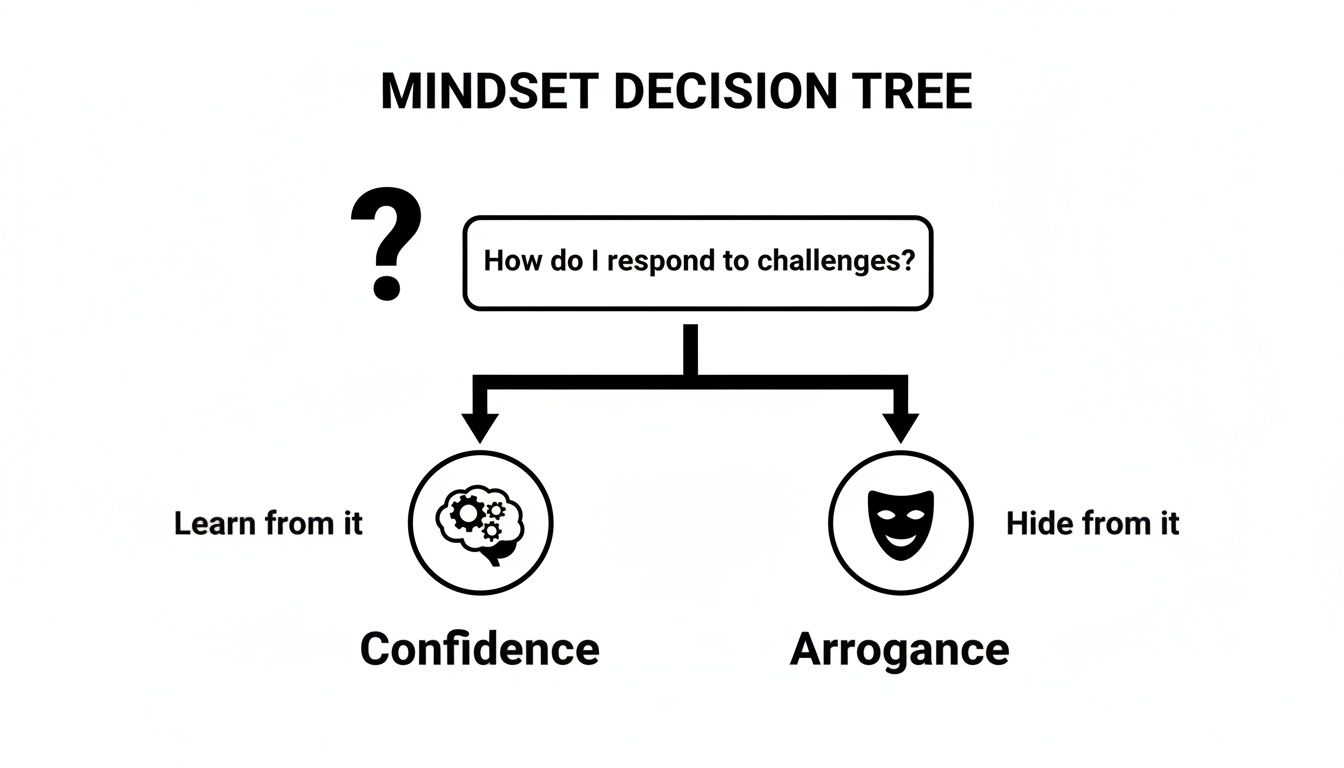
As you can see, the path to authentic confidence is paved with a willingness to learn from challenges. Hiding from them, usually through defensive posturing, is a classic sign of arrogance.
Leadership And Team Collaboration
When a leader is involved, the difference between confidence and arrogance can make or break a team. A confident leader fosters psychological safety, creating an environment where people feel safe enough to innovate. An arrogant one breeds fear and resentment.
Think about a typical project kickoff meeting:
- The Confident Leader: They act as a facilitator, drawing out ideas from everyone in the room and making sure the quietest voices are heard. They give credit where it’s due and frame success in terms of “we” and “us.”
- The Arrogant Leader: They hold the floor, shutting down opinions that don’t align with their own. The project is framed around their singular vision, and you’ll hear “I” and “my” used constantly to stake a claim on any potential wins.
A confident leader lifts their team up, knowing that shared success reflects well on everyone. An arrogant leader pushes their team down to elevate themselves, fearing that others’ achievements might overshadow their own.
This isn’t just bad for morale; it’s actively destructive. Research confirms that arrogant leadership corrodes company culture. In one study of 299 employees, those who saw their leader as arrogant were far more likely to spread negative gossip about them. Interestingly, this gossip-spreading was less common among employees with high personal resilience, who were better able to detach their self-worth from the toxic environment. This shows that arrogance doesn’t just kill motivation—it actively encourages toxic communication that can rot an organization from the inside out. You can explore the full research on arrogant leadership and its consequences here.
Owning Mistakes And Sharing Credit
Finally, just watch how someone handles accountability. Everyone messes up eventually. How a person deals with that moment says everything about their character.
Handling a Mistake
A confident person owns their mistakes quickly and without drama. They’ll say something direct like, “You’re right, I missed that. I’m fixing it now, and here’s what I’ll do to make sure it doesn’t happen again.” The focus is on the solution, not the shame.
An arrogant person, however, will deny, downplay, or deflect. They might blame a colleague, a different department, or some vague “external factor.” For them, admitting a mistake feels like admitting they aren’t perfect, and their ego just can’t handle it.
Sharing Success
The same pattern appears when things go well. When a project is a hit, a confident person shines a spotlight on the team. An arrogant person steps into that spotlight alone, happy to take a solo bow for a group effort.
Ultimately, confidence builds bridges. Arrogance builds walls.
How This Impacts Your Hiring and Career
Let’s be blunt: the impression you make during the hiring process can define your entire career. The line between confidence and arrogance isn’t just a fine point of personality; it’s a critical distinction that recruiters are trained to spot. Getting it right can open doors, while getting it wrong can slam them shut before you even get a foot in.
Genuine confidence is a massive asset. It tells a hiring manager you’re competent, self-aware, and—most importantly—coachable. Arrogance, on the other hand, sets off alarm bells. It screams “difficult,” “unreceptive to feedback,” and “not a team player.”
How Confidence Wins the Interview
When you’re sitting across from a hiring manager, a confident person demonstrates their value without needing to put anyone else down. They talk about their achievements with a quiet assurance that comes directly from experience. This isn’t about bragging; it’s about giving clear, evidence-based examples of what you can do.
Here’s what that looks like in practice:
- Sharing credit naturally: They use “we” when talking about team wins and can clearly explain their specific contribution without inflating it.
- Answering thoughtfully: They aren’t afraid to take a beat before answering. That small pause shows they respect the question and are giving a considered response, not just a canned one.
- Admitting what they don’t know: Saying, “I haven’t had a chance to work with that tool, but I’m a quick study. For example, I taught myself [new skill] for my last project” shows honesty and a growth mindset. It’s incredibly powerful.
This approach builds instant trust. It signals that you’re secure in your skills and ready to learn more, making you an excellent long-term investment for the company.
Why Arrogance is a Career-Limiting Move
On the flip side, arrogance is often a deal-breaker. It projects an image of someone who is uncooperative and resistant to being managed or coached. In an interview, these behaviors are surprisingly easy to spot and create an immediate negative vibe.
Look out for these red flags:
- Dismissing questions: Treating an interviewer’s question as “basic” or “obvious” is a huge sign of disrespect.
- Blaming past employers: Bad-mouthing former colleagues or bosses is a classic sign of someone who doesn’t take accountability for their own part in failures.
- Hogging the credit: Taking sole credit for group projects suggests an ego that will be toxic to a team environment.
The line between confidence and arrogance is razor-thin, but the impact is enormous. Employer surveys show that while 42% of HR professionals see confidence as a top trait, an overwhelming 72% name arrogance or over-confidence as “the biggest personality turnoff.”
This points to a major shift in how companies hire. A study from TopInterview and Resume-Library found that 70% of employers now place personality among the top three factors in their decision-making—often on par with, or even above, experience. As career expert Amanda Augustine puts it, behavior is now the key differentiator. Projecting self-assurance is a huge plus, but the moment it crosses into superiority, you risk instant rejection. You can read more about how confidence affects hiring decisions on Payscale.
Long-Term Career Growth: Confidence vs. Arrogance
This divide doesn’t just disappear after you land the job. Over a career, confidence and arrogance create two completely different paths.
Confident professionals build a reputation for being reliable, collaborative, and easy to work with. They build strong relationships, earn the trust of leaders, and are seen as people who make the whole team better. This reputation is what leads to mentorship opportunities, key promotions, and a seat at the table for high-impact projects.
The arrogant professional, however, leaves a trail of friction. They might get some short-term wins through sheer force of will, but their inability to listen, share credit, and collaborate eventually becomes a serious liability. Their careers often hit a ceiling because nobody wants to manage them or promote someone known for being toxic to the company culture.
A Practical Guide to Building Authentic Confidence

Knowing the difference between confidence and arrogance is one thing. Actually building genuine, earned self-assurance is another game entirely. It’s where the real work begins. True confidence isn’t some personality trait you’re lucky enough to be born with; it’s a skill you forge through deliberate, consistent practice.
This isn’t about “faking it ’til you make it.” We’re moving past theory and into a practical framework for cultivating that quiet inner strength. It all comes down to taking small, intentional steps that, over time, build a rock-solid foundation of self-trust and competence. These are the sustainable habits that create a version of yourself who doesn’t need applause to feel secure.
Start With Small, Deliberate Wins
The path to real confidence is paved with small victories. Aiming for huge, life-altering goals right out of the gate is a recipe for paralysis and self-doubt. The secret is to break things down and start stacking up proof that you can trust yourself to get things done.
Give yourself one small, manageable goal for the day—something you are 90% sure you can nail. Maybe it’s finally clearing out your inbox, making that one phone call you’ve been dreading, or just spending 15 focused minutes on a task you’ve put off. When you do it, take a second to consciously register the accomplishment.
This simple act starts to rewire your brain, creating a powerful link between action and success. Every completed task is like a deposit into your self-trust account. Pretty soon, you’ve built up a surplus that makes tackling bigger challenges feel far less intimidating.
Master Your Internal Monologue
The voice in your head is the architect of your reality. Arrogance is often a desperate attempt to shout over a loud, insecure inner critic, demanding external praise to feel okay. Authentic confidence, on the other hand, is nurtured by a calm, realistic, and compassionate internal dialogue.
Start by simply noticing your negative thought patterns without judgment. When you catch yourself thinking, “I’m going to completely bomb this presentation,” just pause. Reframe it with a dose of grounded reality: “I’ve prepared for this, and I’m going to do my best. If I stumble on a point, it’s a chance to learn for next time.”
Confidence isn’t about pretending you have no doubts. It’s about learning to take action even when they’re there. Your self-talk doesn’t need to be relentlessly positive, just rooted in evidence and a core belief that you can handle whatever comes next.
This is a fundamental shift. You’re moving from an inner critic who fears failure to an inner coach who sees every outcome, good or bad, as valuable feedback for growth.
Create a Tangible Record of Your Competence
Our brains are hardwired with a negativity bias, which means it’s ridiculously easy to dwell on our failures while our successes fade into the background. To fight this, you need to create a physical record of what you’re capable of. This is where an “achievement journal” or “success log” can be an absolute game-changer.
At the end of each week, take five minutes to write down three to five specific things you accomplished.
- Don’t just write: “Did well at work.”
- Instead, write: “I successfully handled that tense client negotiation and found a compromise that worked for everyone.”
This isn’t about stroking your ego; it’s about collecting cold, hard evidence. When imposter syndrome inevitably rears its head, you can flip open that journal and see tangible proof of your competence. That internal validation is infinitely more powerful than any external compliment.
Your Action Plan For Authentic Confidence
Building confidence is a marathon, not a sprint. A structured approach helps turn these ideas into ingrained habits. This table outlines a simple yet powerful routine you can adopt to systematically build your self-assurance over time.
| Timeframe | Actionable Strategy | Desired Outcome |
|---|---|---|
| Daily | Set & Complete One Small Win: Identify one manageable task you are 90% sure you can finish. | Creates daily momentum and provides immediate evidence of capability. |
| Daily | Reframe One Negative Thought: Notice a self-critical thought and consciously rephrase it with realism and compassion. | Rewires your internal monologue from a critic to a supportive coach. |
| Weekly | Log 3-5 Specific Successes: Write down your accomplishments in an “achievement journal.” Be specific. | Builds a tangible record of competence to combat negativity bias and imposter syndrome. |
| Weekly | Seek One Piece of Actionable Feedback: Ask a trusted colleague or friend for one specific way you can improve on a recent task. | Normalizes feedback as a tool for growth, not a personal attack. Reinforces security. |
| Monthly | Review Your Achievement Journal: Read through your logged successes from the past month. | Reinforces your progress and builds a deep, evidence-based sense of self-trust. |
This plan isn’t about adding more to your plate; it’s about being more intentional with what you’re already doing. Consistency here is what separates wishful thinking from real, lasting change.
Seek Feedback as a Tool For Growth
If there’s one clear dividing line in the confidence vs. arrogance debate, it’s how a person handles feedback. An arrogant person runs from criticism because it threatens their fragile ego. A truly confident person actively seeks it out. They know they have blind spots and that constructive feedback is the fastest path to getting better.
Get into the habit of asking people you trust for specific, actionable advice. Ditch the vague, “How did I do?” and get targeted:
- “What’s one thing I could have done to make that meeting run smoother?”
- “Was there any part of my proposal that felt unclear or confusing?”
Asking questions like this shows you’re secure enough to learn and genuinely committed to improving. It reframes feedback from a scary judgment into a collaborative tool for excellence. For anyone serious about accelerating this process, working with a dedicated confidence coach can offer the structure and accountability needed to make profound changes.
By weaving these strategies into your life—celebrating the small stuff, managing your inner voice, tracking your wins, and embracing feedback—you stop projecting confidence and start embodying it. You build it from the inside out, based on real competence and self-awareness, creating a resilient self-assurance that no one can ever take from you.
Frequently Asked Questions About Confidence and Arrogance
Even after breaking down the definitions, that line between confidence and arrogance can still feel a bit hazy in real life. It’s normal to have lingering questions, especially when you run into those tricky “gray area” situations.
This section tackles some of the most common questions head-on, giving you practical answers to help you navigate the confidence-versus-arrogance dynamic in your own life.
Can You Be Too Confident? Where Is the Line?
Yes, you can be “too confident”—but when people say that, they’re usually pointing to arrogance without knowing the right word for it. The line gets crossed when your quiet inner belief in yourself turns into an outward display of superiority.
True confidence is rooted in competence and self-awareness. A confident person knows what they bring to the table, but they’re just as aware of what they don’t know. Arrogance is what happens when you lose that second part. You start acting as if your knowledge is absolute, which leads you to shut down other people’s ideas and ignore obvious risks.
So where’s the line, exactly? It’s the moment you stop listening. When you decide you have nothing left to learn from someone or a situation, you’ve strayed from confidence into the dead-end of arrogance.
The most confident people I know have something anchoring them outside of their work. They don’t need the role or the job or the title to define who they are. Arrogance shows up the minute you start believing the work is the only thing holding you together.
How Do I Give Feedback to an Arrogant Person?
Giving feedback to an arrogant person feels like walking on eggshells, doesn’t it? That’s because their behavior is often a shield against criticism. To get through, you have to frame your feedback in a way that feels collaborative, not confrontational.
Here are a few ways to approach it:
- Focus on the situation, not the person. Instead of saying, “You were so dismissive in that meeting,” try something like, “I think we’d get more creative solutions if we made sure everyone had a chance to share their thoughts without being cut off. What do you think?” This makes it about improving a shared process, not about their personal flaws.
- Use “I” statements to own your perspective. A phrase like, “I feel like I can’t contribute my best ideas when the conversation moves really fast,” is much less accusatory than, “You just talk over everyone.”
- Tie your feedback to a goal you both share. Try to connect what you’re saying to something they already care about. For example: “I really want this project to be a huge success. For that to happen, it’s crucial that the whole team feels their input is valued.”
Even with the best approach, be ready for a defensive reaction. The goal isn’t to “win” the argument but to plant a seed. Sometimes, the best you can do is state your point clearly and calmly, and then give them the space to think about it later.
Is “Fake It Till You Make It” Good Advice?
That old saying can be a powerful tool or a complete disaster. It all comes down to what you’re faking.
On one hand, faking confident behaviors is incredibly useful. Research on “embodied cognition” shows that adopting a confident posture—standing tall, making eye contact, speaking clearly—can actually make you feel more confident on the inside. You act the part, and your brain starts to believe it.
On the other hand, faking competence is where this advice goes horribly wrong. Pretending you have skills you don’t possess isn’t confidence; it’s just deception. That’s a fast track to coming off as arrogant, and it almost always ends badly, destroying trust and damaging your reputation.
A healthier way to think about it is this: act as if you are capable of learning, not as if you already know it all. Fake the bravery to try something new, not the expertise itself. This approach pushes you out of your comfort zone to build real, hard-won skills—and that’s where authentic confidence comes from.
At David Pexa, we provide structured guidance and clear recommendations to help you build the mindsets and habits for sustainable personal growth. Explore our resources to move from theory to action. Learn more at DavidPexa.com.
