



Think of a confidence coach as a personal trainer for your mind. They provide a structured, supportive partnership to help you build self-belief, hold you accountable, and equip you with practical skills for the real world. It’s far more than just a series of pep talks; it’s a strategic process for personal and professional growth.
What Does a Confidence Coach Actually Do?

If you wanted to get physically fit, you could go to the gym alone. But a great personal trainer helps you identify weak spots, perfect your form, and stick to a plan that gets real results. A confidence coach does the exact same thing for your inner world—your self-perception, assertiveness, and resilience.
Their goal isn’t to hand you the answers. Instead, they guide you toward finding your own. By creating a safe, forward-looking space, they help you unpack the roots of self-doubt and build the capabilities you need to move forward.
Digging Up and Challenging Limiting Beliefs
At the core of low confidence, you’ll almost always find limiting beliefs. These are the quiet, persistent stories we tell ourselves—things like, “I’m not experienced enough for that role,” or “If I speak up, everyone will think I’m foolish.” A coach is trained to help you spot these hidden narratives that are quietly sabotaging your potential.
They use powerful, probing questions to challenge these assumptions, helping you see them for what they are: outdated patterns, not unchangeable facts. A coach might ask, “What solid evidence do you have that this belief is 100% true, 100% of the time?” This simple question can be the first step in tearing down the mental walls holding you back.
To give you a clearer picture, here’s a breakdown of what a coach focuses on during your time together.
Key Focus Areas of a Confidence Coach
| Area of Focus | What It Involves | Expected Outcome |
|---|---|---|
| Mindset & Beliefs | Identifying and questioning negative self-talk and deep-seated limiting beliefs. | A shift from a self-critical mindset to one of self-compassion and possibility. |
| Goal Setting | Breaking down a vague desire for “more confidence” into small, actionable steps. | A clear roadmap with achievable milestones that build momentum and self-trust. |
| Skill Development | Practicing assertive communication, boundary setting, and public speaking in a safe space. | The ability to handle difficult conversations and high-pressure situations effectively. |
| Accountability | Creating a structured plan and holding you responsible for taking consistent action. | Genuine progress and follow-through, turning intentions into tangible results. |
Ultimately, this structured approach ensures you’re not just thinking differently, but actively building a new reality for yourself.

Turning Self-Belief into Tangible Goals
True confidence isn’t built on positive thinking alone; it’s forged by taking action and gathering evidence that you are capable. A huge part of a coach’s job is helping you translate a big, fuzzy goal like “I want to be more confident” into small, measurable, and achievable actions.
These goals become the building blocks of self-trust. They might look like:
- Speaking up within the first two minutes of your next team meeting.
- Making the first move to introduce yourself to someone at a networking event.
- Politely but firmly saying “no” to a request that oversteps your boundaries.
Each time you complete one of these small goals, you provide your brain with concrete proof of your abilities. This creates a powerful feedback loop that steadily grows genuine self-assurance. The method works—a stunning 80% of coaching clients report a significant boost in their self-esteem from the process. You can explore more life coaching statistics and their impact to see the data for yourself.
Developing Practical, Real-World Skills
Finally, a confidence coach helps you master the “how” of confident behavior. The work doesn’t stay theoretical. You’ll dive into practical skills you can use immediately in your daily life, from role-playing a tough conversation with your boss to refining your body language for a presentation.
A confidence coach acts as an architect for your future self. They don’t just give you a blueprint; they work alongside you, handing you the tools and guidance needed to build a stronger, more resilient foundation from the ground up.
This focus on actionable skills is what makes coaching so effective. The progress you make in your sessions translates directly into your career and personal life. You don’t just feel more confident—you learn how to act with confidence when it truly counts.

The Proven Methods Behind Building Confidence
A great confidence coach does more than just give you a pep talk. Think of them as a personal trainer for your mind, using proven, evidence-backed methods to help you build real, lasting self-belief. It’s not about temporary fixes or “faking it ’til you make it.”
This is a structured process. We’re talking about systematically taking apart the old mental habits that hold you back and replacing them with stronger, more resilient ways of thinking. The goal is to give you the tools to understand why you feel stuck and the practical steps to change it for good.
Cognitive Behavioral Coaching for Mindset Shifts
One of the most effective frameworks a coach will use is Cognitive Behavioral Coaching (CBC). The core idea is simple but powerful: your thoughts, feelings, and actions are all linked. If you can change a negative thought pattern, you can change how you feel and, ultimately, how you act.
Let’s say you’re tapped to lead a big project at work. That sinking feeling hits, and an automatic thought pops up: “I’m going to mess this up, and everyone will know I’m a fraud.” That single thought can trigger anxiety, which leads to you procrastinating or second-guessing every move you make.
A coach using CBC helps you press pause and challenge that initial thought. They act as a guide, helping you question its validity with prompts like:
- “Where’s the hard evidence that you’re definitely going to mess this up?”
- “Is there a more balanced or realistic way to look at this?”
- “What might happen if you just acted as if you were capable, for this one project?”
This isn’t about slapping a layer of fake positivity on top of your fears. It’s about dismantling distorted thoughts and replacing them with more accurate, empowering ones. Over time, you literally carve out new neural pathways, making confident thinking your new normal. If you want to get a head start, our guide on overcoming limiting beliefs is a great place to begin.
Strengths-Based Coaching to Build Self-Efficacy
While CBC is fantastic for rewiring negative thinking, Strengths-Based Coaching comes at it from the other direction—by focusing on what you’re already great at. The truth is, it’s far easier to build confidence from a foundation of your natural talents. Most of us are experts on our own flaws but have a massive blind spot when it comes to our strengths.
A coach will help you uncover and actually name what you’re good at. Maybe you have a knack for making people feel heard, or you’re a genius at untangling complex data. These aren’t just personality quirks; they are resources.
“True confidence comes not from being flawless, but from knowing you have the inner resources to handle whatever comes your way. Strengths-based coaching helps you build an inventory of those resources.”
Once you know your strengths, the next step is to use them on purpose. For instance, someone who is a natural connector but dreads public speaking could be coached to start their presentation by engaging the audience in a small-group activity. They’re playing to their strength—building rapport—to ease into the part that scares them.
This creates a powerful feedback loop. Using your strengths leads to small, tangible wins. Those wins build self-efficacy, which is the rock-solid belief in your own ability to get things done. This isn’t just hype; it’s confidence built on a foundation of your own proven competence.

Coaching vs. Therapy vs. Mentoring
It’s easy to get lost in the world of personal development, especially when you hear terms like “coach,” “therapist,” and “mentor” thrown around. They might sound similar, but they fill very different roles. Figuring out which one is right for you starts with understanding what makes each unique.
Think of it this way: a therapist is like an archaeologist. They help you carefully dig into your past to understand how your history has shaped you. The goal is often to heal old wounds or treat clinical conditions like anxiety and depression, focusing on the “why” behind your current feelings.
A confidence coach, on the other hand, is your architect. They don’t dwell on the past; they partner with you to design and build the future you want. The work is all about action—setting goals, learning new skills, and creating a concrete plan to get you from where you are to where you want to be.
The Role of a Mentor
So where does a mentor fit in? A mentor is a guide who has already walked the path you’re on. They’ve found success in a field you’re pursuing and offer advice based on their hard-won experience. A mentor essentially says, “I’ve been there. Here’s how I got through it.”
A mentor’s advice is rooted in their personal journey. A coach, however, is a trained expert in the process of change itself. They don’t need to have lived your exact life to help you build a better one. This is where understanding what is mindset coaching can shed light on this forward-looking approach.
A good coach doesn’t just offer generic advice; they use proven methods to help you either reframe your limiting thoughts or tap into your natural talents, as this flowchart shows.
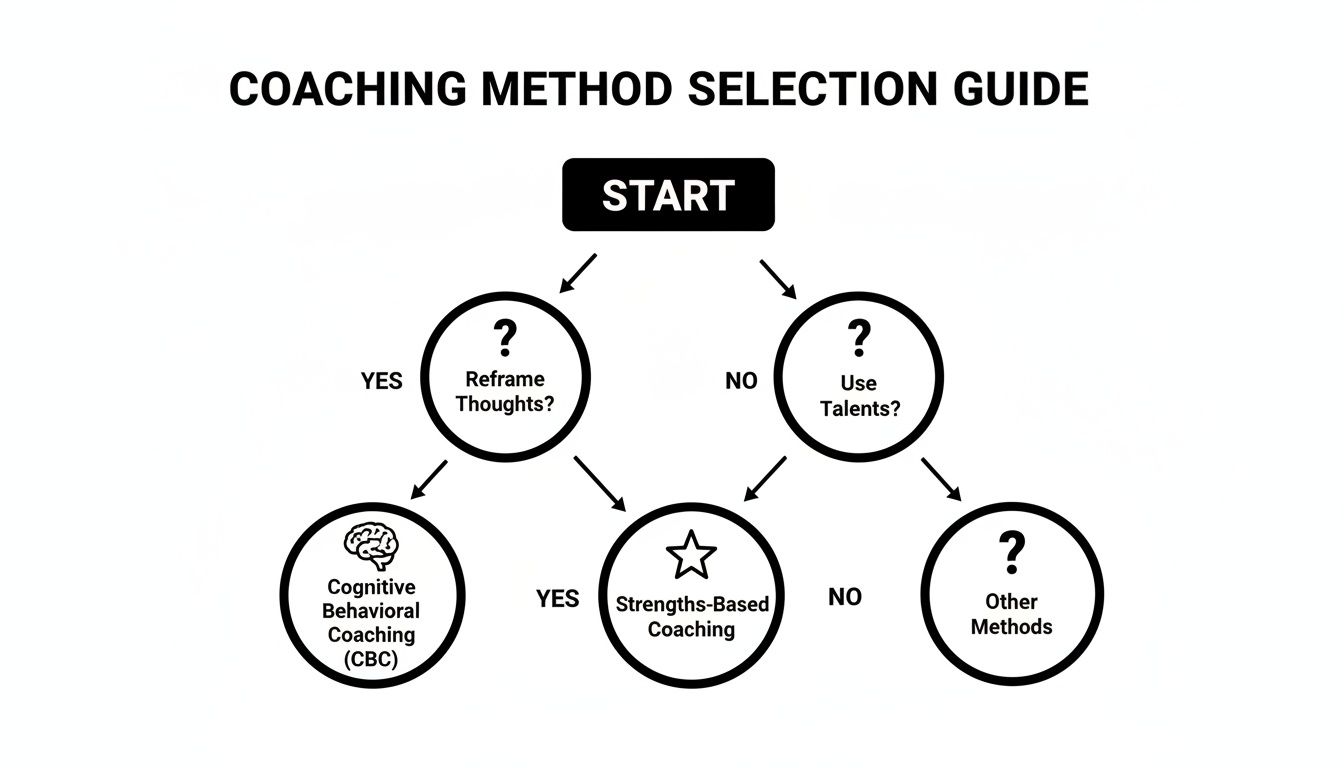
This just goes to show that professional coaching is a strategic process, not a random series of pep talks. It’s a system designed to meet you where you are.
Confidence Coach vs. Therapist vs. Mentor at a Glance
To make the differences even clearer, here’s a quick side-by-side comparison. This should help you pinpoint which kind of support best matches what you need right now—whether that’s healing, building, or getting advice from someone who’s gone before you.
| Attribute | Confidence Coach | Therapist | Mentor |
|---|---|---|---|
| Primary Focus | Forward-looking; centered on achieving goals and building skills. | Past and present; focused on healing trauma and treating mental health conditions. | Specific path; sharing wisdom and direct experience from their own journey. |
| Relationship | A collaborative partnership where you co-create solutions. | A clinical, patient-provider relationship for diagnosis and treatment. | An advisory role based on informal guidance and personal advice. |
| Qualifications | Often certified (e.g., ICF), but the industry is unregulated. | Must be licensed by a state board (e.g., LPC, LCSW, PhD). | Based on personal expertise and proven success in a specific field. |
| Key Question | “What do you want to create, and what’s the plan to get there?” | “How do your past experiences influence how you feel today?” | “Here’s what worked for me; have you considered trying this?” |
This table shows that while all three roles are supportive, their methods, qualifications, and core questions are fundamentally distinct.
So, how do you choose? It really comes down to your immediate goal. If you’re working to overcome past trauma or manage a diagnosed mental health condition, a therapist is the right choice. If you want career advice from an industry veteran, find a mentor.
But if you’re feeling stuck and ready to bridge the gap between your potential and your current reality, a confidence coach is the architect who can help you build that bridge to your future.
How to Find the Right Confidence Coach
Think of finding the right confidence coach like picking a guide for a trek up a mountain you’ve always wanted to climb. You wouldn’t just hire anyone; you’d want someone who knows the terrain, has the right equipment, and, most importantly, makes you feel you can actually make it to the summit.
The coaching world has exploded in recent years. In fact, the life coaching industry is on track to become a $6.12 billion market by 2031. While this means you have a ton of great options, it also means you need to be smart about sifting through the noise to find a genuine pro. You can see more on the coaching industry’s rapid expansion and what it means for you.
Start with Credentials and Specialization
Let’s be clear: coaching isn’t regulated the way therapy is. Anyone can call themselves a coach. That’s why professional credentials are one of the first things you should look for—they’re a sign that a coach takes their craft seriously and is committed to ethical, effective practices.
Here’s what to keep an eye out for:
- ICF Certification: The International Coaching Federation (ICF) is the gold standard. Look for credentials like ACC (Associate Certified Coach), PCC (Professional Certified Coach), or MCC (Master Certified Coach). This tells you they’ve met rigorous training and experience requirements.
- Specialized Training: Do they have a background in relevant fields like Cognitive Behavioral Coaching, neuroscience, or somatic work? This shows they have a deeper toolkit than just generic motivational phrases.
- A Clear Niche: A fantastic confidence coach usually doesn’t try to be everything to everyone. They might specialize in building confidence for public speaking, career transitions, or dating. A coach who gets your specific world will offer much more targeted and useful guidance.
These qualifications are what separate a true professional from a well-meaning amateur. It ensures your coach is working with proven methods for creating real change. This focus is also what differentiates a confidence coach from a more generalist personal growth coach in our related article.
Ask Insightful Questions During the Discovery Call
Almost every coach worth their salt offers a free consultation, often called a “discovery call.” This is not a sales pitch. This is your interview to see if there’s a good fit. It’s your opportunity to gauge their style, personality, and whether you genuinely click.
A discovery call isn’t about being sold; it’s a chemistry check. The whole point is to see if you can build a relationship based on trust, respect, and a clear vision for your goals.
Don’t just show up and wing it. Come prepared with questions that dig deeper than what’s on their website. Try these:
- What does your coaching process actually look like? Get a feel for their methodology. Is it a structured program or more free-flowing and client-led?
- How do you and your clients track progress? A solid coach will have a clear way to measure success, whether it’s through celebrating small wins, hitting specific milestones, or using feedback exercises.
- Can you share an anonymous example of how you helped someone with a challenge similar to mine? This lets you see their experience in action without breaking client confidentiality.
- What’s your philosophy on building confidence? You want to hear answers rooted in evidence-based ideas like mindset shifts and practical skill-building, not just “think positive!”
- What do you expect from me as a client? This is crucial. It clarifies the work you’ll be responsible for between your sessions.
Pay attention to their answers, but also listen to your gut. How do you feel talking to them? Do you feel heard and respected? A strong, comfortable rapport is absolutely essential for this to work.
Understand the Investment
Finally, let’s talk about money. Confidence coaching is a real investment in yourself, and you should feel completely clear about the financial side of things. The cost can vary dramatically based on a coach’s experience, location, and the depth of their program.
Most coaches work in packages, not one-off sessions, because real change doesn’t happen overnight. You’ll typically see options for three- to six-month commitments, which can run anywhere from a few hundred to several thousand dollars a month.
Be wary of anyone who is cagey about their pricing or uses high-pressure sales tactics. A true professional will be transparent about their rates and the value you’ll receive, empowering you to make a choice that feels right for both your personal goals and your wallet.
A Look Inside a Typical Coaching Session

If you’ve never been in a coaching session, the whole idea can feel a bit vague. But it’s far from a directionless chat. A great session is a structured, collaborative meeting where you are the single most important item on the agenda.
It’s all about creating forward momentum. The goal isn’t just to have you leave with interesting ideas; it’s to walk away with a clear action plan that you helped create—one designed to build real, tangible self-belief out in the real world.
The Standard Session Framework
While every confidence coach brings their own personality to the table, most professional sessions follow a reliable five-part rhythm. This structure isn’t rigid or corporate; it’s a flexible framework that makes sure every minute is spent moving you closer to where you want to be.
Think of it like a personal training session for your mind. You start with a warm-up, dive into the main workout focused on a specific goal, and then finish with a cool-down that sets you up for the week ahead.
A coaching session is a dedicated space where you can press pause on the noise of daily life and zoom in on what truly matters for your growth. The coach’s role is to hold that space, ask the right questions, and ensure you walk away with clarity and a plan.
This predictable flow is what makes the process feel so productive and safe. You know what to expect, which frees you up to do the deep, meaningful work that real change requires.
Breaking Down the Five Key Stages
Most coaching calls, whether they’re 45 or 60 minutes long, move through these distinct phases. Each stage flows naturally into the next, creating an arc that takes you from reflection to concrete action. This is the engine that drives your progress.
Here’s what you can expect, step-by-step:
-
The Check-In and Celebration: Things always kick off with you. You’ll talk about what’s happened since your last session—the wins, the hurdles, and any new insights. Celebrating the small victories, like finally speaking up in a meeting or holding a difficult boundary, is a huge part of this. It literally rewires your brain to recognize your own capabilities.
-
Setting the Session’s Focus: With the context set, you and your coach will pinpoint the most important thing to tackle today. You bring the topic—maybe it’s prepping for a nerve-wracking presentation or unpacking a recent moment of self-doubt. The coach helps you clarify what a “win” for this specific session would look like.
-
Exploration and Discovery: This is the heart of the conversation. Using powerful, open-ended questions, your coach will help you look at the situation from new angles. They’ll gently challenge the limiting beliefs that are holding you back, help you spot your own hidden strengths, and brainstorm new possibilities. This isn’t about the coach giving you advice; it’s about them helping you find your own answers.
-
Co-Creating Actionable Steps: An “aha!” moment is great, but it doesn’t mean much without action. Here, you’ll translate your discoveries into a few small, concrete, and achievable steps to take before you meet again. A skilled coach makes sure these steps feel empowering, not overwhelming.
-
Establishing Accountability: To wrap up, you’ll clearly state your commitment to the action steps you just designed. Your coach’s job here is simply to be your accountability partner. Knowing you’ll be sharing your progress next time provides just enough positive pressure to help you follow through and turn your intentions into actual accomplishments.
Confidence-Building Exercises You Can Start Today
You don’t have to wait for your first coaching session to get started. The truth is, confidence isn’t something you’re born with—it’s a skill you build. And like any skill, it gets stronger with a little bit of consistent practice.
These exercises are things you can try right now to get a real feel for what this work is all about. Think of them as small habits that begin to rewire the old, worn-out pathways of self-doubt and create new ones based on trusting yourself.
Keep an Accomplishment Log
Our brains have a funny habit of holding onto our mistakes while letting our wins slide right by. It’s called a negativity bias, and an Accomplishment Log is the perfect way to fight back. This isn’t about bragging; it’s about collecting hard evidence of your own abilities.
At the end of each day, just write down one thing you did that you feel good about. It doesn’t have to be a huge, earth-shattering achievement. Did you finally send that tough email? Did you handle a toddler’s meltdown with surprising patience? Write it down. The key is to notice it.
By intentionally focusing on your achievements, no matter how small, you’re gathering concrete data that challenges the narrative of “I’m not good enough.” This creates a powerful feedback loop that builds genuine self-efficacy over time.
This simple practice starts to shift your entire perspective. You begin to see yourself from a place of capability, not a place of lack, and that changes everything.
Discover Your Core Values
Real confidence isn’t about being flawless; it’s about feeling like you. When your actions are in line with what you truly believe in, you feel more authentic and grounded. A Values Discovery exercise is like finding your internal compass.
Grab a piece of paper and start listing words that feel important to you. Think of things like “creativity,” “integrity,” “connection,” or “growth.” Once you have a good list, circle the top five that feel non-negotiable for who you are. Those are your core values.
Now, for the fun part. Each day, ask yourself: “How can I live one of these values today?”
- If connection is a core value, maybe you call a friend instead of just sending a text.
- If you value growth, you could spend 15 minutes reading about something new.
When your actions match your values, you build a deep sense of self-worth that no one can take away from you.

Practice Mindful Self-Compassion
Confidence has less to do with never messing up and more to do with how you treat yourself when you do. That inner critic is harsh, and beating yourself up just floods your system with stress, making it impossible to learn or move forward. Mindful Self-Compassion is the way out.
The next time you make a mistake or that familiar wave of insecurity hits, try this simple three-step pause:
- Acknowledge It Hurts: Say to yourself, “This is really hard right now,” or simply, “Ouch.”
- Remember You’re Not Alone: Remind yourself, “Everyone struggles. Making mistakes is part of being human.”
- Offer Yourself Kindness: Put a hand on your heart and say something you’d tell a good friend, like, “It’s okay. You can get through this.”
This doesn’t make the problem disappear, but it does calm your nervous system right down. It gives you the emotional resilience you need to get back up and try again, even when doubt is knocking at the door.
Your Confidence Coaching Questions, Answered
It’s smart to have questions before you invest your time, energy, and money into coaching. Let’s clear up some of the most common ones so you can move forward with total clarity.
Think of this as our own little Q&A session. I want you to have all the facts you need to make a decision that feels right for you.
How Long Does It Take to See Results?
This is probably the number one question people ask, and the honest answer is: it varies. While many clients feel a noticeable shift in their mindset and energy after just one or two sessions, building real, lasting confidence is a marathon, not a sprint.
A typical coaching relationship lasts somewhere between three and six months. This gives us enough time to move beyond surface-level fixes and really rewire the old patterns holding you back. You’ll likely see small wins right away—like speaking up in a meeting or quieting your inner critic—but the deep, unshakeable confidence you’re after takes root over several months of consistent work.
A great coach won’t just set a finish line; they’ll help you see and celebrate the milestones along the way. That’s how you build momentum and stay motivated.
Is Confidence Coaching Covered by Insurance?
Generally, no. Health insurance policies are designed to cover medical treatments for diagnosed conditions, and coaching doesn’t fall into that category. It’s considered a service for personal and professional development.
Therapy, on the other hand, is provided by licensed mental health professionals and is often covered by insurance for treating conditions like anxiety or depression. That said, it’s always worth checking with your employer. Many companies now offer stipends for professional development or wellness benefits that you can absolutely use for coaching.
Can Someone Be a Coach Without Certification?
Technically, yes. The coaching industry isn’t legally regulated, so anyone can call themselves a coach. This is exactly why doing your homework is so important.
An experienced, committed coach will almost always have a certification from a respected organization like the International Coaching Federation (ICF). This isn’t just a fancy credential; it’s proof that they’ve invested in their craft and are committed to:
- A Code of Ethics: They know how to maintain a professional, safe, and confidential space for you.
- Proven Methods: They’ve been trained in powerful techniques that actually work.
- Professional Standards: They’re part of a community that holds them accountable to a high standard of practice.
While a certificate isn’t a legal requirement, it’s one of the best indicators you have of a coach’s professionalism and skill.
What If I Do Not Connect with My Coach?
The connection you have with your coach is everything. Feeling safe, understood, and respected isn’t just a nice-to-have; it’s the foundation for any real progress.
This is why nearly every reputable coach offers a free consultation or “chemistry call.” This is your interview. Don’t be shy—ask tough questions, see how they respond, and pay close attention to how you feel talking to them. Do you feel heard? Does their style resonate with you?
If you start working with someone and the vibe just isn’t right, it’s okay to say so. A true professional will understand completely. They want you to succeed, and if they aren’t the right person to help you do that, they should be supportive of you finding someone who is.
At David Pexa, we’re focused on giving you the evidence-based tools you need to build a more confident and fulfilling life. To explore more strategies and practical guides, discover our curated resources at davidpexa.com.
