



Are you trying to build confidence in your career and life? It’s a common search, and the mission is universal: to forge a powerful, unshakeable belief in yourself. The best part? This isn’t some genetic lottery you lost at birth. It’s a practical skill you can absolutely build.
What Is True Confidence and Why Does It Matter Now

Let’s clear something up. True confidence isn’t about being the loudest person in the room or faking it until you make it. It’s a quiet, steady inner conviction that you can figure things out. It’s the trust you have in your own ability to learn, adapt, and handle whatever challenges life throws your way.
Think of it as your ‘mental core strength.’ Just like a strong physical core gives you stability and balance on uneven ground, a strong inner core—your confidence—keeps you standing firm when your professional or personal world feels shaky. This is authentic self-belief, and it’s rooted in self-trust and resilience, not superficial bravado.
The Foundation of Resilience
This isn’t just a “nice-to-have” soft skill. In a world of constant change and professional uncertainty, developing this inner stability has become a flat-out necessity for any kind of meaningful growth. It’s what separates people who crumble under pressure from those who find a way to push forward, even when the path isn’t clear.
This connection between inner belief and outer reality shows up in broader trends, too. For instance, in January 2026, the Ipsos Global Consumer Confidence Index rose to 49.9, a small but significant bump after months of stagnation. While this is just one data point, it highlights how our professional outlooks are tied to a collective sense of stability. It’s a powerful reminder of why building personal resilience is so critical during unpredictable times. You can explore the data yourself by reviewing the full Ipsos report.
This leads us to a crucial distinction between the real deal and its flimsy imitation.
True Confidence vs False Confidence
It’s easy to mistake arrogance or external validation for genuine confidence. The following table breaks down the core differences to help you spot where your own patterns might lie.
| Attribute | True Confidence (Internal) | False Confidence (External) |
|---|---|---|
| Source | Comes from self-trust, experience, and a belief in one’s ability to learn. | Depends on external validation, praise, titles, or outperforming others. |
| Behavior | Listens more than speaks. Open to being wrong. Asks for help. | Dominates conversations. Needs to be right. Hides weaknesses. |
| Resilience | Bounces back from setbacks, viewing them as learning opportunities. | Crumbles or becomes defensive in the face of failure or criticism. |
| Focus | Collaborative. Centered on growth and achieving a collective goal. | Competitive. Centered on winning and proving personal superiority. |
| Vulnerability | Willing to admit “I don’t know” and show imperfections. | Projects an image of perfection and invincibility at all costs. |
Ultimately, the difference is simple but profound: false confidence needs an audience, while true confidence is about what you believe when no one is watching.
Building Your Confidence Muscle
The great news is that confidence is a muscle. With the right training, it gets stronger. You don’t have to wait for it to magically appear; you can actively build it, one small action at a time. That’s exactly what this guide is designed to help you do—move from just understanding confidence to actually becoming more confident.
A solid first step is to get clear on what we’re actually building. People often use “confidence” and “self-esteem” interchangeably, but they are two very different things. Understanding the distinction is key to focusing your efforts effectively. We break it all down in our guide on the difference between self-esteem and self-confidence. Getting this right sets a much clearer target for your personal growth.
The Real Reasons You Struggle with Self-Doubt
Self-doubt isn’t something that just appears one day. It’s more like a tangled knot of past experiences, stubborn thought patterns, and quiet fears that have been pulling at your self-belief for years. If you want to build genuine confidence, the first step is to start patiently untangling that knot.
For many high-achievers, this feeling takes a specific form: imposter syndrome. It’s that nagging, persistent sense that you’re a fraud and it’s only a matter of time before everyone finds out—even when you have a track record of success to prove otherwise. This isn’t just a bit of modesty; it’s a powerful internal story that writes off your wins and puts your mistakes under a microscope.

The Vicious Cycle of Low Confidence
This feeling is almost always tied to a paralyzing fear of failure. You start to see mistakes not as feedback or learning opportunities, but as a final judgment on your abilities and worth. It’s a classic catch-22 that creates a downward spiral known as the confidence-competence loop.
- You feel a lack of confidence, so you shy away from new challenges.
- Because you avoid those challenges, you don’t get the chance to build new skills or prove your competence.
- Without those new skills and proven competence, your confidence sinks even lower, and the cycle starts all over again.
The only way to break this cycle is to take small, manageable risks. You have to prove to yourself that you can handle the outcome, whether it’s a win or a lesson learned. This is where you have to get honest about your internal roadblocks. You can learn more about tackling those specific mental hurdles in our guide on how to overcome limiting beliefs.
Self-doubt is like a faulty internal compass. It consistently points you away from the very actions and experiences you need to grow, convincing you that staying put is safer, when in reality, it’s what keeps you stuck.
This isn’t just a personal struggle; it often reflects what’s happening in the world around us. For example, by March 2026, global consumer confidence saw its first dip in nearly a year, falling to 49.4. In times of uncertainty, people naturally look for ways to build mental resilience. It’s common to see interest in coaching and wellness resources climb by 10-25% during such periods. It’s a collective acknowledgment that our inner stability is our best asset against outer chaos. You can find more details in the global confidence report.
Identifying Your Triggers
Another huge piece of the puzzle is chronic negative self-talk. This is the voice of your inner critic—the one that has a running commentary on everything you do. It’s often repeating scripts you picked up years ago from criticism, setbacks, or comparing yourself to others. It’s the voice whispering, “You aren’t smart enough for this,” or “You’re definitely going to mess this up.”
Simply starting to notice this voice is a huge breakthrough. Does your self-doubt show up in specific situations, like just before a presentation? Is it triggered by certain people, like a critical boss or a judgmental relative? Or is it more of a constant, low hum of anxiety?
When you can pinpoint when and why your self-doubt gets loud, you can start to challenge it. You take back the power, clearing the way to build real, lasting confidence.
Assess Your Current Confidence Levels
Before we jump into building new habits, we need a clear-eyed look at where you are right now. You wouldn’t start a road trip without looking at a map, and building confidence is no different. This self-check isn’t about judgment; it’s about honest self-awareness. It’s about drawing a map of your own internal landscape.
Think about it: confidence is rarely a flat line. Most of us feel like a rockstar in some areas of our lives and a complete novice in others. You might be brilliant at negotiating multi-million dollar deals but feel your stomach drop at the thought of making small talk at a party. That’s perfectly normal.
Our goal here is to get specific. Where does your self-belief shine, and where does it flicker? Answering that question is what turns this from a passive read into a personal project.
A Reflective Confidence Inventory
Grab a notebook and give yourself a few minutes to reflect on these questions. There’s no scorecard—just honest discovery. Think about how you typically feel and behave across the different “rooms” of your life.
Career and Professional Life:
- Speaking Up: In a meeting, you have a solid idea or a counter-point to what’s being said. Do you share it? How often?
- Receiving Feedback: When a manager or colleague gives you constructive criticism, what’s your gut reaction? Do you hear it as a personal critique or as valuable data for improvement?
- Decision-Making: Are you comfortable owning a key decision, even with incomplete information, or do you find yourself constantly polling others for their approval first?
Social and Personal Life:
- New Situations: What’s your first thought when invited to a party where you won’t know many people? Do you get a jolt of excitement or a wave of anxiety?
- Setting Boundaries: Can you say “no” to a friend’s request or an extra project at work without a tidal wave of guilt washing over you?
- Personal Goals: Think about the last promise you made to yourself—like going to the gym, finishing a book, or working on a side project. Did you follow through?
Keeping the promises you make to yourself is a powerful feedback loop. Each time you follow through on a small commitment, your brain gets a rewarding dose of dopamine, reinforcing the belief that you are someone who gets things done.
Turning Reflection into Action
Okay, take a look at your notes. What themes are jumping out? Maybe you noticed your confidence dips primarily in situations with high stakes or authority figures. Or perhaps it’s the personal promises you let slide.
These aren’t weaknesses. They’re signposts. They are pointing directly to your biggest opportunities for growth.
If you found that you consistently shy away from speaking up in meetings, you’ve just found your starting point. You don’t have to overhaul your entire personality overnight. Your only job is to pick one of those signposts and take the first small step in that direction. This is how real, lasting confidence is built—not with grand gestures, but with focused, intentional action.
Alright, we’ve talked about what causes a dip in confidence. Now for the most important part: what you can actually do about it.
Actionable Frameworks for Building Unshakable Confidence
Knowing where your confidence issues come from is a great start, but insight alone doesn’t build self-belief. Real, lasting confidence is built brick by brick through consistent action. It’s about creating new habits for how you think and how you act.
I’m going to walk you through three powerful methods I’ve seen work time and time again. These aren’t quick fixes or motivational fluff. They are structured, evidence-based ways to build genuine self-trust from the inside out.
The Mindset Reframing Method
Let’s get one thing straight: your thoughts are not facts. That critical inner voice that pipes up with “I can’t do this” or “I’m going to look stupid” feels real, but it’s usually just a story you’re telling yourself. The trick is to stop treating that voice as the absolute truth and start treating it like a hypothesis—something to be questioned.
This is where reframing comes in. It’s a simple, three-step mental habit.
- Step 1 Identify: First, just notice the thought when it pops up. For example, “I’m going to completely bomb this client presentation.”
- Step 2 Challenge: Next, push back on it. Ask yourself, “What’s the actual evidence I’ll bomb it? Haven’t I handled tough presentations before? What went well then?”
- Step 3 Reframe: Finally, swap the negative thought for a more balanced and productive one. Something like, “This presentation is a challenge, but I’ve done my homework. Even if it isn’t perfect, it’s a fantastic opportunity to get feedback and grow.”
This is the core practice of shifting from a fixed mindset (“My abilities are set in stone”) to a growth mindset (“I can develop my abilities”). If you want to dive deeper into this, we have a whole guide on adopting a growth vs. fixed mindset.

The Small Wins Strategy
Momentum is your best friend when it comes to building confidence. Think about it—it’s much easier to feel capable when you have a string of recent successes, no matter how small. The Small Wins Strategy is all about creating that momentum on purpose.
Our brains are literally wired to respond to progress. Every time you complete a task, you get a little hit of dopamine, the “feel-good” neurotransmitter. This creates a positive feedback loop: you do something, feel good, and feel more motivated to do the next thing. The key is to break down overwhelming goals into laughably small, achievable steps.
Confidence comes from keeping the promises you make to yourself. When you prove to yourself, day after day, that you are someone who follows through, your self-belief has no choice but to grow.
So instead of a huge goal like “get in shape,” your promise to yourself is a 10-minute walk today. Instead of “write that massive report,” it’s “just write the first paragraph.” These tiny victories stack up, creating a solid foundation of proof that you are someone who gets things done.

The Performance Rehearsal Technique
Truly confident people rarely just “wing it” in high-stakes situations. Their poise is almost always the result of deliberate preparation. The Performance Rehearsal Technique is about mentally and physically practicing for the moments that matter most before they happen.
This is a journey—you reframe your mind, build momentum with small wins, and then you rehearse for the main event.
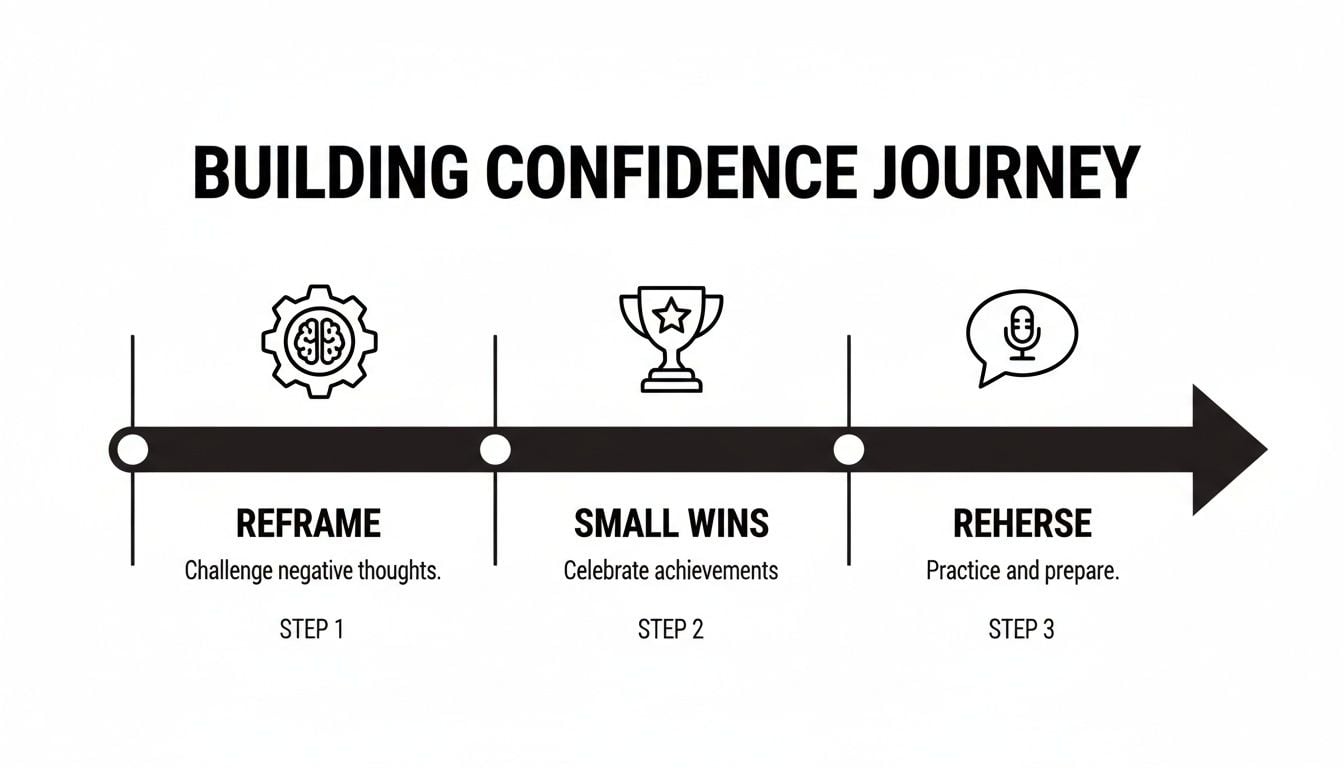
This simple timeline shows how each step builds on the last. You can’t just jump to rehearsal without having the right mindset or a foundation of small successes to stand on. It’s a progressive process.
So, how do you do it? Before a tough conversation, actually say your main points out loud. If you have a big pitch coming up, close your eyes and visualize yourself delivering it with calm authority, smoothly handling any questions that come your way. This isn’t just daydreaming; it builds familiarity, quiets anxiety, and literally carves out the neural pathways for success. It’s the exact same technique elite athletes use to prepare for a championship game.
Even on a macro level, we see this principle at play. When economic forecasts cool, smart professionals double down on what they can control: their own skills. For instance, even with U.S. real GDP growth forecasts slowing to 1.8% for 2026, business leaders have shown measured confidence. In past periods with similar projections (around 1.9% GDP growth), we’ve seen personal development investments rise sharply, with course enrollments jumping 18%. People instinctively know that building their own capabilities is the best bet in any climate. You can discover more about these economic confidence trends and see why self-improvement is always a winning strategy.
Alright, we’ve covered the theory behind confidence—what it is, what gets in its way, and the mental frameworks to change it. But knowledge is only half the battle. The real work, and the real results, come from putting those ideas into practice.
This is where the rubber meets the road.
Your 30-Day Confidence Action Plan

True confidence isn’t built overnight with some grand, heroic act. It’s built brick by brick, through small, consistent actions that prove your capability to the most important person: yourself.
This plan is designed specifically for busy professionals. We’re not adding another huge project to your plate. Instead, we’re focusing on simple, daily micro-practices that slot right into your existing routine. Each week builds on the last, creating a steady momentum that feels empowering, not overwhelming.
Let’s get started.
Week 1: Build Awareness and Challenge Thoughts
Your first seven days are all about becoming a detective of your own mind. The mission is simple: catch the negative self-talk that’s been running on autopilot and start to question its authority. This is the Mindset Reframing Method in action.
Daily Micro-Practice:
- Each day, catch and write down one negative thought that pops into your head. Just one.
- Look at that thought and ask yourself: “Is this 100% true, without a doubt?”
- Now, rewrite it. Reframe it as something more balanced, neutral, or constructive.
For instance, the thought “I’m terrible at networking” becomes, “I’m still figuring out my style for navigating new social events, and every conversation is a chance to practice.” This tiny shift moves you from being a victim of your inner critic to being the one in charge of the conversation.

Week 2: Document Your Small Wins
With a week of mindset work under your belt, it’s time to shift your focus from what feels wrong to what’s going right. Week two is dedicated to the Small Wins Strategy, where you deliberately gather evidence of your own competence.
Confidence is built by keeping the promises you make to yourself. As you consistently check small items off your list, your brain gets a rewarding dose of dopamine, reinforcing the belief that you are someone who follows through.
Daily Micro-Practice:
- At the end of each day, write down one “small win.”
- This could be anything: clearing out your inbox, finally making that phone call you were dreading, or simply choosing not to procrastinate for 15 minutes.
- Nothing is “too small” to count. The win isn’t the task itself—it’s the act of following through on your intention.
This simple habit starts rewiring your brain to actively scan for proof of your effectiveness. A well-studied principle shows this creates a positive feedback loop, making it easier to keep the momentum going.
Week 3: Rehearse for Key Moments
You’ve started managing your thoughts and tracking your wins. Now, let’s get proactive. Week three is all about the Performance Rehearsal Technique, mentally preparing for those moments that usually make you second-guess yourself.
Daily Micro-Practice:
- Pinpoint one upcoming situation that gives you a flutter of anxiety—a presentation, a difficult conversation, or even just a new task.
- Spend just five minutes a day rehearsing for it.
- You can visualize it unfolding successfully, say your key talking points out loud to your dog, or just scribble a few bullet points on a notepad. This isn’t about perfection; it’s about building familiarity to lower the stakes and the anxiety.
Week 4: Expand Your Comfort Zone
In our final week, we put your growing confidence to the test in the real world. The goal isn’t to take a terrifying leap, but to take one small, deliberate step outside your comfort zone. This is how you prove to yourself that you can handle more than you think.
Daily Micro-Practice:
- Do one thing that feels just a little bit uncomfortable.
- Maybe you speak up with an idea in a meeting when you’d normally stay quiet. Perhaps you ask a colleague for help or introduce yourself to someone from another department.
- The key is to act despite the discomfort. That’s the moment you teach your brain that you are capable and resilient.
To help you visualize how these small, daily actions come together, here is a summary of the 30-day challenge.
30-Day Confidence Building Challenge
This table provides a week-by-week overview of the plan, showing how each focus area connects to a concrete daily action. It’s a simple roadmap to turn these concepts into a lived reality.
| Week | Focus Area | Example Micro-Practice |
|---|---|---|
| Week 1 | Mindset & Awareness | Catch one negative thought daily and reframe it into a constructive one. |
| Week 2 | Evidence Gathering | Each evening, write down one “small win” from your day, no matter how minor. |
| Week 3 | Proactive Preparation | Spend five minutes visualizing or rehearsing for an upcoming nervous moment. |
| Week 4 | Behavioral Activation | Do one small thing each day that is just outside your normal comfort zone. |
By the end of these 30 days, you won’t just think you’re more confident—you’ll have a month’s worth of evidence to prove it. This isn’t about a magic transformation; it’s about the powerful, compounding effect of small, consistent effort.
How to Make Confidence Stick for Good
Getting that initial boost of confidence feels great, but the real work—and the real reward—is in making it a permanent part of your professional identity. The frameworks and habits we’ve covered aren’t a one-and-done fix. Think of them as a toolkit you’ll keep coming back to as you navigate the ups and downs of your career.
To make confidence last, you have to change how you think about setbacks. They’re not failures; they’re just part of the game. A missed deadline or a rocky client presentation isn’t a final judgment on your abilities. It’s just a piece of information, giving you clues on what to tweak for next time.
Build Your Inner Circle Wisely
The people you spend your time with can either build you up or wear you down. This has a massive impact on your long-term confidence. Make a conscious effort to surround yourself with colleagues, mentors, and friends who give you honest, constructive feedback and genuinely want to see you succeed.
A great support system is your buffer against the inevitable tough days. They help you reframe a challenge, celebrate a small win, and remind you of your own resilience.
Lasting confidence isn’t about avoiding failure. It’s the quiet, steady belief that you have the skills and the support to get back up, every single time. It’s a deep trust in your own ability to bounce back.
Another key to making this stick is to stop playing it safe. Your comfort zone is where confidence goes to die. By intentionally stretching yourself with new projects—even just slightly outside what you think you can do—you constantly feed your brain new proof that you can learn, adapt, and handle whatever comes your way.
Where to Go From Here
Your growth is a journey, not a destination. To keep the momentum going, here are a few hand-picked resources that can help you deepen your practice and stay on track.
- Coaching Programs: If you’re looking for structured support and a dedicated accountability partner, a coaching program can make a world of difference. You can explore options at DavidPexa.com.
- Must-Read Books: To really dig into the psychology behind all this, I highly recommend “Mindset” by Carol S. Dweck and “Atomic Habits” by James Clear. They are foundational for understanding growth and building better systems for yourself.
- Community and Content: Keep learning! Continue exploring articles on professional growth and connect with others who are on the same path.
Turning a fleeting feeling of confidence into an unshakable asset is an active process. It’s about how you respond to setbacks, who you keep in your corner, and your willingness to always be learning. Do that, and confidence will become less of a goal and more of just who you are.
Your Top Confidence Questions, Answered
As you start working on your confidence, a few common questions always seem to pop up. Let’s tackle some of the most frequent ones I hear from people who are serious about building genuine, lasting self-belief.
How Long Does It Take to Build Lasting Confidence?
This is probably the number one question I get, and the honest answer is that building real confidence is a marathon, not a sprint. While a focused plan—like the 30-day one we’ve discussed—can create noticeable shifts in just a few weeks, true, resilient self-belief is built over the long haul.
Think of it like getting physically fit. You feel better after a few workouts, but real strength and endurance take months of consistent effort. The goal here is consistency, not speed.
Can You Be Confident and Still Feel Nervous?
Yes, and in fact, you absolutely will. This is a huge misconception. True confidence isn’t about eliminating fear or nerves; it’s about trusting your ability to perform despite them.
Even the most seasoned public speakers get butterflies before walking on stage. The difference is, their confidence isn’t in feeling perfectly calm. It’s in knowing they have the skills and preparation to handle the situation effectively, even with a case of the nerves.
What Is the Difference Between Confidence and Arrogance?
This is a crucial distinction. Confidence comes from a place of quiet self-assurance. It’s grounded in a realistic understanding of your strengths and weaknesses, and it leaves room for humility and learning. It’s an internal feeling.
Arrogance, on the other hand, is usually a loud, external performance designed to cover up deep insecurities. It’s about an inflated sense of self and a refusal to acknowledge faults. Confidence is a sturdy foundation; arrogance is a flashy, hollow facade.
Is “Fake It Till You Make It” Good Advice?
It can be, but only if you understand what it really means. It’s not about being phony or pretending to be someone you’re not. It’s about practicing the behaviors of a confident person.
Think of it as “acting as if.” When you stand taller, make eye contact, and speak more deliberately, you’re not just putting on a show. You’re sending signals to your own brain that help forge new neural pathways. Over time, these behavioral rehearsals can lead to a genuine shift in how you feel inside.
Ready to build a structured approach to your personal growth? The team at David Pexa offers practical strategies and curated resources to help you upgrade how you think and live. Discover actionable frameworks and clear guidance by visiting https://davidpexa.com.
