


Summary: Essentials of Understanding Psychology: Unlock Mental Clarity — a practical breakdown of what matters, what doesn’t, and what to do next.
You don’t need a psychology degree to understand why people do what they do. But having a few key frameworks changes how you see every interaction.
When you boil it down, psychology isn’t just about theories you’d find in a dusty textbook. It’s the closest thing we have to a user manual for the human brain. Learning its essentials gives you a practical set of tools for making sense of your own mind and the world you live in. With these core principles in hand, you can start living with more purpose and less confusion.
Why Understanding Psychology Is Your Everyday Superpower

Ever found yourself wondering why you put off important work, even when you know you shouldn’t? Or why a simple conversation can sometimes leave you feeling completely drained? Psychology helps explain these moments, reframing them not as personal flaws, but as predictable—and understandable—patterns of human behavior. It’s the science dedicated to uncovering the “why” behind what we think, feel, and do.
Think about it this way: your mind is constantly running complex programs in the background. If you don’t have a clue how it all works, you’re stuck just reacting to whatever pops up. Getting a handle on psychology is like finally being given the admin password. Suddenly, you can start to debug old habits, uninstall unhelpful ways of thinking, and upgrade your mental software for a much smoother experience.
A Practical Toolkit for Modern Life
In a world buzzing with endless distractions and pressures, understanding yourself isn’t a soft skill—it’s essential for survival. There’s a reason the global market for psychological services was valued at USD 240 billion in 2025 and is expected to hit USD 420 billion by 2033. As a society, we’re waking up to the need to prioritize our mental well-being, both at home and at work. You can explore this trend in more detail in the full analysis from Future Data Stats.
Learning these foundational concepts pays off almost immediately in your day-to-day life. It helps you:
- Build Stronger Habits: You can finally see the triggers and rewards that drive your routines, which makes it much easier to build good habits that actually stick.
- Boost Productivity: By spotting the mental roadblocks behind procrastination, you can develop real strategies to stay focused and motivated.
- Improve Relationships: When you understand what drives other people—their fears, desires, and emotional states—you can communicate far more effectively.
Psychology isn’t just for therapists and academics. It’s a practical superpower that gives you a framework for self-improvement, helping you navigate life’s complexities with confidence and purpose.
This guide is designed to be your roadmap. We’ll break down the big ideas into simple, clear strategies, starting with core theories and moving all the way to practical exercises you can use today. You’re about to learn evidence-based techniques to think, feel, and live with a greater sense of awareness and control. Let’s get started on that upgrade.
The Building Blocks of Your Mind
To really get your head around psychology, we first need to look at its major “schools of thought.” These aren’t rival universities, but more like different pairs of glasses for viewing human behavior. Each one gives us a unique angle on why we think, feel, and act the way we do, and no single school has all the answers.
Think of yourself as a detective trying to solve the mystery of your own mind. You wouldn’t just look for fingerprints and ignore witness statements. You’d gather every piece of evidence you could. In the same way, these psychological frameworks are the different tools you need to build a complete picture.
From Unconscious Drives to Observable Actions
Let’s start with one of the most famous (and sometimes infamous) schools: Psychoanalysis. You’ve probably heard of its founder, Sigmund Freud. His big idea was that our actions are often guided by unconscious desires, fears, and memories, most of which trace back to our childhood. He famously used the iceberg analogy: our conscious mind is just the small tip we see, while the enormous, hidden mass below the surface is our unconscious.
From this perspective, someone’s chronic procrastination might not be simple laziness. It could be an unconscious fear of failure they picked up years ago. The goal of psychoanalysis is to bring those hidden motivations into the light, giving you the insight to resolve those deep-seated conflicts.
But not everyone was sold on digging into the unseen. A new school of thought called Behaviorism came along with a radically different approach. Pioneers like B.F. Skinner argued that psychology should be a science of the observable. Forget the unconscious—let’s just study what people actually do and how their environment shapes those actions through rewards and punishments.
Behaviorism is the science behind your habits. Think about how you automatically reach for your phone when you feel a pang of boredom. The trigger (boredom) leads to an action (scrolling) that gives you an immediate reward (a dopamine hit). That’s a classic behavioral loop. Once you see this, you can start designing new loops, like tying your morning coffee ritual to a five-minute journaling session to build a better habit.
This framework is incredibly practical. It explains how we form associations—like the rush of happiness from a song that was popular in your teens—and how reinforcement can either build good habits or break bad ones. It’s less concerned with why you feel a certain way and more focused on the external triggers that dictate what you do next.
The Mind as a Computer
Focusing only on behavior left a lot of questions unanswered. What about thinking, memory, and perception? This gap led to the Cognitive Revolution, which brought the focus back inside the mind, but with a much more systematic approach than psychoanalysis. It draws a powerful analogy: the human mind is like a computer, processing information through specific mental programs.
This school zooms in on our internal software:
- Thinking: How we form ideas and solve problems.
- Memory: How we record information and pull it up later.
- Perception: How we make sense of the signals coming from our eyes and ears.
A cognitive psychologist looking at anxiety, for example, would investigate the thought patterns fueling the emotion. They’d look for “cognitive distortions”—like jumping to the worst-case scenario or believing one mistake makes you a total failure. The goal is to identify and fix these faulty lines of code to change the emotional output. This is the very foundation of Cognitive Behavioral Therapy (CBT), one of the most effective modern therapies.
A Practical Look at Major Schools of Psychology
So, which school is right? The answer is that they all offer a valuable piece of the puzzle. They work best together, not in opposition. To make this crystal clear, this table breaks down their different approaches.
| School of Thought | Core Focus | Practical Application Example |
|---|---|---|
| Psychoanalysis | Unconscious drives, past experiences, and internal conflicts. | Exploring how a deep-seated fear of rejection from childhood might be influencing your adult relationships. |
| Behaviorism | Observable actions and how they are shaped by environmental rewards and consequences. | Using a reward system, like treating yourself to a movie after a week of consistent gym sessions, to reinforce a new habit. |
| Cognitive Psychology | Mental processes like thinking, memory, perception, and problem-solving. | Challenging negative self-talk (e.g., “I’m a failure”) by looking for evidence that contradicts the thought. |
By getting to know these foundational ideas, you’re building a much richer, more flexible toolkit for understanding yourself and others. You can start to see how your past echoes in your present (psychoanalysis), how your environment quietly guides your habits (behaviorism), and how your thoughts directly create your feelings (cognitive). Holding these perspectives at once is a huge step toward psychological literacy.
Why Your Brain Takes Shortcuts (And How It Can Lead You Astray)
Your brain is a powerhouse, but it’s also wired for efficiency. To conserve precious mental energy, it relies on a whole set of mental shortcuts—what psychologists call cognitive biases—to make snap judgments. While these shortcuts help us navigate thousands of tiny decisions every day, they can also lead to significant errors in thinking that affect our work, relationships, and even how we see ourselves.
Think of it like flying on autopilot. Most of the time, this system works beautifully, guiding you through your day without a hitch. But every so often, the autopilot misreads the signals and veers off course. Learning to spot these biases is like a pilot learning to recognize when the system is glitching so they can grab the controls and make a better call.
Spotting Common Biases in Your Daily Life
These mental shortcuts aren’t just abstract theories; they’re running in the background of your mind all day long. One of the most pervasive is Confirmation Bias, which is our natural tendency to hunt for, and favor, information that proves what we already believe.
Let’s say you have a nagging feeling your boss is unhappy with your work. Confirmation bias will have you fixating on every curt email or missed “good morning,” while conveniently filtering out the praise you received in last week’s team meeting. You end up reinforcing a belief that might not even be true.
Another big one is the Availability Heuristic. This shortcut convinces us that if we can recall something easily, it must be important or common. For example, after seeing a week of dramatic news coverage about a shark attack, you might feel a surge of fear about swimming at the beach. Even though your statistical odds of being attacked are incredibly low, the vivid, easily-available memory makes the threat feel much more real than it is.
These mental processes are exactly what different schools of psychology, like behaviorism and cognitive psychology, seek to explain. They provide the frameworks for understanding how our minds operate.
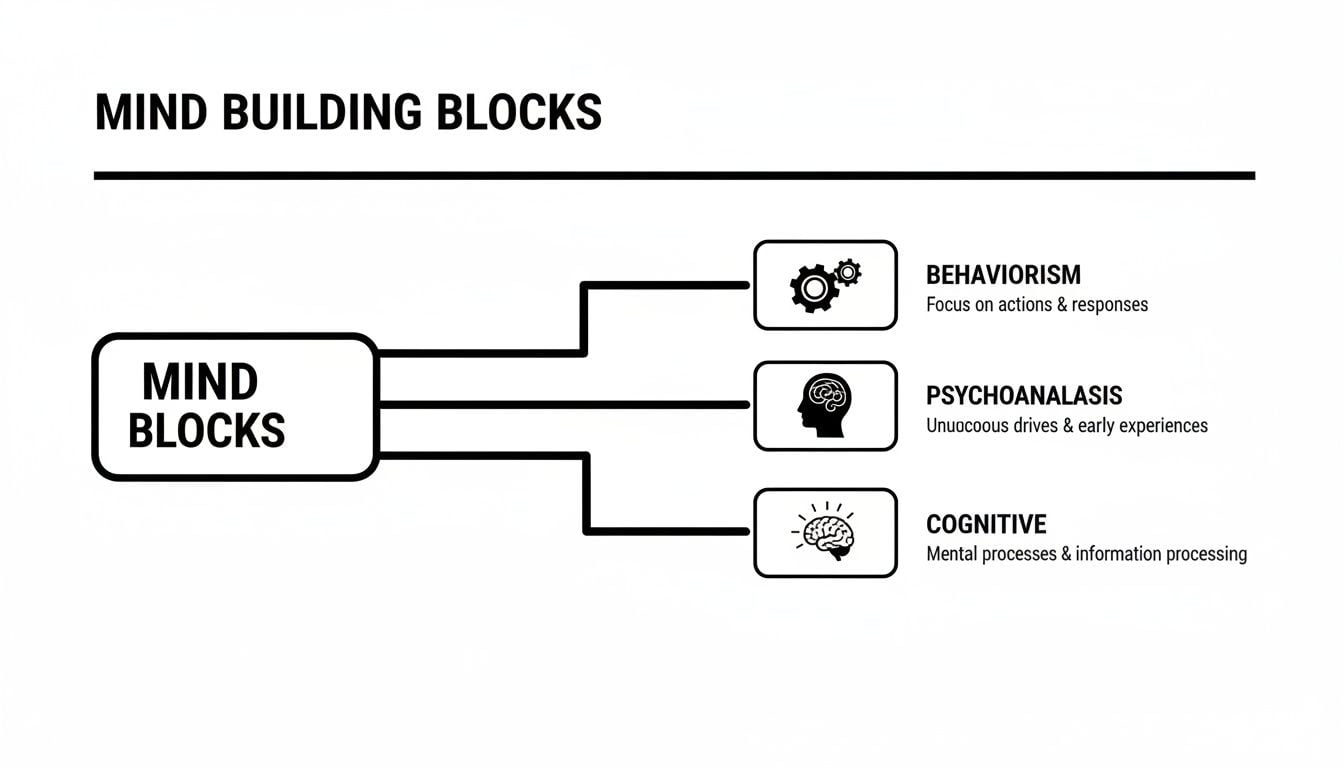
As you can see, these major theories are the building blocks of modern psychology, and the cognitive approach is especially helpful for digging into the mental shortcuts we all use.
The Dunning-Kruger Effect and the Illusion of Expertise
Have you ever met a total beginner who speaks with the unshakeable confidence of a seasoned expert? You’ve likely witnessed the Dunning-Kruger Effect in action. This is a fascinating bias where people with low ability in a certain area dramatically overestimate their own competence.
Why? Because the very knowledge they lack is what would allow them to spot their own mistakes.
This is often called the “peak of Mount Stupid”—that treacherous place where a little bit of knowledge feels like mastery. On the flip side, true experts often do the opposite; they underestimate their own abilities because they’re acutely aware of how vast and complex their field truly is.
Understanding concepts like this is becoming more mainstream. We’re seeing a massive cultural shift toward prioritizing mental fitness, which is reflected in the economics of the U.S. behavioral health market. Valued at USD 96.9 billion in 2025, it’s projected to soar to USD 159.35 billion by 2035. This growth signals that we’re finally treating our mental processes with the same seriousness as our physical health. You can learn more about this trend by exploring the mental wellness growth in the U.S. behavioral health market.
Simple Strategies to Debug Your Thinking
Here’s the good news: you’re not doomed to be a victim of your brain’s lazy habits. Once you’re aware of these patterns, you can start to actively “debug” your own thinking. The first step, as with so many things, is simply noticing.
Here are a few practical ways to challenge these biases:
- Actively seek out disagreement. To combat confirmation bias, make an effort to find opinions that challenge your own. Genuinely ask, “What if I’m wrong about this? What would that look like?”
- Think in probabilities, not just possibilities. When the availability heuristic strikes, step back from the vivid mental image. Instead of asking “How easily can I imagine this?” ask, “How likely is this, statistically?”
- Embrace a learner’s mindset. The best defense against the Dunning-Kruger effect is curiosity. Acknowledge that you always have more to learn, and actively seek feedback from people with more experience.
By putting these mental debugging techniques into practice, you can shift from being unconsciously led by faulty shortcuts to making more deliberate, clear-headed choices. It’s an essential skill for anyone looking to gain an edge in their personal and professional life.
Understanding Your Engines of Action: Motivation and Emotion
Ever wonder why you can pour endless energy into one project, while another feels like an uphill battle through thick mud? The answer almost always comes down to two of the most powerful forces in our psychological toolkit: motivation and emotion.
These twin drivers are behind nearly everything we do, from the simple act of rolling out of bed to chasing our biggest life goals. Getting a real handle on how they operate is fundamental. It’s the difference between spinning your wheels with vague advice like “just be more motivated” and actually using proven principles to fuel your drive and navigate your feelings. So, let’s get into the science of what truly gets you moving.
The Two Types of Fuel: Intrinsic vs. Extrinsic Motivation
Not all motivation is created equal. It really comes in two distinct flavors, and knowing which one you’re running on is key to building habits that last.
-
Extrinsic Motivation: This is the drive that comes from the outside world. Think of rewards and punishments: working hard for a bonus, studying to dodge a bad grade, or cleaning the house because guests are coming over. It’s a powerful short-term push, but it often has a short shelf life.
-
Intrinsic Motivation: This is the stuff that comes from within. You do something simply because you find it fascinating, fun, or deeply satisfying. It’s reading a book on a topic you’re obsessed with, playing guitar just for the joy of it, or getting lost in a puzzle for the thrill of the solution.
Think of extrinsic motivation as a shot of caffeine. It gives you a quick, effective jolt, but it wears off, and you eventually need another hit from an outside source. Once the reward is gone or the threat disappears, the motivation often vanishes with it.
Intrinsic motivation, on the other hand, is like a well-tended garden—it’s sustainable and generates its own energy from your genuine interests. While both types have their place, an over-reliance on external rewards is a classic recipe for burnout. The real trick is to tie your goals, even the boring ones, to something you find genuinely meaningful.
Your Emotions Are Data, Not Directives
One of the biggest mistakes people make is labeling their emotions as “good” or “bad.” A far more powerful way to think about them is as data signals from your brain. They are pure information, not commands you have to obey.
Anxiety isn’t just a “bad” feeling; it’s a signal that your brain is flagging a potential future threat. Sadness isn’t a sign of weakness; it’s your system’s way of processing a loss. Instead of trying to ignore or suppress these feelings, the goal is to get curious and interpret the data. What is this anxiety trying to warn me about? What loss is this sadness connected to?
By seeing emotions as messengers, you stop simply reacting to them and start responding thoughtfully. This shift in perspective is the first step toward true emotional regulation.
There’s a fantastic cognitive strategy for this, sometimes called “Name It to Tame It.” The next time you feel a powerful emotion like anger or anxiety bubbling up, just pause and label it in your mind: “This is anxiety,” or “I’m feeling frustrated right now.” This simple act of naming activates the more logical, rational parts of your brain, creating a bit of psychological distance. That tiny gap gives you the breathing room to decide how you want to act, rather than being swept away by the feeling. A great way to get better at this is to use an emotions chart to better identify and name your feelings.

Practical Hacks to Conquer Procrastination
When you understand the mechanics of motivation, you can start to diagnose why you procrastinate. It’s rarely about being lazy. More often, we put things off because the task feels too big, too boring, or just plain overwhelming. We simply lack the “activation energy” to get started.
This is the perfect scenario to deploy a brilliantly simple psychological trick: the “Two-Minute Rule.” Popularized by author James Clear, the idea is to shrink any new habit or dreaded task into something that takes less than two minutes.
- Want to build a reading habit? Don’t commit to a full chapter. Just commit to reading one page.
- Want to start running? Don’t pressure yourself to run for 30 minutes. Just commit to putting on your running shoes and stepping outside.
The point isn’t to finish the task; it’s just to start it. By making the first step almost laughably easy, you dissolve the mental resistance that keeps you stuck. You make it harder to say “no” than to just do it. And more often than not, once you’ve taken that tiny first step, a little bit of momentum kicks in and carries you forward. It’s a perfect, practical example of using psychology to outsmart your own brain.
The Psychology of Learning and Personal Change
Knowing why you want to change is a huge step, but it’s only half the battle. How do you turn that self-awareness into real, lasting change? This is where the psychology of learning provides a blueprint, showing us exactly how we build habits and learn new skills.
This isn’t about finding some hidden reserve of willpower, which, let’s be honest, is a resource that runs out. It’s about being smarter than your own brain’s old programming. You can learn to architect your environment and set up reward systems that make success almost automatic. You become the designer of your growth, not just a passenger along for the ride.
Shaping Your Habits with Classical Conditioning
You’ve probably heard of Pavlov and his dogs. But classical conditioning isn’t just some dusty old experiment—it’s a force that shapes your behavior every single day. This is the kind of learning that happens when your brain links two things together. Think about how the specific notification sound from your phone can make you feel a jolt of excitement or anxiety before you even see the message. The sound is now tied to the emotion.
We can put this to work for us by intentionally creating environmental triggers that kick off the right behaviors.
- Want to exercise first thing in the morning? Lay out your running shoes and workout clothes right next to your bed the night before. That visual cue becomes the trigger to get moving, no internal debate required.
- Trying to drink more water? Get a water bottle you love and keep it full on your desk. Its presence becomes a constant, subtle reminder to take a sip, creating a healthy new reflex.
When you engineer your surroundings this way, you take the burden off your decision-making muscle. Your environment does the heavy lifting, creating an automatic response that serves you.
Using Operant Conditioning to Reward Progress
While classical conditioning is about linking two stimuli (like a bell and food), operant conditioning is about linking a behavior to a consequence. B.F. Skinner figured out something simple but profound: behaviors that are followed by a reward are more likely to happen again. Behaviors followed by a punishment (or no reward at all) tend to fade away. This is the engine of habit formation.
You can use this immediately by creating a personal reward system for your new habits.
The trick is to make the reward immediate and genuinely satisfying. If you power through a tough project, don’t just promise yourself a break “later.” Reward yourself right away with something you actually enjoy, like 20 minutes of your favorite podcast or a walk outside. This creates a powerful, positive feedback loop in your brain that says, “Hey, do that again!”
This works so well because it taps directly into your brain’s natural reward system. If you want to dive deeper into practical strategies like this, our guide on Cognitive Behavioral Therapy techniques offers a whole toolkit for reshaping both your thoughts and actions. The need for these skills is growing, too; the global market for psychologists and counselors was valued at USD 74.6 billion in 2026, with North America having the largest share and the Asia-Pacific region growing the fastest. It’s clear there’s a worldwide shift toward investing in mental well-being, and you can discover more about the psychologist and counselor market on Kentley Insights.
Your Brain Can Change at Any Age
For decades, we thought the adult brain was more or less set in stone. We now know that couldn’t be further from the truth. The discovery of neuroplasticity is one of the most empowering ideas in all of neuroscience. It means your brain has an incredible, lifelong capacity to rewire itself by forming new connections.
Every single time you practice a new skill, repeat a new habit, or even challenge an old belief, you are physically changing your brain’s structure. It’s like forging a new path through a dense forest. The first time is tough going, and you have to push through the undergrowth. But each time you walk that same path, it gets wider, clearer, and easier to travel, until it becomes your brain’s preferred route.
This is precisely why consistency is everything. You aren’t just “building momentum”—you are literally strengthening the neural circuits for your new behavior. Knowing this can be a huge source of motivation. It’s scientific proof that you are never too old or too stuck to change. The actions you take today are actively sculpting the brain you’ll have tomorrow.
Your Personal Growth Toolkit

Knowing the theory is great, but applying it is where the real changes happen. Let’s take everything we’ve talked about and turn it into a practical toolkit you can start using today. This isn’t just a recap; these are simple, powerful exercises to weave these psychological concepts into your daily life.
Think of this as your personal lab for self-improvement. By intentionally using these tools, you stop being a passive observer of psychology and start actively using it to sharpen your focus, strengthen your relationships, and boost your well-being. This is where the essentials of understanding psychology come to life.
Your Daily Bias Check-In
Your brain’s mental shortcuts are working all the time, which means your awareness needs to be just as consistent. The ‘Daily Bias Check-In’ is a quick, five-minute exercise designed to sharpen your decision-making and get you in tune with your own thought patterns.
At the end of your day, just take a moment to reflect on a few decisions you made. Ask yourself:
- Confirmation Bias Check: Did I look for information that challenged my initial gut feeling, or did I just hunt for evidence that confirmed I was right?
- Availability Heuristic Check: Was my decision swayed by a recent, vivid memory, or did I consider the bigger picture and the actual data?
- Emotional Influence Check: What was my mood when I made this choice? How might those feelings have nudged me toward a certain conclusion?
The point isn’t to beat yourself up over past choices. It’s about training your brain to recognize its own habits, making you a clearer, more objective thinker over time.
This simple routine builds the muscle for making better decisions tomorrow. If you want to dive deeper into this, we have more strategies in our guide on how to improve mental clarity to help you build a more focused mind.

Your Weekly Motivation Audit
Motivation isn’t a gas tank you can just fill up; it’s more like a sail you have to constantly adjust to catch the wind. The ‘Weekly Motivation Audit’ is a ritual to make sure your day-to-day actions are actually aligned with what truly drives you. This is the secret to sustaining effort without burning out.
Set aside 15 minutes every week—maybe Sunday evening—to review your goals and tasks.
- List Your Top 3 Goals: What were the most important things you worked on this week?
- Identify the ‘Why’: For each one, name the main driver. Was it intrinsic (you did it because of genuine interest, passion, or personal values) or extrinsic (you did it for a reward, to meet a deadline, or because someone else expected it)?
- Analyze and Adjust: Is your to-do list running purely on external pressure? If so, think about how you can connect those tasks to something that matters to you personally. Find one small way to tie an extrinsic goal to an intrinsic value for the week ahead.
This audit is all about proactively managing your energy. It shifts your focus from just getting things done to doing things that feel meaningful, which is the key to creating momentum that lasts.
If this resonated, go deeper. My book Love, Success, Freedom and Boundaries gives you twelve frameworks for seeing the patterns that shape your life — and changing the ones that aren’t working.
Frequently Asked Questions
What are the essential concepts in psychology?
The fundamentals include cognitive biases (how your brain shortcuts), conditioning (how behaviors are learned), attachment styles (how you relate to others), and defense mechanisms (how you protect yourself from pain). These four explain most human behavior.
Is psychology just common sense?
It often seems like common sense after you learn it. But before learning it, most people misread behavior consistently — attributing to character what’s actually driven by situation, or to choice what’s actually driven by conditioning. Psychology corrects those misreadings.
How do I apply psychology in everyday life?
Start by observing without judging. When someone does something confusing, ask “what would make this behavior make sense?” instead of “what’s wrong with this person?” That single shift changes everything.
Keep Reading
- Unlock Your Mind: Understanding Psychology
- Best Standing Desks for Home Office: Top Picks for Comfort and Productivity
- The 8 Best Productivity Timers on Amazon to Boost Your Focus
Conclusion
Understanding is the first step, but it’s what you do with that understanding that changes things. The ideas in this article aren’t meant to sit in your head — they’re meant to shift how you see your situation and give you something concrete to act on. Start with the one thing that felt most relevant, apply it this week, and notice what changes.
If this resonates, the full framework lives in Love, Success, Freedom and Boundaries.
A practical playbook for raising emotionally resilient kids — and breaking the patterns you didn’t choose to inherit.
