



Summary: Guided Focus: guided meditation for focus to boost clarity — a practical breakdown of what matters, what doesn’t, and what to do next.
I resisted meditation for years because I thought it meant sitting still and thinking about nothing. Guided meditation for focus is different — it’s more like a workout for your attention.
Guided meditation for focus is less about emptying your mind and more about giving it a specific job to do. Think of it as a practical, brain-training tool where you use audio cues to sharpen your attention. Instead of getting lost in a sea of thoughts, you simply follow a narrator’s instructions, usually guiding you to concentrate on an anchor like your breath.
This simple act strengthens your ability to tune out the noise and zero in on what matters, both during the session and long after.
How Guided Meditation Unlocks Immediate Focus

In a world filled with endless notifications and sprawling to-do lists, finding genuine focus can feel like an uphill battle. This is where a guided meditation for focus steps in, offering a structured, actionable way to train your brain for better concentration.
It’s truly a workout for your mind. Just as you’d lift weights to build physical muscle, you use this practice to strengthen your “focus muscle”—the part of your brain known as the prefrontal cortex.
The Science Of A Sharper Mind
The goal here isn’t to force your thoughts into silence, which is a near-impossible task for most of us. The real magic happens in the moments when your mind inevitably wanders. The guided voice serves as a gentle nudge, prompting you to bring your attention back to your anchor, like the physical sensation of your breath.
Every time you catch your mind drifting and consciously guide it back, you’re actively reinforcing the neural pathways responsible for attention. This isn’t just theory; it delivers tangible, almost immediate results.
Research has shown that even a single, short session can lead to measurable improvements. A compelling 2018 study found that people who listened to a 13-minute guided meditation performed significantly better on challenging cognitive tasks afterward. Their accuracy only dipped by 4%, whereas the group that didn’t meditate saw their accuracy fall by 8%. You can explore the full research on guided meditation’s cognitive benefits and see the data for yourself.
Key Takeaway: The power of guided meditation isn’t in achieving a perfectly still mind. It’s in the repeated practice of noticing your mind has wandered and gently bringing it back.
More Than Just Concentration
This practice does more than just sharpen your focus; it also lays the groundwork for better mental clarity and emotional balance. By intentionally carving out a small pause in your day, you begin to clear out the mental clutter that often fuels stress and makes it easy to get distracted.
Here’s what that looks like in practical terms:
- Reduced Mental Fatigue: Just a few minutes can feel like a mental reset, allowing you to return to your work with renewed energy.
- Improved Task Switching: You’re training yourself to consciously shift your attention, which makes it easier to move between different projects without losing your rhythm.
- Greater Self-Awareness: You start to notice your own mental habits, like when you’re most likely to get sidetracked, giving you the power to change them.
Ultimately, making guided meditation a regular habit is a smart move for anyone looking to gain a mental edge. If this resonates with you, you might find our guide on how to improve mental clarity particularly useful.
Setting the Stage for Unwavering Focus
Before you press play on a guided meditation, take a couple of minutes to set up your space. This isn’t about creating a perfectly silent, zen-like sanctuary. It’s simply about making a few conscious choices to reduce interruptions and tell your brain it’s time to shift gears.
Whether you’ve got a dedicated room or just the corner of a noisy office, the principle is the same: create a bubble of intention. Silence your phone and computer notifications. If you’re around other people, noise-canceling headphones are a game-changer for blocking out unexpected chatter or sounds. For a deeper dive into this, check out our practical guide on how to eliminate distractions.
Find a Posture That Keeps You Alert
How you hold your body has a direct line to your mental state. Lying down feels comfortable, but for focus meditation, it’s often a fast track to dreamland—which kind of misses the point. The goal here is alert concentration, and for that, sitting upright is almost always better.
Here’s a quick look at why:
| Posture | The Good | The Catch |
|---|---|---|
| Sitting Upright | Keeps your mind sharp and engaged. | Might feel a bit stiff at first. |
| Lying Down | Great for pure physical relaxation. | You’ll probably just fall asleep. |
Find a comfortable seat where you can keep your spine straight without being rigid. I like to imagine a string gently pulling the top of my head toward the ceiling. This posture opens up your lungs for deeper breaths and sends a subtle but powerful message to your brain: “Stay awake. Pay attention.”
Get Your Head in the Game
Honestly, the most important part of your “space” is what’s happening between your ears. So many people jump into meditation thinking the goal is to have a completely blank mind. When thoughts inevitably pop up, they get frustrated and feel like they’ve failed.
That’s not it at all.
The real work isn’t stopping your mind from wandering. It’s the practice of gently bringing it back, without judgment, every single time it strays.
Think of each distraction as a rep at the mental gym. When your mind drifts to a looming deadline or that email you forgot to send, that’s your cue. Your job is to simply notice it—no criticism, no drama—and gently redirect your attention back to your breath or the guide’s voice. This act of noticing and returning is precisely how you build your focus muscle. Each time you do it, you’re strengthening your ability to control where your attention goes, both in meditation and out in the real world.
A Practical Meditation Script to Sharpen Your Concentration
Alright, let’s put this into practice. Here’s a complete, ready-to-use guided meditation script designed to train your focus. I’ve broken it down into three simple parts to help you settle in, anchor your attention, and then get back to your day feeling sharper.
You’ll find simple, direct cues for breathing and body awareness. But the real secret sauce is in how you handle those inevitable wandering thoughts. The goal here isn’t to wrestle your mind into submission; it’s to notice when it drifts and gently guide it back.
Getting Settled (The First 2 Minutes)
(Find a comfortable, upright posture. Set a timer if that helps you relax, and when you’re ready, either read these cues to yourself or have someone read them to you.)
-
“Let’s begin. Gently close your eyes or let your gaze soften, resting on a spot a few feet in front of you. Take three slow, deep breaths. Breathe in through your nose, letting your belly expand… and then exhale slowly through your mouth, releasing whatever tension you’re holding.”
-
“With that second breath, feel your shoulders drop away from your ears. Just let go of the day’s rush. On the third exhale, feel your body becoming heavy, fully supported by the chair or cushion beneath you.”
-
“Now, bring your awareness to the physical sensations of your body. Notice the points of contact—your feet on the floor, your hands in your lap, the support against your back. Simply feel what it’s like to be right here, right now.”
Anchoring Your Focus (The Core 5-10 Minutes)
Now that you’re settled, we get to the heart of the practice. It’s a simple exercise, but it requires a bit of gentle persistence.
-
“Gently shift your attention to the natural rhythm of your breath. Don’t try to change it in any way. Just observe the sensation of the air entering your nostrils… the rise of your chest and belly… and the fall as you exhale.”
-
“Now, pick one specific sensation to be your anchor point. This could be the coolness of the air at the tip of your nose or the gentle expansion of your rib cage. Let this be the one spot you come back to, over and over.”
-
“Your mind is going to wander. That’s what minds do. When you notice your attention has drifted off to a thought, a sound, or a feeling, the entire practice is to simply acknowledge it without judgment. You might silently say to yourself, ‘thinking,’ and then kindly, gently, guide your awareness back to your anchor point—back to the breath.”
-
“Every single time you bring your focus back, you are strengthening your ability to concentrate. Think of it as a bicep curl for your brain. The thought isn’t a failure; it’s the opportunity to do another rep.”
The real work of this meditation isn’t in maintaining perfect, unbroken focus. It’s in the gentle, repeated act of noticing your mind has wandered and guiding it back to your breath without any frustration.
Returning with Clarity (The Final Minute)
How you end your session is just as important as how you start. This transition is key to carrying the clarity you’ve built into the rest of your day.
-
“Okay, gently release your focus on the breath. Let your awareness expand to your entire body again. Feel the air on your skin and notice the space around you.”
-
“When you feel ready, slowly begin to wiggle your fingers and toes. Take one last deep breath in, and as you exhale, gently open your eyes.”
-
“Take just a moment to notice how you feel. A little calmer? A little clearer? See if you can carry this sense of focused presence with you as you move on to your next task.”
This simple process lays the groundwork for an effective practice.
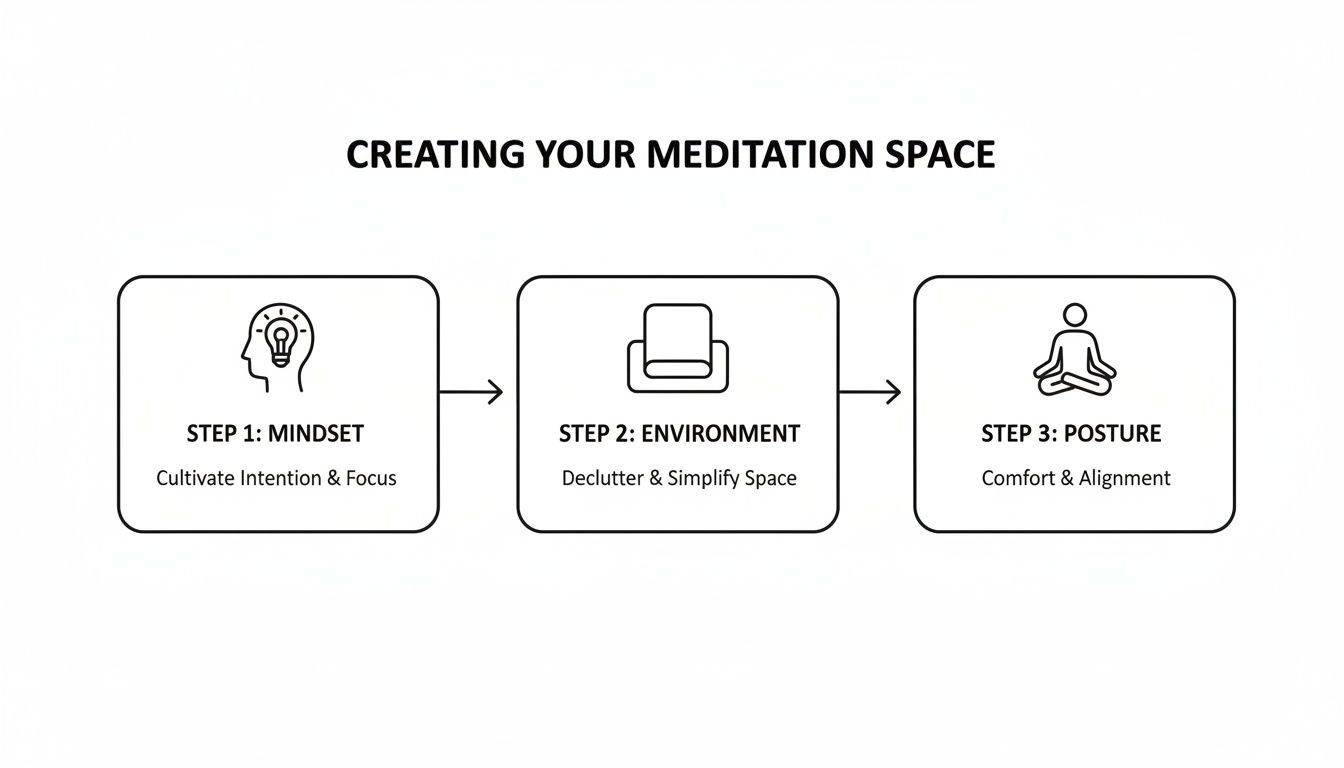
As this shows, a great meditation session starts with the right mindset, followed by creating a space that works for you and finding a comfortable posture.
Making the Script Fit Your Schedule
The best part about this practice is that it’s not rigid. You can easily adapt the script to fit whatever time you have.
- The 5-Minute Focus Reset: This is my go-to for a quick mental boost between meetings. Just shorten the “Anchoring Your Focus” part to about three minutes. The goal is a quick reset, not a deep dive.
- The 15-Minute Deep Work Primer: Got a demanding project ahead? Use this version. Extend the “Anchoring Your Focus” section to 12-13 minutes. This gives your mind more time to settle and builds a much stronger foundation for sustained concentration.
Weaving Meditation Into Your Productivity Workflow

A guided meditation for focus is a powerful tool, but its real magic kicks in when it becomes a consistent part of your life. The biggest hurdle for most people isn’t finding five or ten minutes—it’s making those minutes a non-negotiable part of their day.
The secret is to stop treating it like another task on your to-do list and start weaving it directly into the routine you already have.
This is where a simple but brilliant technique called habit stacking comes in. The idea is to pair your new meditation habit with something you already do on autopilot. By linking the two, your existing habit becomes the trigger for your meditation session, making it far more likely to stick.
Anchoring Your Practice to Your Day
Instead of vaguely promising yourself you’ll meditate “later,” pin it to a specific moment. This gives your brain a concrete cue that’s almost impossible to ignore.
Think about these real-world examples:
- Morning Kickstart: Practice right after your first sip of coffee. The ritual of brewing that morning cup becomes the signal to fire up a five-minute focus session.
- Pre-Work Primer: Meditate for ten minutes just before you open your laptop to start the workday. This creates a clean mental break between your personal time and professional responsibilities.
- Post-Work Decompression: As soon as you close your laptop for the day, start a guided meditation. It’s a fantastic way to mentally “clock out” and stop work stress from spilling into your evening.
The growing popularity of meditation for focus isn’t just a trend; it’s backed by solid data. The number of U.S. adults who meditate more than doubled, jumping from 7.5% in 2002 to 17.3% in 2022. This spike makes sense when you look at the research showing how mindfulness slashes the stress and anxiety that kill concentration. You can discover more insights on meditation’s effectiveness to see just how validated this practice is.
The goal isn’t to find time for meditation; it’s to make it an integral part of the time you already have. Link it to an existing habit, and consistency becomes almost effortless.
Using Meditation as a Strategic Tool
Don’t just think of meditation as a daily ritual. Start seeing it as a precision tool you can deploy at critical moments to boost your productivity. It’s your on-demand reset button for your brain.
Here’s how to use it strategically throughout your day:
- The Mid-Project Reset: Feeling stuck or overwhelmed by a complex task? A five-minute session can break that cycle of frustration and give you a fresh perspective when you return.
- The Meeting Warm-Up: Before a high-stakes presentation or an intense brainstorming session, a quick meditation can calm your nerves and sharpen your mental clarity. You’ll walk in feeling centered and ready.
- The Energy Dip Rescue: Instead of grabbing that third cup of coffee during the afternoon slump, try a guided focus meditation. It’s a powerful way to fight mental fatigue and a key part of effective energy management solutions.
By embedding these short sessions into your schedule, meditation stops being a chore and becomes a core part of your high-performance toolkit—just as essential as planning your day or getting a good night’s sleep.
To make this even more practical, here’s a sample schedule showing how you can fit these sessions into a busy week.
Sample Weekly Meditation Integration Plan
This table illustrates how you can easily slot in different types of focus meditations to align with your daily demands and energy levels.
| Day | Time Slot | Meditation Type | Goal |
|---|---|---|---|
| Monday | 9:00 AM | 10-min Focus Script | Start the week with clear intention and focus. |
| Tuesday | 1:00 PM | 5-min Breathing Session | Overcome the post-lunch energy dip. |
| Wednesday | 8:30 AM | 10-min Focus Script | Prime the mind before a day of deep work. |
| Thursday | 4:00 PM | 5-min Breathing Session | Reset attention before the last hour of work. |
| Friday | 5:00 PM | 10-min Decompression | Transition from work mode to weekend relaxation. |
As you can see, you don’t need to block out huge chunks of time. By strategically placing these short, targeted meditations, you can maintain a high level of focus and energy all week long.
What to Do When Your Mind Won’t Cooperate
Feeling sleepy, restless, or just plain frustrated during your practice? Welcome to the club. Hitting these roadblocks is a completely normal, even expected, part of building any new mental habit. Think of this section as your personal troubleshooting guide for the inevitable bumps in the road.
The most common hurdle by far is the wandering mind. One moment you’re tuned into your breath, the next you’re mentally replaying a conversation from yesterday or planning what to make for dinner. It’s so easy to feel like you’ve failed at this point, but this is precisely where the real training begins.
The “Empty Mind” Is a Myth
Let’s get one thing straight: the goal of this meditation isn’t to achieve a perfectly silent mind. It’s about strengthening your ability to notice when your attention has drifted and gently, without judgment, bringing it back to your anchor—your breath.
Every single time you catch your mind wandering and guide it back, you’ve just completed a mental “rep.” This simple action strengthens the neural networks responsible for attention control. While it can feel frustrating in the moment, neuroimaging shows just how much this persistence pays off. Experienced meditators have less age-related gray matter decline, especially in the brain regions that manage attention. So, that daily effort of redirecting your thoughts is a real, long-term investment in your cognitive health. You can learn more about the brain benefits of meditation and see how it truly helps preserve focus over a lifetime.
Key Insight: A wandering mind isn’t a sign of failure. It’s an opportunity to strengthen your focus muscle by gently guiding your attention back, over and over again.
Practical Fixes for Common Obstacles
Beyond a busy mind, you might run into other physical or mental hurdles. Don’t let them derail you. Instead, think of them as signals to make a small adjustment.
Here’s how to handle a few frequent challenges:
-
Feeling Sleepy? Adjust Your Posture.
If you find yourself nodding off, your body is probably a little too relaxed. The easiest fix is to get off the comfy couch or bed and move to a straight-backed chair. Sit upright with your feet flat on the floor—this posture encourages alertness without creating tension. Practicing first thing in the morning when you’re naturally more awake can also work wonders. -
Feeling Restless? Try a Moving Meditation.
If sitting still feels absolutely impossible, don’t fight it. Channel that nervous energy into a walking meditation. All you need is a quiet space where you can walk back and forth. Instead of your breath, focus your full attention on the physical sensation of your feet touching the ground—the heel, the ball of the foot, the toes lifting off. This gives your restless body something to do while your mind gets to work training its focus. -
Feeling Bored or Unmotivated? Shorten Your Sessions.
Consistency beats duration, every single time. If a 15-minute session feels like a monumental chore, just switch to a 5-minute practice. Committing to a short, manageable session every day builds the habit far more effectively than struggling through an occasional long one. The trick is to make it so easy you can’t say no.
Got Questions About Using Meditation for Focus?
When you first start exploring guided meditation to sharpen your focus, it’s natural to have a few questions. Getting a handle on the common sticking points can make your practice much more effective and help you know what to expect.
Let’s dive into some of the things people often ask.
How Long Before I Actually Notice a Difference?
This is probably the number one question. The encouraging part is that you’ll likely feel a sense of calm and mental space almost immediately, even after your very first session. Think of it as hitting a quick reset button for your brain.
But what about the deep, lasting improvements in concentration? That takes a bit more consistency. For most people, a real shift in their day-to-day focus starts to become noticeable within two to four weeks of regular practice. Sticking with a 10-minute session about five days a week is a great benchmark.
What’s the “Right” Way to Practice for Better Focus?
People often wonder if they can just pop on a meditation while they work or study. My advice? Don’t. The whole point is to train your attention, and you can’t do that effectively if you’re multitasking.
Instead, be strategic. Use a quick, five-minute meditation before you dive into a big project. It’s a fantastic way to clear the mental clutter and get you primed for deep work. Or, try one during a mid-afternoon break when you feel your energy slumping. It can be just the thing to help you return to your desk feeling refreshed.
A guided meditation for focus isn’t about adding another task to your plate. It’s about sharpening the tool—your mind—that you use for every other task.
Is This Mindfulness or Concentration Meditation? What’s the Difference?
You’ll hear these terms a lot, and while they’re related, they aren’t the same. It’s helpful to know what you’re actually doing.
- Mindfulness Meditation is all about open awareness. You simply observe whatever pops into your head—thoughts, sounds, feelings—without judging or getting attached to them.
- Concentration Meditation is what we’re really digging into here. This is the practice of intentionally holding your attention on a single thing, like the sensation of your breath.
When your mind inevitably wanders during a concentration practice, the “rep” is gently bringing it back. The scripts in this guide are built on concentration techniques, but we weave in mindfulness by encouraging you to be kind and non-judgmental with yourself when distractions show up.
Do I Need a Fancy App or Any Special Gear?
So, do you need to download a special app to get started? Absolutely not. All you really need is a script, like the ones we’ve shared here. You can even record it in your own voice on your phone for a completely personalized guide.
That said, apps can be helpful. They offer timers, a library of different voices and background sounds, and progress trackers that some people find really motivating. But the core practice—guiding your attention—is the same no matter what. The best tool is always the one you’ll actually use. Start simple, see if it sticks, and then decide if an app might help you stay more consistent.
If this resonated, go deeper. My book Love, Success, Freedom and Boundaries gives you twelve frameworks for seeing the patterns that shape your life — and changing the ones that aren’t working.
Frequently Asked Questions
Does meditation actually improve focus?
The research is clear: consistent meditation practice strengthens attention networks in the brain. It’s not mystical — it’s exercise for your prefrontal cortex. Even 10 minutes daily shows measurable improvements within weeks.
What type of meditation is best for focus?
Focused-attention meditation, where you concentrate on a single object (breath, sound, sensation) and redirect your mind when it wanders. Each redirect is the equivalent of one rep in a gym. The wandering isn’t failure; it’s the exercise.
How long do I need to meditate to see results?
Consistency matters more than duration. 10 minutes daily for 30 days will improve your focus more than a single 60-minute session. The brain responds to repetition, not intensity.
Keep Reading
- 7 Best Supplements for Attention and Focus
- Unlock Your Mind: Understanding Psychology
- Essentials of Understanding Psychology: Unlock Mental Clarity
If you do any writing alongside the focus work — journaling, drafting, processing what you’re noticing — the tool I use to draft most of my words is Wispr Flow. It transcribes your voice into clean, edited text in real time, so the friction between thinking it and writing it basically disappears.
Conclusion
Understanding is the first step, but it’s what you do with that understanding that changes things. The ideas in this article aren’t meant to sit in your head — they’re meant to shift how you see your situation and give you something concrete to act on. Start with the one thing that felt most relevant, apply it this week, and notice what changes.
A note on affiliates: This article includes affiliate links to platforms I’ve vetted and would recommend to my own clients and students. If you start with a recommended service through a link here, I may earn a small commission — at no extra cost to you. I only mention what I’d actually point you to in person. The recommendation comes first; the relationship is disclosed second.
If this resonates, the full framework lives in Love, Success, Freedom and Boundaries.
A practical playbook for raising emotionally resilient kids — and breaking the patterns you didn’t choose to inherit.
