



Summary: A practical guide to increase mental stamina and sharpen your focus. What actually works, what doesn’t, and where to start.
Mental stamina isn’t about grinding harder. It’s about building recovery into your process so you can sustain focus when it actually matters.
Pushing through mental fatigue isn’t about sheer willpower. It’s about training a skill, and that skill is built on three core pillars: optimizing your biology, training your focus, and mastering recovery. When you consistently fuel your brain, practice deep work, and give yourself strategic rest, you build the resilience to perform when it counts. This guide is your blueprint for doing just that.
What Mental Stamina Actually Is (And Why It’s a Game-Changer)
We’ve all been there. It’s 3 PM, your brain feels like it’s wading through mud, and even the smallest decision feels like a monumental effort. That’s your mental stamina running on empty.
Mental stamina is more than just gritting your teeth through a long day. It’s your ability to sustain peak cognitive performance, keep your emotions in check, and make sharp decisions—especially when you’re tired, stressed, or up against a tough challenge.
Imagine two project managers facing the same impossible deadline. The one with low stamina gets irritable, makes impulsive calls, and starts avoiding the hardest tasks. The other, with high mental stamina, stays cool, breaks the problem down logically, and keeps their focus sharp right up to the finish line. That’s not a gift they were born with; it’s a strength they built.
The Three Pillars of Mental Endurance
Building this kind of resilience doesn’t just happen. It takes a deliberate approach that treats your mind and body as one interconnected system. It really all comes down to consistently strengthening three fundamental areas.
This visual lays out the simple, powerful framework for building mental endurance that lasts.
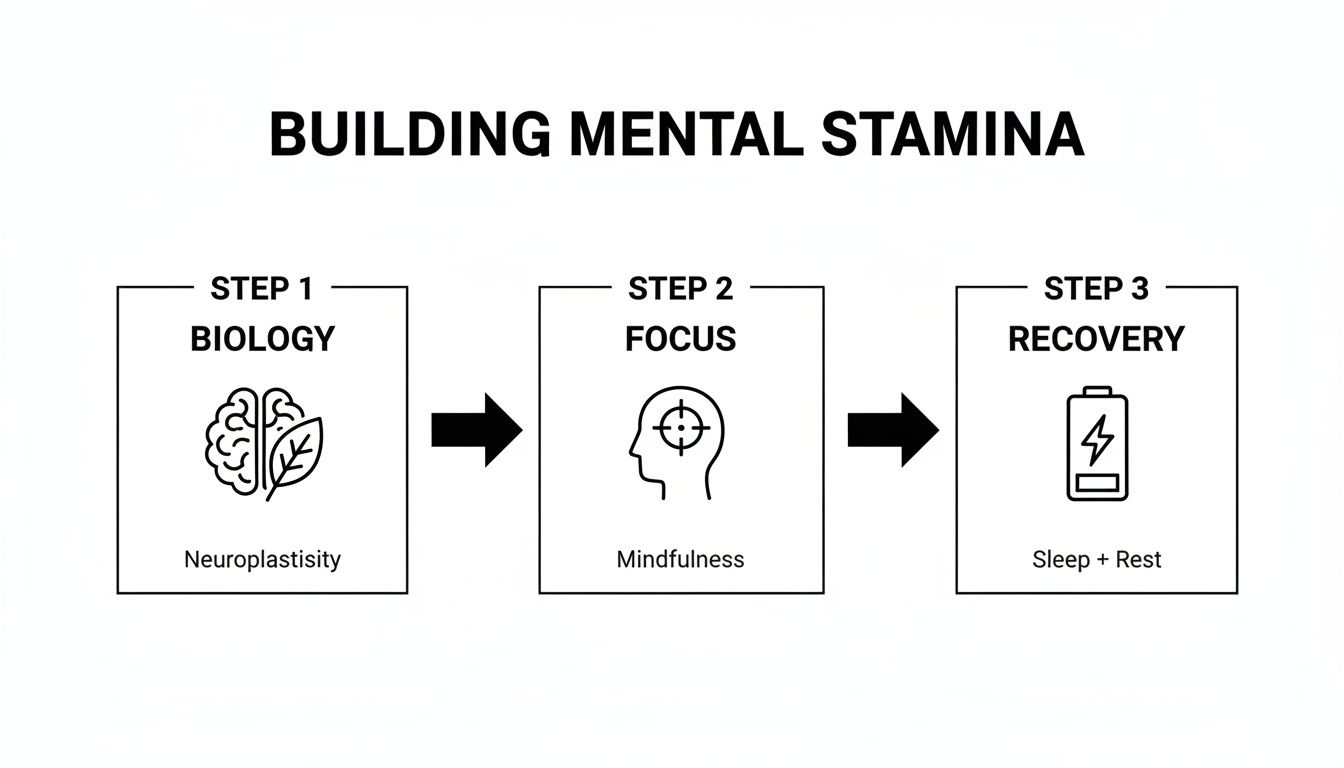
As you can see, true mental strength is a cycle: you fuel your biology, which allows you to sharpen your focus, and then you prioritize recovery to do it all again.
These pillars create a powerful feedback loop. If you neglect one—say, you skimp on sleep—the others will suffer. It becomes harder to focus, and your recovery is compromised. On the flip side, improving your nutrition gives you the raw materials needed for deep, focused work.
Throughout this guide, we’ll dive into practical, evidence-based strategies for each pillar:
- Optimizing Your Biology: This is your foundation. We’ll get into the specifics of how food, hydration, and sleep directly fuel brain function and create the right internal environment for high performance.
- Training Your Focus: Think of your attention span as a muscle. You’ll learn cognitive exercises, mindfulness practices, and work-structuring methods like the Pomodoro Technique to build concentration and fight off distractions.
- Mastering Strategic Recovery: Rest isn’t lazy; it’s a critical part of the performance cycle. We’ll show you how to use micro-breaks and intentional downtime to recharge your cognitive batteries and sidestep burnout.
The core idea is simple: You can’t expect your mind to perform at its best if you don’t give it the right fuel, training, and rest. It’s an integrated system where small, consistent habits produce significant long-term gains in mental endurance.
Adopting this framework is about more than just knowing what to do; it requires a genuine shift in perspective. A huge part of this journey is understanding the growth vs. fixed mindset, because truly believing you can improve is the first real step toward making a lasting change.
Laying the Foundation: Fuel for Your Mind

You wouldn’t enter a marathon after a night of partying and a breakfast of donuts. So why do we expect our brains to perform at an elite level when we neglect the very things that fuel them? Your biological bedrock—sleep, nutrition, and hydration—is absolutely non-negotiable for building real mental endurance.
Get these fundamentals right, and you’re giving your brain the raw materials it needs for sustained focus. Trying to push through without them is like driving a high-performance car with sugar water in the tank. It might sputter along for a while, but it’s guaranteed to break down when you need it most.
Master Your Sleep for Cognitive Restoration
Let’s get one thing straight: sleep isn’t just passive downtime. It’s an active, critical process where your brain gets to work. While you’re sleeping, it’s busy consolidating memories, clearing out metabolic junk, and restoring the neural circuits you need for sharp thinking the next day. It’s your brain’s dedicated overnight cleaning and repair crew.
Skimping on sleep, even for a single night, has an immediate and measurable impact on your focus, emotional regulation, and problem-solving skills. If you’re serious about increasing mental stamina, treating your sleep as a priority isn’t a luxury—it’s a requirement.
An effective wind-down routine can make all the difference. This isn’t about adding more tasks to your day, but about sending clear signals to your brain that it’s time to power down.
- Dim the lights. About an hour before bed, kill the bright overheads. Low light helps kickstart the production of melatonin, the hormone that tells your body it’s time to sleep.
- Disconnect from screens. The blue light from your phone and laptop is a saboteur, tricking your brain into thinking it’s still daytime. Put all devices away at least 60 minutes before you want to be asleep.
- Cool your room. A slight drop in your core body temperature helps initiate sleep. A cool, comfortable room makes this process much easier.
Here’s a pro tip: A consistent sleep schedule, even on weekends, is one of the most powerful tools you have. It trains your internal clock, making it far easier to fall asleep and wake up feeling genuinely restored, not just “awake.”
The Brain Food That Builds Mental Endurance
The food on your plate directly translates into your brain’s performance. A diet loaded with processed junk and simple sugars is a recipe for an energy rollercoaster—a series of spikes and crashes that are devastating for sustained focus.
On the flip side, a brain-healthy diet provides a steady stream of high-quality fuel, protecting your neurons and supporting cognitive horsepower for the long haul.
You’ll want to prioritize these key nutrients:
- Omega-3 Fatty Acids: Think fatty fish like salmon, walnuts, and flaxseeds. These are essential for building brain and nerve cells and are critical for learning and memory.
- Antioxidants: Berries, dark chocolate (in moderation!), and leafy greens are packed with these. They fight cellular stress and inflammation, basically acting as your brain’s bodyguards.
- Complex Carbohydrates: Foods like oats, quinoa, and sweet potatoes give you a slow, steady release of glucose—your brain’s main fuel source. This prevents the harsh energy crashes that come from sugary snacks.
A Sample Day of Eating for Peak Mental Stamina
So, what does this look like in the real world? Here’s a simple template for fueling a demanding workday, designed to keep you sharp from morning to night.
| Meal | Food Choices | Why It Works |
|---|---|---|
| Breakfast (8 AM) | Oatmeal with blueberries, walnuts, and a dash of cinnamon. | Provides slow-release carbs for sustained energy, antioxidants from berries, and omega-3s from walnuts. |
| Lunch (1 PM) | Grilled salmon salad with mixed greens, avocado, and an olive oil vinaigrette. | Delivers a heavy hit of omega-3s, healthy fats for brain health, and nutrient-dense greens. |
| Afternoon Snack (4 PM) | An apple with a handful of almonds. | The combination of fiber and healthy fats stabilizes blood sugar and stops the dreaded afternoon slump in its tracks. |
| Dinner (7 PM) | Chicken breast with quinoa and steamed broccoli. | A perfectly balanced meal with lean protein, complex carbs for energy stores, and fiber. |
Finally, don’t forget the simplest tool of all: water. Your brain is about 75% water, and even mild dehydration can immediately impair your attention and memory. The secret is to keep a water bottle on your desk and sip consistently throughout the day. Don’t wait until you feel thirsty—by then, your performance is already taking a hit. This one habit can make a surprisingly big difference.
Using Physical Exercise to Build a Resilient Mind

The link between a fit body and a sharp mind isn’t just a motivational slogan; it’s a biological fact. I like to think of exercise as a direct hardware upgrade for your brain. Each time you get your heart rate up, you aren’t just conditioning your body—you’re actively building a more efficient, resilient, and stress-proof mind.
This goes way beyond the temporary mood boost of a “runner’s high.” When you exercise consistently, you trigger a whole cascade of neurochemical and structural changes that are absolutely fundamental to increasing your mental stamina. Frankly, it’s one of the most powerful tools we have for achieving sustained cognitive performance.
How Cardio Supercharges Your Brainpower
Activities like running, swimming, or cycling are particularly amazing for cognitive function. When you do aerobic exercise, you’re flooding your brain with freshly oxygenated blood and crucial nutrients. This improved circulation has some pretty profound effects.
For one, it kicks off the release of brain-derived neurotrophic factor (BDNF), a protein that’s essentially fertilizer for your brain cells. BDNF helps your existing neurons survive and even encourages the growth of new ones—a process that’s vital for learning, memory, and just plain sharp thinking.
Think about what it would feel like to power through a tough workday without that familiar brain fog rolling in by mid-afternoon. That’s the real-world impact of regular cardio. But it’s not the only type of movement that makes a difference.
In a landmark study on collegiate athletes, a 12-week yoga program—just three sessions per week—slashed perceived stress by 27% and dropped cortisol levels by 19%. Even better, follow-ups showed lasting neurobiological changes, like a boosted hippocampal volume by up to 54%. Resistance training also packed a punch; in a 6-month program where athletes lifted at 70% of their one-rep max twice a week, depressive symptoms plunged 24% compared to the non-exercisers.
Strength Training for Emotional Stability
If cardio helps build the pathways for focus, then resistance training is what fortifies your emotional resilience. Lifting weights or doing bodyweight circuits has a powerful effect on mood regulation. The physical effort helps dial down symptoms of anxiety and depression, both of which are massive drains on your mental energy.
Each tough rep is teaching your nervous system how to handle stress more effectively. Over time, that translates into an ability to stay calm and collected when you’re facing challenges at work or at home. You’re not just building muscle; you’re building a buffer against mental fatigue.
The key takeaway here is that different workouts offer unique cognitive benefits. A balanced routine that incorporates both cardio for focus and strength training for emotional regulation creates a synergistic effect, dramatically enhancing your overall mental stamina.
Building Your Weekly Mental Stamina Plan
Knowing the “why” is one thing, but putting it into practice is what counts. A structured weekly plan is the best way to make sure you’re getting the full spectrum of cognitive perks without burning out on one type of exercise. The goal isn’t to become an elite athlete, but to strategically use movement to build a stronger mind.
Here’s a sample schedule I often recommend to busy professionals. It’s designed to balance high-intensity work with smart recovery to really maximize those mental gains.
Weekly Exercise Plan for Enhanced Mental Stamina
This is a sample weekly schedule that balances different types of exercise to maximize cognitive benefits, stress reduction, and overall mental endurance.
| Day | Activity (30-45 mins) | Primary Mental Benefit |
|---|---|---|
| Monday | Moderate-intensity run or cycling. | Boosts BDNF, enhances focus, and sets a productive tone for the week. |
| Tuesday | Bodyweight strength training (squats, push-ups, planks). | Improves mood regulation and builds resilience to stress. |
| Wednesday | Active recovery (brisk walk or light stretching). | Promotes blood flow and mental clarity without causing physical strain. |
| Thursday | High-intensity interval training (HIIT) on a stationary bike. | Maximizes cognitive benefits in a short time, sharpening executive function. |
| Friday | Full-body resistance training with weights. | Reduces symptoms of anxiety and fights the mental drain of a long week. |
| Saturday | Long, slow hike or a yoga class. | Lowers cortisol levels and allows for mental decompression and stress regulation. |
| Sunday | Rest or very light activity like a casual stroll. | Allows for physical and mental systems to recover and consolidate gains. |
Of course, this is a flexible template, not a rigid prescription. The most important thing is consistency. When you make exercise a non-negotiable part of your routine, every workout becomes a strategic investment in your mental capital. It pays dividends in focus, resilience, and clarity long after you’ve cooled down.
Training Your Focus and Attention Control
Your ability to focus is a muscle. Let it atrophy by constantly switching tasks and chasing notifications, and it weakens. But train it with discipline, and it becomes incredibly strong, allowing you to sustain deep concentration for hours. This is your mental gym routine—a set of exercises designed to build the attention control that elite mental stamina requires.

Let’s move past generic advice and dig into specific, proven methods that teach your brain to resist the constant pull of distraction. Think of these as the actual sets and reps that will forge a more resilient and focused mind.
Combine Brainpower with Brawn Using BET
What if your physical workouts could pull double duty, building both physical endurance and mental focus at the same time? That’s the brilliant idea behind Brain Endurance Training (BET), a method that pairs cognitive tasks with physical exercise to create a serious boost in performance.
The logic here is pretty straightforward. By making your brain work hard right before or during physical exertion, you’re conditioning it to handle a heavy cognitive load even when your body is under stress. This directly builds your resistance to mental fatigue.
A recent study drove this point home. Over eight weeks, one group of sedentary women added a 20-minute cognitive task before their usual 45-minute workouts. The results were impressive: they saw a 7.8% jump in cognitive performance, handily beating the 4.5% gain from the exercise-only group. Given that brain disorders are projected to cost the global economy $16 trillion by 2030, this dual-action approach is a game-changer. You can explore the full study on how brain training boosts physical abilities here.
Structure Your Work for Deep Focus
In a world of open-plan offices and nonstop pings, the ability to do deep, uninterrupted work has become a genuine superpower. One of the most effective ways to train your attention span is to intentionally structure your workday to create pockets of intense focus. Two methods stand out for their sheer effectiveness.
- The Pomodoro Technique: This is about more than just a timer; it’s about managing your decisions. You commit to 25 minutes of absolute single-tasking, then take a 5-minute break. Every time a distracting thought pops up, you jot it down and immediately return to the task. Each 25-minute block is a successful rep in your focus training.
- Deep Work Blocks: This means scheduling longer, 90-minute blocks of totally uninterrupted time on your calendar. During these sessions, the phone goes off, unnecessary browser tabs are closed, and you dedicate all your mental energy to your most demanding work. It’s tough at first, but it’s how you train your brain to sustain concentration.
The real goal here isn’t just about productivity. It’s about fundamentally retraining your brain’s response to boredom and distraction. By repeatedly bringing your attention back to a single task, you are strengthening the neural circuits responsible for focus.
Sharpen Attention with Mindfulness Meditation
Mindfulness is often misunderstood as some attempt to “empty your mind.” It’s not. In reality, it’s the ultimate attention-training exercise. It teaches you to notice where your focus is, acknowledge when it wanders, and gently guide it back—again and again. This is the very essence of attention control.
Even a few minutes a day can make a massive difference in your ability to stay calm and focused under pressure. For a practical start, give this simple 5-minute exercise a try.
A Simple 5-Minute Mindfulness Exercise:
- Find a Quiet Spot: Sit comfortably in a chair with your feet flat on the floor and your hands resting in your lap.
- Set a Timer: Use a timer for five minutes so you aren’t wondering how much time is left.
- Focus on Your Breath: Close your eyes and bring your full attention to the physical sensation of your breath. Notice the air entering your nostrils, filling your lungs, and then leaving.
- Notice the Wandering: Your mind will wander. That’s what minds do. When you realize you’re thinking about your to-do list or what’s for dinner, just acknowledge it without judging yourself.
- Gently Return: The moment you notice your mind has strayed, gently bring your focus back to the feeling of your breath. This act of returning is the core of the exercise. Each time you do it, you’re building your “focus muscle.”
Consistently practicing these techniques builds the mental architecture needed for high performance. The underlying principles are foundational to many therapeutic approaches, and you can learn more about reshaping thought patterns by exploring different cognitive behavioral therapy techniques.
Mastering Strategic Recovery to Prevent Burnout
Here’s a hard truth most of us learn too late: true mental stamina isn’t forged in the fires of relentless grinding. It’s built in the quiet, intentional moments of recovery. We’ve been fed a narrative that rest is for the lazy, but that’s a dangerous and outdated way of thinking. In reality, smart recovery is a non-negotiable part of the high-performance equation.
The real trick is learning to tell the difference between low-quality “rest” and high-impact downtime. Mindlessly scrolling through your phone for an hour might feel like a break, but it often leaves you feeling more drained and agitated than before. That’s just passive consumption, not true restoration.
High-impact recovery, on the other hand, actively replenishes your cognitive resources. It’s about deliberately disengaging in a way that allows your brain to reset, process information, and gear up for the next round of focused effort.
The Power of Micro-Breaks and True Detachment
You don’t need a week-long vacation to start feeling the benefits of proper recovery. Weaving small, deliberate breaks into your workday can have a profound impact on your mental endurance. Think of these “micro-breaks” as a pressure release valve that prevents cognitive overload from building up throughout the day.
For instance, after you’ve pushed through a demanding 90-minute task, step away from your desk completely. And I don’t mean just switching tabs to check your email. I mean get up, walk to the kitchen for a glass of water, do a few stretches, or simply stare out a window for five minutes. This short period of actual detachment gives your prefrontal cortex—the part of your brain running the show—a much-needed breather.
True detachment is all about creating a hard boundary between work and the rest of your life. It’s a screen-free evening spent with a good book, a walk in the park without your phone buzzing in your pocket, or a weekend hobby that completely absorbs your attention. This isn’t a luxury; it’s essential for long-term endurance.
Embracing Active Recovery for Your Mind
Just like an athlete uses a light jog to recover physically, you can practice “active recovery” for your mind. This just means engaging in low-stress activities that are enjoyable and stimulating but completely different from your day-to-day work.
- Learn something new: Picking up a musical instrument or trying a new language lights up different neural pathways. It promotes brain health and provides a fantastic distraction from work-related stress.
- Connect with people: Meaningful social interaction is one of the most powerful buffers against burnout. A real conversation with a friend—one that isn’t about work—can dramatically shift your mood and perspective.
- Get moving: Light exercise is a brilliant form of active recovery. It shifts your focus from the cognitive to the physical, clearing your head while delivering a huge list of mental health benefits.
This isn’t just feel-good advice; movement literally rewires the brain for stamina. Consider this: in 2019, when 12% of the global population was grappling with mental disorders, data showed that higher physical activity slashed the odds of depression by 17%. Practices like yoga or Tai Chi can lead to stress drops of 27-35% and a 40% gain in emotional regulation. You can discover more insights from this comprehensive analysis of physical activity and mental health.
Spotting the Early Warning Signs of Burnout
The best way to deal with burnout is to stop it before it takes hold. This requires a bit of self-awareness and the honesty to act when you spot the early warning signs. Think of it as running a personal diagnostic check every now and then.
Burnout isn’t a sudden event; it’s a slow leak in your mental stamina reserves. By learning to spot the signs early, you can adjust your recovery strategy before you find yourself running on empty.
Use this checklist to periodically take your own pulse:
- Persistent Cynicism: Are you feeling increasingly negative, cynical, or detached from your work?
- Constant Exhaustion: Do you feel bone-tired all the time, even after what should have been a full night’s sleep?
- Reduced Performance: Are tasks that used to be a breeze now feeling overwhelming or impossibly difficult?
- Emotional Irritability: Are you snapping at coworkers or loved ones more often than you’d like to admit?
If you find yourself nodding along to these points, it’s a clear signal to make recovery your top priority. That might mean scheduling more breaks, fiercely protecting your evenings, or exploring effective energy management solutions to build a more sustainable workflow.
Always remember, rest isn’t the reward you get for doing great work; it’s the foundation that makes great work possible in the first place.
Got Questions? Let’s Talk Through Them.
As you start putting these ideas into practice, you’re bound to run into some real-world snags and questions. That’s completely normal. Building mental endurance isn’t a straight line, and it’s smart to ask if you’re heading in the right direction. Let’s tackle some of the most common questions that pop up.
Think of this as a quick chat to clear up any confusion and help you push forward with confidence.
How Quickly Will I Actually See Results?
This is the big one, isn’t it? The honest-to-goodness answer is: it really depends. Some habits give you an almost instant lift. A solid night’s sleep or a good workout can boost your clarity and mood within 24 hours. You feel that difference right away.
But building deep, unshakable mental stamina is a lot like physical conditioning. You wouldn’t train for a week and then expect to crush a marathon. Real change happens through neuroplasticity—literally rewiring your brain—and that takes consistent effort over time.
Here’s a realistic timeline based on what I’ve seen:
- The First Couple of Weeks: You’ll start noticing small wins. Your focus during a work block feels a bit sharper. Your mood is more stable thanks to better sleep or regular exercise.
- One to Three Months In: This is where the magic starts. You’ll feel a genuine shift in how you handle stress. Demanding tasks won’t drain you as quickly, and you’ll bounce back from a tough day much faster.
- Six Months and Beyond: This is when it all clicks. The habits are no longer things you do; they’re part of who you are. High mental stamina becomes your default setting, not something you have to white-knuckle your way through.
Remember, consistency trumps intensity every time. A brief, daily mindfulness practice will do infinitely more for you than one heroic meditation session a month.
What If I Have a Bad Day and Fall Off the Wagon?
First off, welcome to the club. Everyone has days where it all falls apart. A project explodes, you get a terrible night’s sleep, or you just wake up feeling like you have nothing in the tank. The goal here isn’t perfection—it’s resilience.
Falling off track for a day doesn’t erase all your hard work. Not even close.
What matters is what you do next. Instead of spiraling into guilt, look at it as a data point. What tipped the scales? Were you running on fumes from poor sleep? Did you skip that walk you promised yourself? Use it as a chance to learn.
People think mental toughness means you never struggle. The truth is, it means you get incredibly good at getting back up. You don’t let one bad day bleed into a bad week.
So, if today was a mess, just acknowledge it. Give yourself a little grace. And tomorrow, just get back to your basics. Your routine is the anchor that will pull you right back on course.
Do I Really Need to Do All of This at Once?
Please don’t! Trying to simultaneously overhaul your sleep, diet, exercise, and work habits is a classic recipe for burnout. It’s just too much, too soon. A far more effective way to go about it is to pick one or two small things to focus on.
My advice? Find your biggest bottleneck and start there.
- Feeling groggy and unfocused? Make your sleep routine your number one priority for the next few weeks. Nothing else.
- Can’t stop getting distracted at work? Start with the Pomodoro Technique. Just aim for one or two focused sessions a day.
- Feeling stressed and on edge? Just add a 30-minute walk to your daily schedule. That’s it.
Once that new habit feels like second nature, you can layer another one on top. This slow-but-steady approach creates real momentum and makes the whole process feel manageable instead of overwhelming. This is a marathon, not a sprint, and this is how you make sure you actually cross the finish line.
If this resonated, go deeper. My book Love, Success, Freedom and Boundaries gives you twelve frameworks for seeing the patterns that shape your life — and changing the ones that aren’t working.
Frequently Asked Questions
What is mental stamina?
Mental stamina is the ability to sustain focused, high-quality thinking over extended periods without degrading. It’s the cognitive equivalent of endurance — not how hard you can think, but how long you can think well.
How do I build mental stamina?
The same way you build physical stamina: progressive overload and recovery. Gradually extend your focused work sessions, then rest properly. Mental stamina breaks down without adequate sleep, nutrition, and downtime.
Why does my mental stamina decrease throughout the day?
Your prefrontal cortex (the part responsible for complex thinking) is metabolically expensive. It fatigues like any other muscle. This is why your best thinking usually happens in the morning and difficult decisions get worse by evening.
Keep Reading
- How to Improve Mental Clarity and Reclaim Your Focus
- Reducing Anxiety Naturally: Tips – reducing anxiety naturally
- The 10 Morning Habits of Successful People to Master in 2026
If you do any writing alongside the focus work — journaling, drafting, processing what you’re noticing — the tool I use to draft most of my words is Wispr Flow. It transcribes your voice into clean, edited text in real time, so the friction between thinking it and writing it basically disappears.
What I Actually Take
If you want a supplement that does what most of these strategies need a boost from, I take BrainSupreme MAAC Stack. Built for sustained mental endurance. The stack I take when I need to think clearly all day, not just for an hour. Use code PEXA at checkout for 15% off.
Conclusion
Understanding is the first step, but it’s what you do with that understanding that changes things. The ideas in this article aren’t meant to sit in your head — they’re meant to shift how you see your situation and give you something concrete to act on. Start with the one thing that felt most relevant, apply it this week, and notice what changes.
A note on affiliates: This article includes affiliate links to platforms I’ve vetted and would recommend to my own clients and students. If you start with a recommended service through a link here, I may earn a small commission — at no extra cost to you. I only mention what I’d actually point you to in person. The recommendation comes first; the relationship is disclosed second.
If this resonates, the full framework lives in Love, Success, Freedom and Boundaries.
A practical playbook for raising emotionally resilient kids — and breaking the patterns you didn’t choose to inherit.
