



Summary: A practical guide to eliminate distractions: simple strategies for deep focus. What actually works, what doesn’t, and where to start.
I used to blame my phone for my distraction problem. Then I realized the phone was just the escape route — the real issue was that I hadn’t made my work compelling enough to compete.
Let’s be honest, those little distractions—a quick glance at a notification, an “urgent” email, a random thought that sends you down a Wikipedia rabbit hole—feel like minor annoyances. But they aren’t harmless. They’re productivity assassins in disguise, quietly dismantling your ability to do meaningful work.
The real damage isn’t just the lost minute here or there. It’s the cumulative toll on your output, your creativity, and even your mental health. This isn’t just a hunch; the numbers tell a pretty sobering story.
The Unseen Price of Interruption
The modern workday is a minefield of interruptions. A landmark study from the University of California, Irvine, found that office workers get, on average, just 12 minutes of uninterrupted time on a task before something pulls them away.
What’s even crazier? It takes an average of 23 minutes to get fully back on track. Do the math, and you’ll see why so many of us feel like we’re spinning our wheels all day. This constant cycle of stopping and starting adds up, costing the average U.S. worker more than 26 hours of productive time every single month.
Globally, the picture is just as grim. Employee disengagement, largely fueled by distractions, is estimated to cost the world economy a staggering $8.8 trillion in lost productivity. You can see more data on the productivity impact of distractions.
Simply “trying harder” isn’t a strategy; it’s a recipe for burnout. To genuinely reclaim your focus, you need a systematic approach. Instead of relying on willpower, which is a finite resource, we’re going to build a durable system.
“Focus is the ability to direct your attention according to an intention. This happens both over the span of minutes and seconds… as well as over years and decades, as you consider how to use your finite time here on Earth.”
This guide is your roadmap to building that system.
Your Three-Pillar Focus Restoration Plan
So, how do we actually do this? We’ll break it down into a simple, repeatable three-stage process. This isn’t about quick fixes; it’s about making foundational changes that stick.
Here’s the framework we’ll be working with:
| Pillar | Objective | Key Actions |
|---|---|---|
| Pillar 1: Diagnose | Identify your unique distraction triggers. | Conduct a distraction audit, analyze your energy cycles, and pinpoint internal vs. external interruptions. |
| Pillar 2: Design | Architect your physical and digital environments for deep work. | Set up device-level blocks, optimize your workspace, and create “focus zones.” |
| Pillar 3: Implement | Adopt proven cognitive and behavioral strategies. | Master time-blocking, use the Pomodoro Technique, build focus habits, and create accountability systems. |
This three-pillar approach is designed to give you a clear, step-by-step method for taking back control.
Here’s a bird’s-eye view of how these pieces fit together.
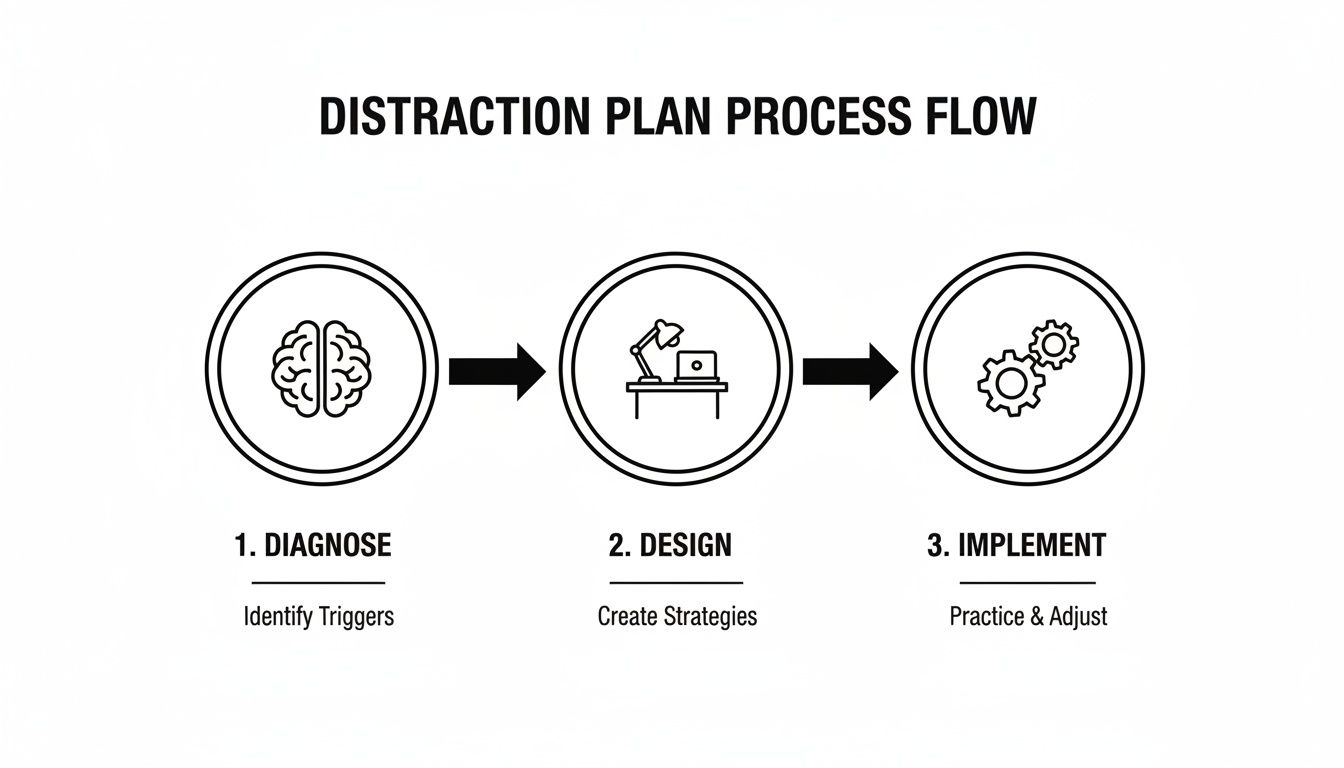
This process shows that winning the war against distraction isn’t about a single magic bullet. It’s about a smart, sequential strategy that tackles the problem from every angle—your mind, your habits, and your environment.
Throughout this guide, we’ll dive deep into each of these pillars. I’ll give you practical steps, real-world examples, and the tools you need to build a system for sustained focus that doesn’t burn out.
Find Out What’s Really Breaking Your Focus

Before you can build a workflow that actually works, you have to play detective. That vague feeling of being “unfocused” isn’t something you can fix. To really get a handle on distractions, you need to know exactly what they are, when they show up, and what’s causing them.
This isn’t about judging yourself—it’s just about gathering data. Think of it like a doctor needing a diagnosis before they can write a prescription. You need a clear picture of what’s tripping you up before you can start clearing the hurdles.
Start a One-Week Distraction Audit
The single best way to pinpoint your personal triggers is to track them. For the next seven days, grab a notebook or open a simple document and start a log. The only goal is to record every single time you get pulled off task.
Don’t overthink it or turn it into another chore. Just simple observation. When you catch your mind wandering or realize you’ve just lost 10 minutes to something else, jot down a few details.
Your Distraction Log Should Have:
- Time of Day: When did it happen?
- The Distraction: What was the thing that pulled you away? (e.g., Slack notification, thought about groceries, a coworker’s question).
- The Trigger: What was the real cause? (e.g., phone buzzed, the task felt boring, an open browser tab).
- Internal or External? Did it come from your environment (external) or your own head (internal)?
You’ll be surprised how quickly patterns emerge. After just a couple of days, you might see that your focus evaporates around 3:00 PM every day, or that a single app is behind 70% of your interruptions. This is the raw data you need.
Internal vs. External Distractions: Know Your Enemy
It’s so important to know the difference between the two main types of distractions because you can’t solve them the same way. Most people get hung up on the external stuff, but the internal triggers are often way more powerful.
External distractions are the obvious culprits—all the sensory inputs from the world around you:
- Your phone buzzing.
- The ping of a new email or Slack message.
- A colleague dropping by your desk to chat.
- The background noise of a busy office or coffee shop.
Internal distractions are the ones that come from inside your own head. They’re quieter, but they can be far more sneaky and disruptive:
- Suddenly remembering you need to schedule a dentist appointment.
- Anxiety about a looming deadline that makes it impossible to even start.
- Sheer boredom with a difficult task that sends you searching for anything more interesting.
- That powerful, almost physical urge to check social media “just for a minute.”
Understanding this split is the first real step. You can’t fix an internal problem like anxiety with an external solution like noise-canceling headphones. It just doesn’t work. Many of these internal habits are about retraining your brain’s responses, and you can learn more about cognitive behavioral therapy techniques that directly address these patterns.
A squirrel deciding whether to stay in a tree for more nuts is a perfect analogy for our modern information habits. Technology has reduced the “distance” to the next tree (the next piece of information), making us constantly jump from task to task.
Tally Up the Results
At the end of the week, take a hard look at your log. Don’t just skim it—analyze the data and find the recurring themes. This is where you find your biggest focus drains.
Ask yourself these questions:
- Who or what is my biggest interrupter? Is it a specific person? A particular Slack channel? Notifications from one app?
- When am I most distractible? Do you crash in the afternoon when your energy wanes? Or are you most scattered in the morning before your coffee kicks in?
- What’s my go-to escape? When you feel stuck, bored, or overwhelmed, where do you run? The news? Instagram? Mindlessly organizing your inbox?
This little audit gives you a concrete, data-backed list of your personal focus-killers. For one person, the log might scream that Slack is the number one problem, constantly derailing deep work. For someone else, it might be the internal habit of daydreaming the second a task gets hard.
Once you have this clarity, you’re no longer fighting a vague, overwhelming enemy. You have a precise list of targets. Now you’re ready to start building an environment and a workflow designed to shut them down.
Engineer Your Environment for Deep Work
Once you’ve diagnosed your personal distraction triggers, the next move is to fundamentally reshape your surroundings. Your workspace—whether it’s a corner office or a nook in your kitchen—is either your greatest ally for focus or a constant saboteur. Relying on willpower to fight a distraction-rich environment is a losing battle. The smarter play is to design a space where focus is simply the easiest option.
It all starts with your physical desk. A cluttered surface isn’t just messy; it’s a cognitive minefield. Every stray paper, book, or gadget is a tiny signal to your brain, pulling on a sliver of your attention. A clean, organized workspace sends a powerful, unspoken message: this is a place for serious, high-value work.
Create Dedicated Focus Zones
This might be the single biggest game-changer for your productivity: designate a specific area only for deep work. You don’t need a separate room. It could be a specific chair, the left side of your desk, or a particular coffee shop you only visit for focused sessions.
The principle here is called stimulus control. When you consistently use a space for one type of activity, your brain builds a powerful Pavlovian link. Soon, just sitting down in your “focus zone” will act as a trigger, priming your mind to get into a state of concentration. It’s the mental equivalent of putting on your running shoes to signal it’s time for a workout.
On the flip side, stop working from places you associate with relaxation, like your bed or the couch. When you mix work and rest in the same location, you blur the mental boundaries, making it harder to switch on when you need to work and, just as importantly, harder to switch off when you’re done.
Master Your Digital World
Let’s be honest: while a messy desk is a problem, your digital space is usually the real battleground. Our devices and the apps on them aren’t just minor annoyances; they are engineered to be silent thieves of our potential. It’s not just a feeling—research shows these interruptions cost businesses an average of $4,500 per employee each year in lost productivity. That number makes sense when you learn the average worker checks their phone a staggering 96 times a day.
Even just having your phone nearby can reduce your cognitive capacity. The problem is bigger than most of us realize, and you can explore the full productivity cost of distractions to see just how deep the rabbit hole goes.
To win this fight, you need a protocol.
Your environment should make your desired actions easier and your undesired actions harder. If you have to walk to another room to check your phone, you’re far less likely to do it impulsively.
This is where a systematic “Digital Detox Protocol” comes in. This isn’t about giving up technology; it’s about taking back control and using it on your terms.
Here’s a simple but powerful protocol you can implement today:
- Conduct a Ruthless Notification Audit: Open your phone and computer settings and turn off every single notification that isn’t absolutely critical. No more banners, badges, or sounds for email, social media, or news. The only things that should get through are direct communications from actual people you need to hear from, like a phone call or a message from your boss.
- Embrace Grayscale Mode: Your phone has an accessibility feature to turn the screen black and white. Do it. This one small change strips away the vibrant, psychologically rewarding colors that app designers use to keep you hooked. Your phone will instantly feel more like a tool and less like a toy.
- Establish Phone-Free Zones and Times: Create clear rules. For example, your desk is a phone-free zone during work hours. The first hour of your day is a phone-free time. The key is to physically move the device to another room. Out of sight, out of mind—it really works.
- Use Strategic App Blockers: Willpower fails. A good app blocker doesn’t. These tools are your non-negotiable backstop for enforcing your intentions.
Tools like Freedom are perfect for this. You can schedule recurring sessions that block distracting websites and apps across all your devices, making it impossible to slip up and browse Twitter during a deep work block.
Here’s what setting up a block session in Freedom looks like.
As you can see, you can build custom blocklists for your personal Kryptonite (like social media or news) and then start a session for a specific amount of time. It’s like building a digital fortress around your attention.
Tailor Your Setup to Your Role
There’s no one-size-fits-all “perfect” environment. The right setup depends entirely on the unique challenges of your job.
- For a Content Creator: Your biggest enemy is the internet—the very tool you need to work. Your setup should be about creating a digital cocoon. This could mean using aggressive website blockers, writing in a minimalist app like Ulysses, and investing in a great pair of noise-canceling headphones to find your flow.
- For a Project Manager: Your challenge is the constant stream of communication. Your environment should be designed around batching. This might look like closing your email and Slack for 90-minute sprints, using a physical “Do Not Disturb” sign on your door, and scheduling specific “office hours” where your team knows they can reach you.
By deliberately engineering your physical and digital spaces, you stop running on the finite fuel of willpower. Instead, you build an environment that automatically defends your focus and makes deep work the default.
Master Your Schedule with Proven Focus Techniques
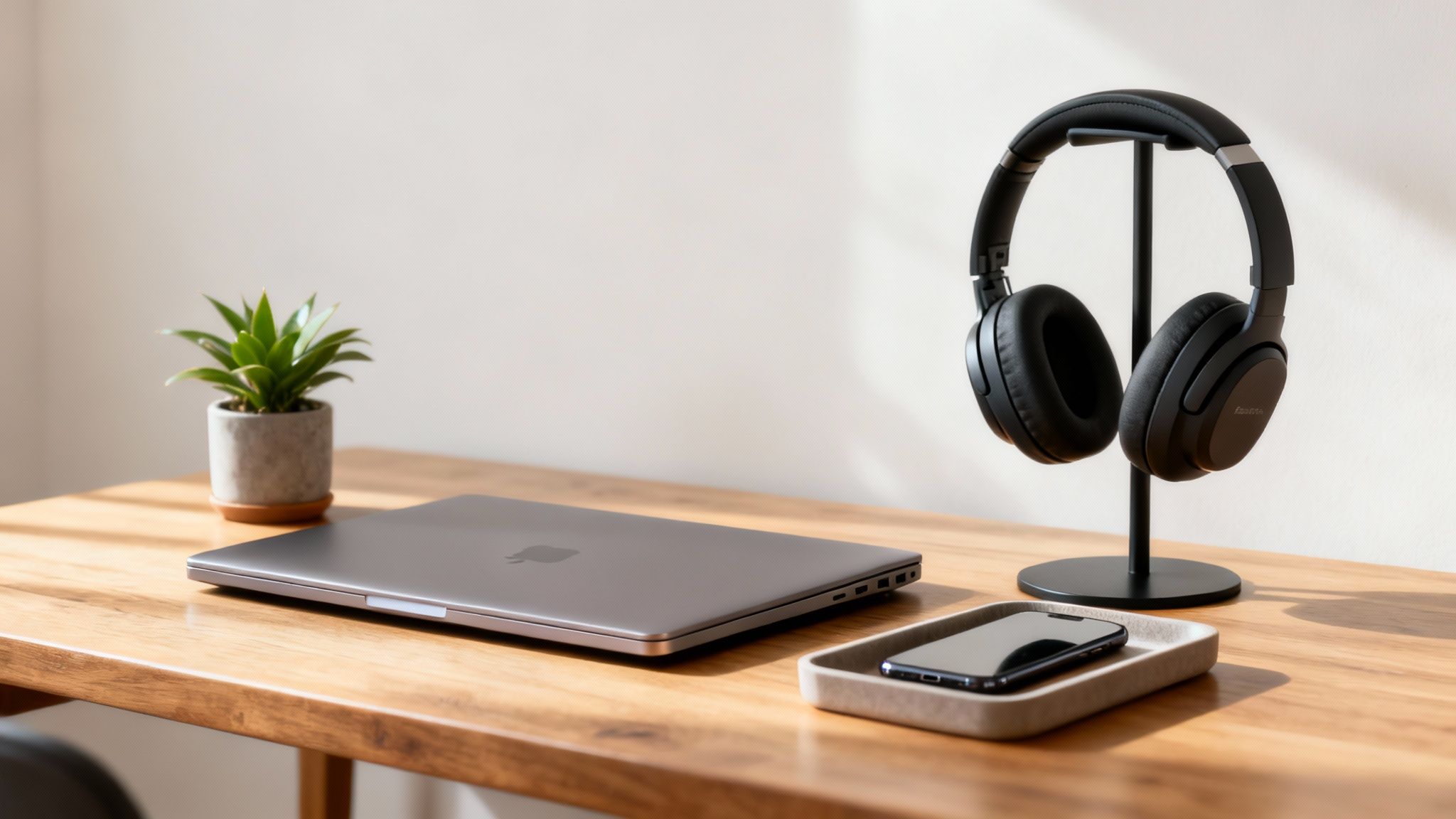
Engineering a focus-friendly environment is a huge win. But even in a perfectly quiet, minimalist workspace, your attention can still shatter without a solid structure for your time. The next layer of defense is to move from just hoping for focus to actively scheduling it. This means building a daily architecture that treats your attention as the non-negotiable asset it truly is.
This goes way beyond a simple to-do list. We’re talking about intentionally giving every minute of your workday a specific job, creating a plan so airtight that distractions can’t find a crack to seep through. Proven methods like Time Blocking and the Pomodoro Technique aren’t just trendy productivity hacks; they’re cognitive training tools that teach your brain to operate in focused, predictable bursts.
Give Every Minute a Job with Time Blocking
Time Blocking is a deceptively simple strategy that packs a powerful punch, famously championed by authors like Cal Newport. Instead of reacting to an endless list of tasks, you proactively carve out blocks of time in your calendar for everything you need to do. Your calendar stops being just a record of meetings and becomes a detailed blueprint for your day.
Think about it. A generic to-do list might just say, “Write blog post.” A time-blocked schedule gets specific:
- 9:00 AM – 9:30 AM: Research and outline the blog post.
- 9:30 AM – 11:00 AM: Write the first draft (Deep Work Block).
- 11:00 AM – 11:30 AM: Review and edit the draft.
This simple shift turns your day from a series of exhausting decisions into a sequence of clear commitments. It completely eliminates that paralyzing “what should I work on next?” moment that so often leads to procrastination. A well-planned schedule is also a fantastic tool for managing your most critical resource; our guide to energy management solutions dives deeper into how you can align these blocks with your natural energy cycles for even better results.
Use the Pomodoro Technique for Focused Sprints
For those tasks that feel monstrously overwhelming, or just on days when your focus feels scattered, the Pomodoro Technique is a perfect way to get started. The classic method is simple: set a timer for 25 minutes and give your undivided attention to a single task. No email, no phone, no “quick” web searches. When the timer goes off, you take a mandatory 5-minute break.
After four of these cycles (or “Pomodoros”), you earn a longer break of 15-30 minutes. This rhythm of intense work followed by deliberate rest is fantastic for preventing burnout and training your attention muscle. The short, defined interval makes it so much easier to resist an impulse because you know a break is just around the corner.
The real magic of the Pomodoro Technique isn’t the 25-minute timer itself. It’s the unwavering commitment to single-tasking. During a sprint, you do one thing and one thing only. If an unrelated thought pops into your head, you jot it down on a notepad and get right back to the task.
Choosing Your Focus Technique
So, which method is right for you? It often depends on your work style, the type of task, and your energy levels. Here’s a quick comparison to help you decide where to start.
| Technique | Best For | Core Principle | Implementation Tip |
|---|---|---|---|
| Time Blocking | Planners who like structure; managing a day with varied, complex tasks. | Proactive Scheduling | Use a digital calendar and color-code different types of work (e.g., green for creative, blue for admin). |
| Pomodoro Technique | Those prone to procrastination or burnout; breaking down large, daunting tasks. | Rhythmic Sprints & Breaks | Start with just one Pomodoro. The goal is to build momentum, not to be perfect from day one. |
| Eat the Frog | Tackling the most challenging task first to build momentum. | Prioritize by Impact | Identify your “frog” the night before so you can start immediately the next morning. |
| The Eisenhower Matrix | Individuals who need to triage tasks and focus on what’s truly important. | Urgency vs. Importance | Be ruthless about what you place in the “Urgent & Important” box. Most things aren’t. |
Ultimately, the best technique is the one you’ll actually stick with. Don’t be afraid to experiment, combine methods, or adapt them to fit your unique workflow. The goal is to find a system that helps you consistently do your best work.
Defend Your Calendar from People
Even the most perfectly blocked-out schedule can be derailed by human-centric distractions—think pointless meetings and the constant hum of office chatter. These interruptions are tricky because they often feel like productive work. The data, however, tells a different story.
Unproductive meetings eat up a staggering 79 hours of a professional’s year, while simple office noise is a primary complaint for 27% of workers. Even worse, research from Economist Impact and Dropbox shows that recovering from interruptions alone claims another 127 hours annually. Clearly, learning to protect your time is a critical skill.
Here are a few practical ways to start reclaiming that time:
- Champion “Focus Wednesdays.” Propose a company-wide or team-level “no-meetings” day. This creates a predictable sanctuary for deep work that everyone can plan around and respect.
- Use Asynchronous Video. Instead of a 30-minute status meeting, record a 5-minute update using a tool like Loom. It respects everyone’s schedule and lets them engage on their own time.
- Demand Agendas and Hard Stops. For meetings that absolutely must happen, insist on a clear agenda with defined goals. Set a hard stop time and stick to it. If a meeting invite lacks a clear purpose, it’s perfectly acceptable to politely decline.
By mastering these scheduling techniques, you build a powerful fortress around your attention. You get to decide what gets your focus and when, transforming your day from a chaotic mess of external demands into a deliberate execution of your most important goals.
Turn Fleeting Focus Into Lasting Habits

Okay, you’ve started to reshape your environment and take control of your schedule. Those are massive wins. But to make this change stick, we need to go deeper. The real goal is to turn these conscious, effortful actions into automatic, unconscious habits.
Lasting focus isn’t about white-knuckling it through every day. It’s about building systems that run on their own, making deep work your default setting instead of a constant battle. This is where we can borrow from the science of habit formation to literally rewire your brain’s response to distraction.
The Simple Loop That Runs Your Life
Every habit you have—good or bad—operates on a simple, powerful neurological loop: Cue, Routine, Reward.
A cue acts as the trigger, telling your brain to switch to autopilot. The routine is the action itself, whether physical or mental. The reward is that hit of satisfaction that tells your brain, “Hey, remember this loop. It was good.”
Think about your worst distraction. It probably follows this pattern. For me, it used to be hitting a tough spot in a piece of code.
- Cue: Mental friction. The code isn’t working, and I feel stuck.
- Routine: My fingers automatically type
news.ycombinator.com. - Reward: A quick hit of novelty and an escape from the difficult problem.
Our job is to hijack this loop. We keep the cue but swap out the destructive routine for a productive one.
How to Engineer a Better Habit
Let’s build a new habit from the ground up, one that actually encourages focus. We’ll use a framework that makes the new routine obvious, attractive, easy, and satisfying.
Imagine you want to kick off every workday with a solid 90-minute session of uninterrupted work. Here’s how we could engineer that:
- The Cue (Make it Obvious): Pouring your first cup of coffee. The moment you sit down at your desk with that mug, the session begins. No questions asked.
- The Craving (Make it Attractive): Pair the routine with something you genuinely enjoy. Maybe it’s a specific “deep work” playlist on Spotify or lighting a candle you only use for these sessions.
- The Response (Make it Easy): The night before, set the stage. Close every distracting tab, open only the document you need, and—this is crucial—put your phone in another room. Make starting frictionless.
- The Reward (Make it Satisfying): When those 90 minutes are up, give yourself a real reward. Not just a feeling of accomplishment, but something tangible. Walk outside for 15 minutes, check your favorite sites guilt-free, or make that second cup of coffee. This closes the loop and tells your brain it was worth it.
The secret to beating distractions for good is to make focus a more rewarding experience than the distraction itself. You’re not just fighting urges; you’re building a better, more satisfying alternative.
This framework is your new playbook. The cue of putting on noise-canceling headphones can trigger a coding session. The cue of finishing lunch can trigger a 25-minute inbox blitz. By stacking these small, intentional routines, you build a powerful foundation for a focused day. To make these habits truly take root, it helps to see focus as a skill you can develop over time, a concept we explore in our guide on the growth vs. fixed mindset.
Bring in Reinforcements: Accountability and Gamification
Even with perfectly designed habits, motivation ebbs and flows. That’s just human. This is where a little outside help from accountability and measurement systems can make all the difference.
Here are a few simple but incredibly effective systems I’ve seen work:
- Get a Focus Partner: Find a colleague or friend with similar goals. At the start of the day, message each other your top one or two priorities. At the end of the day, a quick text checking in is all it takes. Just knowing someone is going to ask is a powerful nudge.
- Turn It Into a Game: Apps like Forest are brilliant for this. You “plant” a digital tree that grows over a set time—say, 45 minutes. If you cave and use your phone for something else, the tree dies. It sounds silly, but it works.
- Track Your Wins: Use a simple time-tracking tool to log your deep work hours. Watching that number climb week after week provides tangible proof that your efforts are paying off, which is a huge motivator in itself.
When you combine smart habit design with these external systems, you stop relying on willpower, which is a finite resource. You’re building an entire ecosystem where focus becomes the path of least resistance.
Troubleshooting Your Focus: A Field Guide to Common Problems
Putting these strategies into practice is where the real work begins. It’s one thing to have a plan, but it’s another to stick with it when real life gets in the way. Let’s tackle some of the most common hurdles people face when trying to build a distraction-free workflow.
Think of this less as a set of rigid rules and more as a toolkit. The goal isn’t perfection from day one; it’s having the right response ready when your well-laid plans inevitably run into the messy reality of a modern workday.
“But My Job Requires Me to Be on Chat All Day!”
This is probably the single biggest challenge I hear about, especially for those in fast-moving, collaborative teams. The pressure to be always on is immense. The trick is to shift your thinking from constant availability to strategic availability. Going completely dark is rarely an option, but you can build a system that protects your focus without leaving your team hanging.
Instead of keeping Slack or Teams open in your peripheral vision all day, try this:
- Block out “Office Hours”: Carve out two or three specific 30-minute slots in your calendar just for communication. Let your team know these are the best times to grab you for quick questions and syncs.
- Make your status message work for you: Don’t just set it to “busy.” Be specific and manage expectations. A status like, “Deep work on the Q3 report until 2 PM, will reply then,” tells colleagues you’re not ignoring them; you’re just focused.
This batching approach lets you be fully present for your team during those dedicated times, which in turn frees up huge, uninterrupted chunks of your day for the work that really moves the needle. It’s a win-win that respects everyone’s time, especially your own.
“How Do I Handle My Own Brain Wandering or Anxiety?”
Let’s be honest: internal distractions can be way harder to deal with than an external notification. You can’t just put your own thoughts on silent mode. Taming the chatter inside your head requires acknowledging the thought without letting it completely derail you.
First, always have a “thought capture” tool at arm’s reach. It could be a simple notepad, a sticky note, or a text file. When a random worry, a brilliant-but-unrelated idea, or a new to-do item pops into your head, just jot it down to deal with later. The simple act of writing it down—”parking” the thought—tells your brain it’s been handled for now, freeing you up to get back on task.
“Focus is the ability to direct your attention according to an intention. This happens both over the span of minutes and seconds… as well as over years and decades, as you consider how to use your finite time here on Earth.”
Second, start building your attention muscle with tiny mindfulness exercises. I’m not talking about an hour-long meditation session. Just taking two minutes to focus on your breath can train your brain to notice when it has drifted and gently guide it back. It’s like doing a bicep curl for your focus—a small rep that builds strength over time.
“The Pomodoro Technique Just Doesn’t Work for Me.”
I get it. The classic 25-minute Pomodoro is not a one-size-fits-all solution. For many people, especially those doing complex creative or technical work, 25 minutes is just enough time to finally get into a flow state… right before the timer rudely yanks you out. If this sounds like you, don’t ditch the whole concept—just tweak the timing.
The magic of the method isn’t the specific duration; it’s the underlying rhythm of focused work sprints followed by intentional breaks. You just need to find the rhythm that works for your brain.
Try experimenting with these alternatives:
- The 50/10 Cycle: Work for a solid 50 minutes, then take a 10-minute break. This is fantastic for tasks that require a little more time to get warmed up.
- The 75/15 Cycle: For truly deep, immersive work, a 75-minute sprint followed by a 15-minute break can be incredibly productive.
Test out different intervals for a week and pay attention to your energy and output. The whole point is to find a sustainable rhythm that keeps you focused without burning you out.
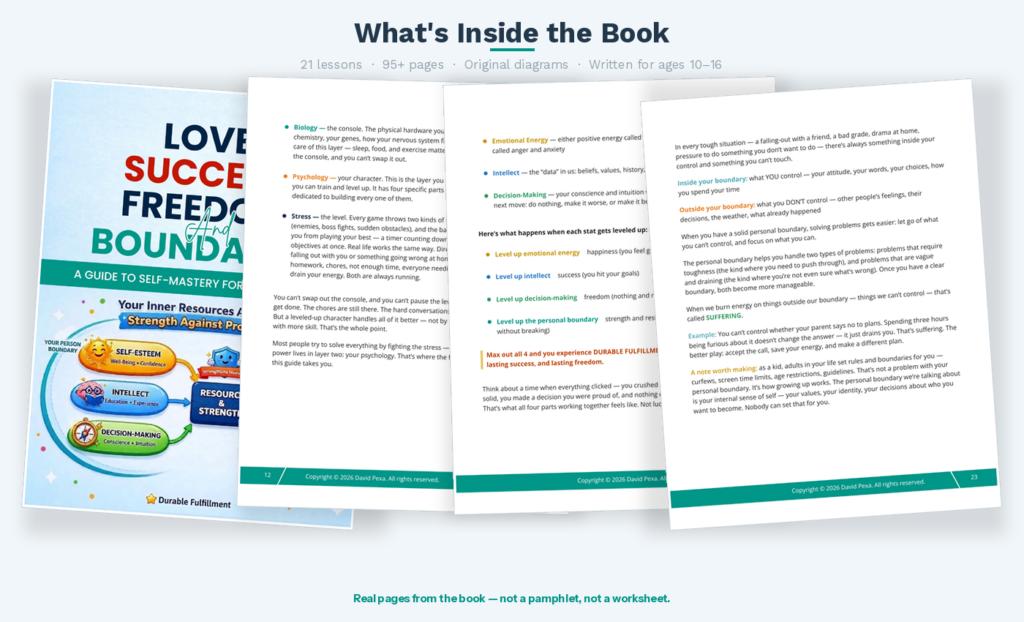
If this resonated, go deeper. My book Love, Success, Freedom and Boundaries gives you twelve frameworks for seeing the patterns that shape your life — and changing the ones that aren’t working.
Frequently Asked Questions
Why am I so easily distracted?
Distraction is usually an avoidance strategy. Your brain seeks distraction when the current task triggers discomfort — boredom, difficulty, or emotional weight. The solution isn’t more willpower; it’s understanding what you’re avoiding.
What’s the most effective way to eliminate distractions?
Design your environment rather than relying on discipline. Remove the phone from the room. Close unnecessary tabs. Make the distraction harder to access than the task. Environment beats willpower every time.
Can I train my brain to focus better?
Yes. Focus is like a muscle — it strengthens with use. Start with short, dedicated focus sessions (25 minutes) and build up. The ability to sustain attention is one of the most valuable skills you can develop.
Keep Reading
- Reducing Anxiety Naturally: Tips – reducing anxiety naturally
- The 10 Morning Habits of Successful People to Master in 2026
- Overcoming limiting beliefs: A Practical Guide to Growth
If you do any writing alongside the focus work — journaling, drafting, processing what you’re noticing — the tool I use to draft most of my words is Wispr Flow. It transcribes your voice into clean, edited text in real time, so the friction between thinking it and writing it basically disappears.
What I Actually Take
If you want a supplement that does what most of these strategies need a boost from, I take BrainSupreme MAAC Stack. A daily nootropic stack that holds focus for hours, not minutes — without the afternoon crash. Use code PEXA at checkout for 15% off.
Conclusion
Understanding is the first step, but it’s what you do with that understanding that changes things. The ideas in this article aren’t meant to sit in your head — they’re meant to shift how you see your situation and give you something concrete to act on. Start with the one thing that felt most relevant, apply it this week, and notice what changes.
A note on affiliates: This article includes affiliate links to platforms I’ve vetted and would recommend to my own clients and students. If you start with a recommended service through a link here, I may earn a small commission — at no extra cost to you. I only mention what I’d actually point you to in person. The recommendation comes first; the relationship is disclosed second.
If this resonates, the full framework lives in Love, Success, Freedom and Boundaries.
A practical playbook for raising emotionally resilient kids — and breaking the patterns you didn’t choose to inherit.
