



Summary: A practical guide to stop procrastinating: how to stop procrastinating with practical systems. What actually works, what doesn’t, and where to start.
I’m a recovering procrastinator. Not the lazy kind — the perfectionist kind, where you delay starting because you’re afraid the result won’t match the vision in your head. Here’s what actually helped me break that cycle.
If you’re reading this, you’ve probably tried the “just do it” approach to beating procrastination. And you’ve probably found that raw willpower just doesn’t cut it. There’s a good reason for that.
The biggest myth about procrastination is that it’s a character flaw or a simple failure of time management. It’s not. At its core, procrastination is an emotional regulation problem. It’s our brain’s way of avoiding negative feelings—like anxiety, boredom, or self-doubt—that we associate with a particular task.
When a task feels threatening, our brain’s limbic system (the part that handles our “fight or flight” response) kicks in. It screams, “Danger!” and steers us toward something more pleasant and immediately gratifying, like checking email or scrolling through social media. This isn’t laziness; it’s a deeply wired instinct to avoid discomfort.
The Real Cost of Putting Things Off
This cycle of avoidance isn’t harmless. It quietly erodes our self-esteem, fuels a constant, low-level hum of anxiety, and can seriously damage our professional reputation.
The financial toll is staggering, too. Research shows the average employee loses around $8,875 annually in productivity due to procrastination. On a global scale, that number balloons to an estimated $650 billion. This isn’t just a minor quirk; it’s a systemic problem with massive consequences.
Trying to fight this with willpower alone is like trying to dam a river with your bare hands. You might hold it back for a moment, but the underlying emotional pressure will eventually overwhelm you. The key isn’t to fight your brain, but to learn how to work with it.
“Procrastination is an emotion regulation problem, not a time management problem.” – Dr. Tim Pychyl, Professor of Psychology
It All Starts with a Mindset Shift
Real change begins the moment you stop blaming yourself. Instead of seeing it as a lack of discipline, we can start getting curious about the root cause.
This means moving from a fixed mindset (“I’m just a procrastinator”) to a growth mindset (“I can build better habits to manage this”). This shift in perspective is everything. It gives you the power to experiment and find what works without the weight of self-judgment. To dig deeper into this, our guide on the differences between a growth vs. a fixed mindset is a great place to start.
Once you have this foundation, you can move from guilt into practical action. The entire approach rests on a few core principles:
- Practice Self-Compassion: Beating yourself up only adds another layer of negative emotion, which just fuels more avoidance. Acknowledge that this is a common human struggle. It’s the first step to breaking the shame cycle.
- Focus on Starting, Not Finishing: The hardest part is almost always getting started. The secret is to make the first step so small and non-threatening that it feels easier to do it than to avoid it.
- Create External Systems: Don’t rely on how you feel. Instead, build systems and design your environment to make doing the work the path of least resistance.
Quick Wins You Can Start Today
Getting started can feel overwhelming, so let’s make it easy. Here are a few incredibly simple strategies you can implement right now to begin building momentum. Don’t try to do them all at once; just pick one that feels doable and give it a shot.
| Strategy | Why It Works | First Step |
|---|---|---|
| The Two-Minute Rule | It lowers the barrier to entry so much that your brain doesn’t have time to resist. | Pick one task you’re avoiding. Set a timer for two minutes and just work on it for that long. That’s it. |
| Tidy Your Workspace | A cluttered space creates mental clutter and decision fatigue. | Spend five minutes clearing your desk or the immediate area where you need to work. |
| Write Down One Task | Getting a task out of your head and onto paper makes it concrete and less intimidating. | Grab a sticky note and write down the single most important thing you need to do next. |
| “Eat the Frog” | Tackling your most dreaded task first gets it out of the way, giving you a huge psychological boost. | Identify the one task you’re dreading the most and commit to working on it for just 15 minutes first thing. |
Remember, the goal here isn’t to magically solve procrastination overnight. It’s about taking one small, manageable step in the right direction. Each tiny win builds the confidence and momentum you need to keep going.
Discovering Your Personal Procrastination Triggers
To really figure out how to stop procrastinating, you have to start with one simple question: Why do you put things off? Procrastination isn’t a one-size-fits-all problem. It’s a deeply personal habit, and the solution has to be just as personal.
Maybe you’re a Perfectionist, so paralyzed by the fear of not doing something perfectly that you never even start. Or maybe you’re an Avoider, actively dodging tasks that just feel boring, overwhelming, or unpleasant. Pinpointing your specific trigger is the first real step toward taking the whole habit apart.
Uncovering Your Procrastination Archetype
Think back to the last big thing you put off. What was the real reason? Were you worried you didn’t have the skills? Afraid of what others might think? Or was it just mind-numbingly dull? You have to be honest with yourself here.
Let’s break down some of the common profiles I see all the time:
- The Perfectionist: You avoid starting because the pressure to be flawless is just too much. The fear of an imperfect result is way more powerful than any deadline.
- The Avoider: You put off anything that feels unpleasant, boring, or anxiety-inducing. This could be making a tough phone call or just diving into a complicated spreadsheet.
- The Overwhelmed: You’re staring at a project so massive that you have no idea where to even begin. The sheer scale of it all leads to analysis paralysis, and you do nothing.
- The Thrill-Seeker: You secretly get a kick out of the adrenaline rush of racing against the clock. You’ve probably told yourself (and others) that you just “work better under pressure.”
Once you see yourself in one of these archetypes, you can stop fighting a generic battle and start targeting the actual cause. An Avoider needs a completely different game plan than a Perfectionist.
Procrastination isn’t a single entity. It’s a symptom with multiple underlying causes. Your job is to become a detective and find the cause that’s driving your delay.
The Mindset Shift From Obligation to Choice
Once you’ve diagnosed your trigger, it’s time to reframe how you think about the task itself. We often see dreaded tasks as obligations that have been forced on us, which immediately creates resistance. The simple act of changing your internal language from “I have to” to “I choose to” can be surprisingly powerful.
“I have to finish this report” feels heavy, like a burden. But what about, “I choose to finish this report so I feel prepared for my meeting”? Now, you’ve connected the task to a positive, personal outcome. It becomes a step toward a goal you actually value, not just a chore to get through. This small mental shift can drain the negative emotions that fuel procrastination in the first place.
This is a core technique used in many therapeutic approaches. If you want to go deeper, you can explore other helpful cognitive behavioral therapy techniques that give you more control over your thoughts and feelings.
The Power of Self-Compassion
It’s so easy to beat yourself up when you procrastinate. But here’s the thing: research shows that self-criticism consistently backfires. It just creates a shame spiral that makes you want to avoid the task even more. The better approach is self-compassion.
This just means acknowledging that procrastination is a normal human struggle, without judging yourself for it. In fact, chronic procrastination is a serious behavioral pattern that affects 20-25% of adults worldwide. That’s a higher prevalence than many other well-known psychological conditions. Seeing it as a legitimate challenge to be solved—not a personal failing—is key.
When you’re stuck in that cycle of stress and overwhelm, this decision tree can help you find a path forward.
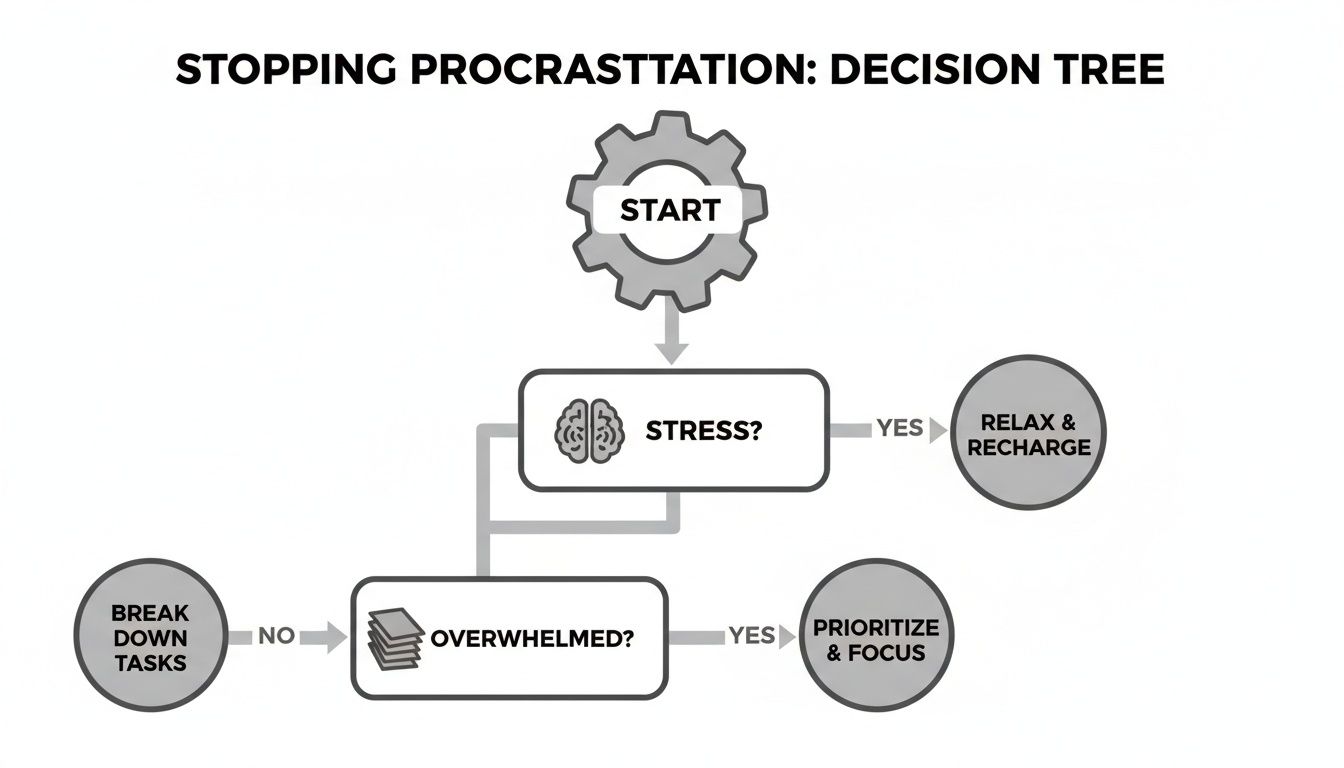
As the flowchart shows, the first move is always to identify the core feeling driving the delay—are you stressed or just overwhelmed? From there, you can choose an action that actually helps.
Building Your Practical Anti-Procrastination System
Knowing why you procrastinate is a huge first step, but insight alone doesn’t check off a to-do list. Now, it’s time to build a practical, external system that works with your brain, not against it. The real goal is to make starting your work the path of least resistance, taking willpower and fleeting motivation out of the equation.
These aren’t just random “productivity hacks.” They are battle-tested frameworks specifically designed to dismantle the habits that fuel procrastination. Let’s dive into a toolkit of specific techniques you can start using today.
Give Every Minute a Purpose with Time Blocking
An open, unstructured schedule is procrastination’s best friend. A vague goal like “work on the presentation this afternoon” makes it incredibly easy for the entire afternoon to just… disappear. Time blocking is the antidote. It fights this ambiguity by giving every block of time in your day a specific job.
You stop living out of your to-do list and start living out of your calendar. Instead of just listing what you need to do, you decide exactly when and for how long you’ll do it.
For instance, a to-do item like “Write blog post” becomes this on your calendar:
- 9:00 AM – 9:45 AM: Research and outline blog post
- 10:00 AM – 10:45 AM: Write first draft of post introduction
This simple shift is a game-changer. The decision of what to work on next is already made for you, which massively lowers the mental barrier to getting started.
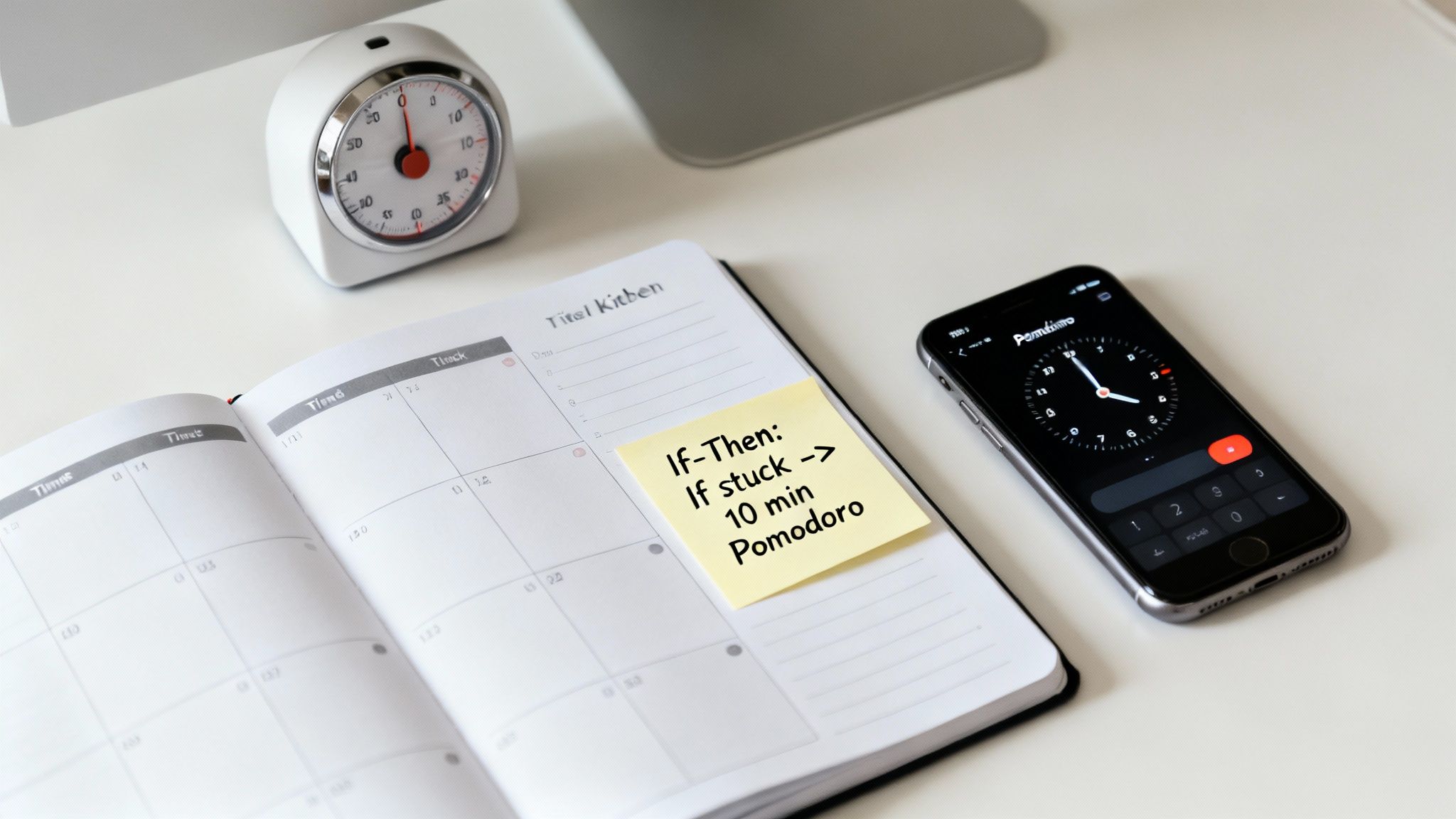
Automate Your Next Move with If-Then Planning
Also known as implementation intentions, this is a powerful psychological trick for hardwiring good habits. You’re basically creating a pre-planned, automatic response to a specific trigger. It’s like writing a simple script for your brain to follow so it doesn’t have to think on its feet.
The formula is dead simple: “If [this situation happens], then I will [do this action].”
This works so well because it removes in-the-moment decision-making. When the trigger you’ve identified occurs, your brain already knows the plan and can execute it on autopilot.
- If I finish my morning coffee, then I will immediately open the project file I’ve been avoiding.
- If I feel the urge to check social media, then I will stand up and stretch for two minutes.
- If it’s 2:00 PM on Tuesday, then I will start my expense report.
By pre-deciding how you’ll handle transitions and temptations, you build a system that runs completely separate from your motivation level. You’re not waiting to feel ready; you’re just following the plan.
Shrink Overwhelming Tasks with the Pomodoro Technique
If you’re an “Overwhelmed” procrastinator who freezes up when looking at a massive project, the Pomodoro Technique will feel like a lifesaver. It breaks down intimidating work into short, highly focused sprints (usually 25 minutes) separated by quick breaks. This method leans on a simple truth: it’s far easier to commit to a small burst of effort than to an endless ocean of work.
Here’s the basic rhythm:
- Pick one—and only one—task.
- Set a timer for 25 minutes.
- Work without any interruptions until the timer goes off.
- Take a real 5-minute break (get up, walk around).
- After four of these “Pomodoros,” take a longer break of 15-30 minutes.
This technique helps you stop procrastinating by changing the goal. Your focus shifts from “finish this entire project” to just “survive for 25 minutes.” Each completed Pomodoro feels like a small win, building momentum and confidence. This kind of focused work is also a core part of building better energy management solutions for your entire day.
Engineer Your Workspace for Deep Focus
Your physical environment is constantly sending subtle cues to your brain. A cluttered desk and a phone buzzing with notifications is a wide-open invitation to get distracted. Environment design is all about intentionally shaping your surroundings to make good behaviors easier and bad ones harder.
First, create a dedicated workspace that your brain associates only with focused work. If you’re at home, this might be a specific desk in the corner of a room—not the couch where you binge-watch Netflix.
Next, you want to remove friction for starting and add friction for procrastinating.
- To Make Work Easier: The night before, lay out the notebook and pen for your first task. Have the necessary files already open on your computer.
- To Make Procrastination Harder: Put your phone in another room. Use a website blocker like Freedom during your work blocks. Close every single browser tab that isn’t related to your current task.
When you optimize your environment, you reduce the number of decisions you have to make and temptations you have to fight. This frees up precious mental energy for the work that actually matters.
Choosing the Right Productivity System for You
Not every technique is a perfect fit for every person or every type of task. The key is to find the system that best counters your specific procrastination style. Think of these methods as tools in a toolbox—you need to pick the right one for the job at hand.
The table below breaks down some of the most effective techniques to help you decide where to start.
| Technique | Best For | Key Benefit | Potential Downside |
|---|---|---|---|
| Time Blocking | People with unstructured days; avoiding decision fatigue. | Creates a clear, actionable plan for the entire day. | Can feel rigid; requires effort to reschedule if things go off track. |
| Pomodoro | Overwhelming tasks; people who get distracted easily. | Makes large projects feel manageable; builds momentum. | Constant interruptions aren’t ideal for creative “flow” states. |
| If-Then Planning | Building specific habits; overcoming predictable triggers. | Automates good behavior and bypasses willpower. | Less effective for complex, unpredictable tasks. |
| Eat the Frog | Dread-filled tasks; “Avoider” procrastinators. | Gets the hardest task done first, creating momentum. | Can be mentally taxing to start the day with your worst task. |
Start by picking the one technique that seems most aligned with your biggest struggle. You don’t need to implement everything at once. Experiment with one system for a week, see how it feels, and then decide whether to stick with it, tweak it, or try another. The goal is progress, not perfection.
Building Your Anti-Procrastination Routine
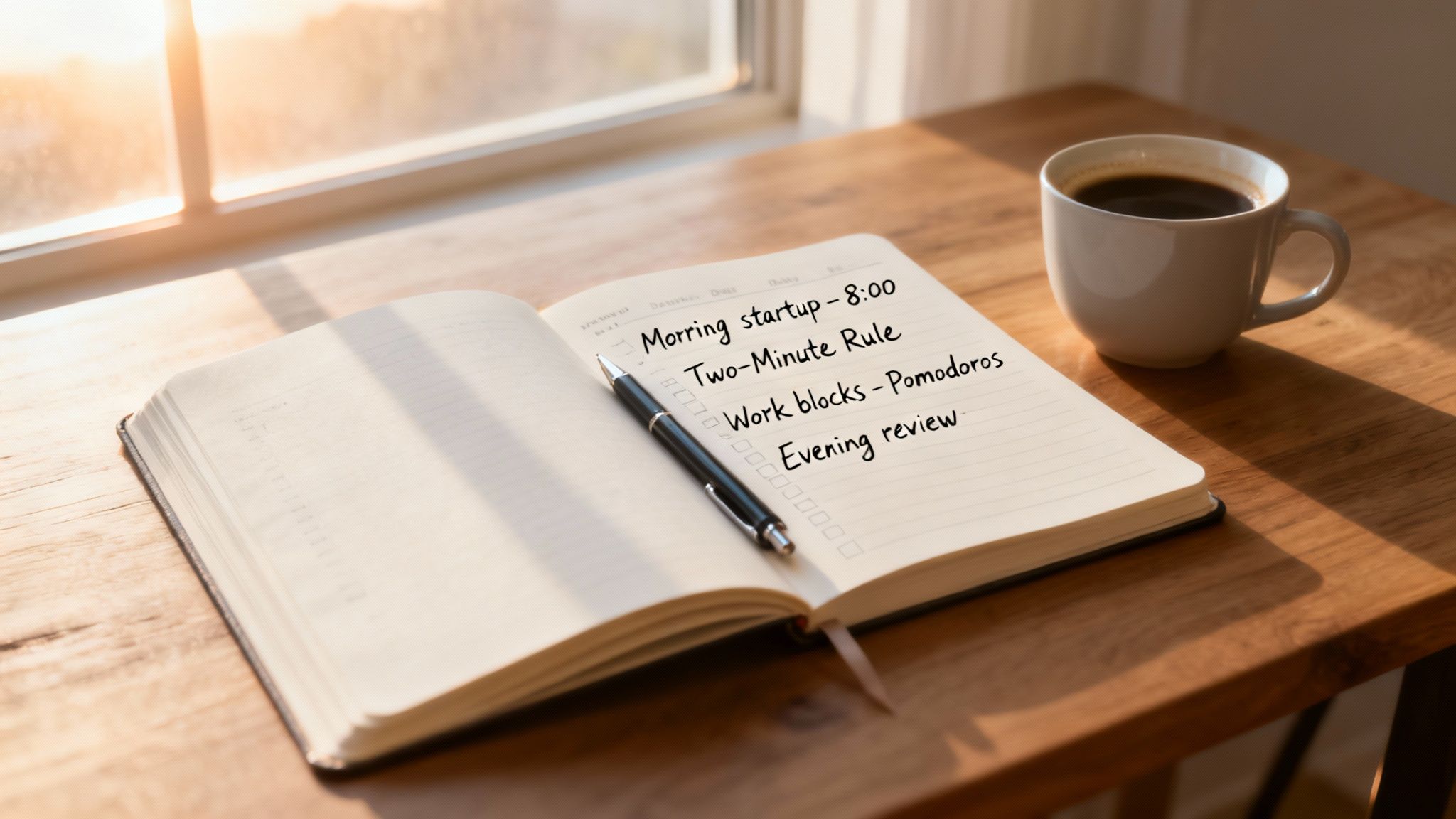
Having a toolkit of strategies is one thing, but actually using them is another. This is where the magic really happens. The secret to finally stopping procrastination for good is weaving these powerful habits into a consistent, daily routine. Think of a solid routine as a scaffold—it supports you when motivation is low and makes getting things done the path of least resistance.
The aim isn’t to lock yourself into a rigid, military-style schedule that shatters the moment life throws you a curveball. It’s about creating a flexible framework, a reliable rhythm for your day that automates the good decisions and saves your precious mental energy for the work that actually matters.
Kickstart Your Day with a Powerful Morning Routine
How you start your day sets the tone for everything else. If you roll over and immediately start scrolling through emails and news alerts, you’re starting on the back foot, reacting to everyone else’s agenda. A proactive morning, on the other hand, builds momentum that can power you through even your toughest tasks.
Your morning startup should be simple and designed to prime your brain for success. It’s less about cramming in more work and more about generating clarity before the chaos of the day kicks in.
Here’s a simple but incredibly effective way to start:
- Hydrate & Move (15 mins): Before you even look at a screen, drink a glass of water. Do a few stretches or take a quick walk around the block. This simple act wakes up your body and brain.
- Plan Your Day (10 mins): Look at your calendar and to-do list. The key here is to identify your one most important task for the day—the one thing that will make you feel accomplished no matter what else happens.
- Launch with a Small Win (5 mins): Find a quick, two-minute task and just do it. Maybe it’s clearing your desk or firing off one specific email. This tiny bit of progress creates an immediate sense of forward motion.
This whole sequence takes just 30 minutes, but I promise it can completely change the trajectory of your entire day.
Structure Your Day for Deep Focus
Once you’ve built that morning momentum, you need to protect your peak focus hours. This is where you bring in the heavy hitters like Time Blocking and the Pomodoro Technique to create dedicated, uninterrupted windows for deep work. I treat these blocks like appointments with my most important client: myself. They are non-negotiable.
Instead of a vague to-do item like “Work on report,” your calendar should have specific, actionable blocks. This small change transforms a fuzzy intention into a concrete commitment.
A system is only as good as the routine that supports it. By designing your schedule, you are no longer leaving productivity to chance; you are building an environment where it is the most likely outcome.
Here’s what a focused morning session could look like on your calendar:
| Time Block | Activity | System Used |
|---|---|---|
| 9:00 – 9:50 AM | Deep Work 1: Draft Q3 report introduction | Pomodoro Technique (2 x 25 mins) |
| 9:50 – 10:00 AM | Scheduled Break: Walk, stretch, get water | Pomodoro Break |
| 10:00 – 10:50 AM | Deep Work 2: Analyze sales data for report | Pomodoro Technique (2 x 25 mins) |
| 10:50 – 11:00 AM | Buffer Time: Review progress & adjust plan | Time Blocking |
A structure like this completely removes the guesswork. You know exactly what to work on and for how long, which is one of the best ways to silence that internal resistance that so often leads to procrastination.
End Your Day with an Evening Wind-Down
Just as a morning routine primes you for a great day, an evening wind-down ensures you close out your work with intention and set yourself up for success tomorrow. This is your chance to process the day, acknowledge what you got done, and clear your head for some well-deserved rest. A frantic, abrupt end to the workday is a recipe for lingering anxiety.
A simple shutdown ritual might look like this:
- Review and Capture: Take 10 minutes to look over what you accomplished. Any unfinished tasks get moved to tomorrow’s list—get them out of your head so they aren’t rattling around all night.
- Plan the First Step: For your biggest task tomorrow, define the very first, tiny action you’ll take. For instance: “On Tuesday, I will open the presentation file and create the title slide before 9 AM.”
- Shutdown Completely: This is crucial. Close all your tabs. Tidy your workspace. Say out loud, “My workday is done.” This creates a clean psychological break between work and personal time, which is absolutely essential for avoiding burnout and staying consistent for the long haul.
What to Do When You Fall Off Track
Let’s get one thing straight: building a system to stop procrastinating isn’t about becoming a perfect productivity machine. That’s a myth. Real progress is messy and never follows a straight line.
You’re going to have days where the plan completely falls apart. An unexpected crisis will torch your schedule, or maybe you just won’t have the energy. It happens to everyone.
Falling off the wagon isn’t a failure—it’s just a data point. The real measure of success isn’t avoiding slip-ups. It’s how quickly you can get back on your feet without beating yourself up about it. One bad day doesn’t have to spiral into a week of avoidance if you know how to handle it.
Conduct a Procrastination Post-Mortem
When you catch yourself putting something off yet again, fight that all-too-familiar urge to get down on yourself. Shame and guilt are procrastination’s favorite fuel. Instead, get curious.
Run a quick, non-judgmental “post-mortem” on what happened. Ask yourself:
- What was the exact trigger that made me stop?
- What feeling was I trying to get away from? (Was it boredom? Anxiety? Sheer confusion?)
- Did my system break down, or did I simply forget to use it?
The goal here isn’t to assign blame. It’s to pinpoint the reason for the breakdown. Maybe you realized the task was way bigger than you thought, or you didn’t block out nearly enough time. This kind of compassionate curiosity turns a setback into a powerful lesson for your next attempt.
Triage and Reset When You Feel Paralyzed
Sometimes, the sheer volume of stuff on your plate is the problem. You stare at a to-do list that has morphed into a monster, and your brain just shuts down. When that paralysis hits, stop trying to conquer the whole list. It’s time to triage.
Grab a blank piece of paper and do an emergency brain dump. Scribble down every single thing that’s making you feel stressed. Then, ask yourself this one critical question: What is the one thing I can do in the next 15 minutes that will bring me the most relief?
Often, the answer isn’t that huge project. It’s the swarm of small, annoying administrative tasks buzzing in the back of your mind. Use Task Batching to swat them all at once. Set a timer for 45 minutes and just answer all those pending emails or make all the phone calls you’ve been dreading. Clearing out that mental clutter can create the breathing room you need to finally face the bigger challenges.
Setbacks are inevitable. Resilience is a choice. Your ability to recover quickly after a slip-up is more important than your ability to follow a perfect plan.
This struggle is incredibly common, especially when the pressure is on. For instance, academic procrastination is a huge issue, with an estimated 80-95% of college students admitting they do it. Research consistently links this behavior to higher anxiety and worse performance, which shows just how vital it is to have these recovery strategies in your back pocket. You can dig into more procrastination statistics to see just how widespread this really is.
Adjust Your System for the Long Haul
A single bad day often shines a spotlight on a weak point in your entire system. Don’t just grit your teeth and push through; use it as a chance to fine-tune your approach.
Here are a few common ways things fall apart and how to adjust:
- If you got derailed by an unexpected crisis: Your schedule is probably too rigid. Start building in “buffer blocks”—pockets of unscheduled time each day—to absorb surprises without wrecking everything.
- If you felt overwhelmed by a single project: You didn’t break it down enough. Your next step shouldn’t be “Write Report.” It should be “Create Outline for Section One.” Make the next action so small it feels ridiculous not to do it.
- If you were simply too tired or burned out: You’re likely ignoring your body’s natural energy cycles. Start paying attention to when you feel sharpest and schedule your most demanding work for those peak hours. Protect your downtime as fiercely as you protect your work time.
By making these small, ongoing adjustments, you build a system that’s more resilient and truly yours. Remember, the goal was never perfection. It’s about creating a sustainable practice that has your back, even on the tough days.
Your Focus Toolkit: Helpful Apps, Books, and Resources
While building better habits is the engine for beating procrastination, the right tools are the high-octane fuel that makes everything run smoother. Smart apps, browser extensions, and even a few good books can provide the external structure you need, especially on days when your willpower is running low.
Think of these not as a magic cure, but as guardrails that keep you on the road to productivity. A good tool simply makes it easier to do what you already planned to do. It automates a system, removes a point of friction, or holds you accountable.
Apps and Extensions for Deep Focus
The best tools are often the simplest ones—they do one thing, and they do it exceptionally well. If you’re serious about implementing something like the Pomodoro Technique, a dedicated app can make all the difference.
Here are a few I’ve seen work wonders for people:
- Forest: This app brilliantly gamifies your focus sessions. You plant a virtual tree when you start a task. If you get distracted and leave the app, your tree dies. It’s a surprisingly effective way to stay on track.
- Freedom: For a more heavy-duty approach, Freedom is the undisputed champ of website and app blocking. You can shut down distractions across all your devices at once, making it a powerful ally in designing your ideal work environment.
- Todoist: A major source of procrastination is feeling overwhelmed. A solid task manager like Todoist is crucial for breaking down huge, scary projects into small, non-threatening steps. Its power lies in helping you create clarity and set deadlines for each tiny piece of the puzzle.
The goal isn’t to find an app that solves your problems; it’s to find one that removes an obstacle. The best tech simplifies your process and reduces the mental energy you spend just trying to stay focused.
Essential Reading for a Productive Mindset
Sometimes the most powerful tool is a new way of thinking. A good book can completely reshape your understanding of work, habits, and the psychology behind why you put things off in the first place. These provide the mental models you need to make lasting changes.
A few foundational books I recommend to nearly everyone are:
- Atomic Habits by James Clear: If you read only one book on this list, make it this one. It’s the definitive, practical guide to building good habits and breaking bad ones through tiny, incremental changes that deliver remarkable results over time.
- Deep Work by Cal Newport: Newport makes a powerful argument that the ability to focus without distraction is becoming increasingly rare and valuable. He provides concrete, actionable advice for cultivating this skill in a world practically designed to distract you.
- The War of Art by Steven Pressfield: This is a short, sharp, kick-in-the-pants manifesto for anyone who struggles with creative work or any task that requires internal motivation. Pressfield gives a name to that internal force of resistance we all feel and shows you how to fight back.
Common Questions Answered
Even with a solid plan, you’re bound to run into some questions as you start untangling the habit of procrastination. Let’s tackle some of the most common ones I hear.
How Long Does This Actually Take?
Look, there’s no magic switch. Procrastination is a deeply wired habit, not a simple glitch you can fix overnight.
Most people start to see real, noticeable changes within a few weeks of consistent effort. The key is to stop chasing perfection and start focusing on progress. It’s not about never procrastinating again—that’s a recipe for failure. The real win is building the self-awareness to notice when you’re slipping and having the tools to get back on track quickly.
What if I Think I Have ADHD or Anxiety?
This is a big one. Procrastination is often a major symptom of conditions like ADHD and anxiety. When that’s the case, the emotional pull to avoid tasks is incredibly strong, and simple productivity hacks might feel like trying to plug a dam with a cork.
The strategies in this guide—breaking things down, managing your environment—are still incredibly helpful. But they might not be the whole solution.
If you suspect something deeper is going on, getting a professional diagnosis is the most important step you can take. A therapist specializing in cognitive behavioral therapy (CBT), for instance, can give you a toolkit that addresses the root cause of the avoidance, not just the symptoms.
Think of self-help strategies as powerful supplements. They work best when paired with professional guidance if you’re dealing with an underlying condition, not as a replacement for it.
Is Procrastination Ever a Good Thing?
Surprisingly, yes—but you have to be careful here. There’s a concept called strategic procrastination (or “active procrastination”), which is the intentional delay of a task.
Sometimes this is a smart move. Maybe you’re waiting for more information to make a better decision, or you’re letting a creative idea marinate. It’s a deliberate choice.
The difference is everything. Chronic procrastination is a gut-level, stress-fueled avoidance you feel you can’t control. Strategic delay is a conscious, calculated choice. You have to be brutally honest with yourself to know which one you’re doing.
If this resonated, go deeper. My book Love, Success, Freedom and Boundaries gives you twelve frameworks for seeing the patterns that shape your life — and changing the ones that aren’t working.
Frequently Asked Questions
Why do I procrastinate even when I know better?
Procrastination isn’t a time management problem; it’s an emotion management problem. You’re not avoiding the task — you’re avoiding the feeling the task triggers: boredom, overwhelm, fear of failure, or perfectionism.
What’s the fastest way to stop procrastinating?
The two-minute rule: if a task takes less than two minutes, do it now. For bigger tasks, commit to just starting for five minutes. Starting is the hardest part; momentum usually carries you forward once friction is overcome.
Is procrastination a sign of laziness?
Almost never. Procrastinators are often high achievers in other areas. The issue is usually perfectionism, anxiety, or unclear priorities — not lack of work ethic. Understanding the root cause is what breaks the pattern.
Keep Reading
- Reducing Anxiety Naturally: Tips – reducing anxiety naturally
- The 10 Morning Habits of Successful People to Master in 2026
- Overcoming limiting beliefs: A Practical Guide to Growth
Conclusion
Understanding is the first step, but it’s what you do with that understanding that changes things. The ideas in this article aren’t meant to sit in your head — they’re meant to shift how you see your situation and give you something concrete to act on. Start with the one thing that felt most relevant, apply it this week, and notice what changes.
If this resonates, the full framework lives in Love, Success, Freedom and Boundaries.
A practical playbook for raising emotionally resilient kids — and breaking the patterns you didn’t choose to inherit.
