



Summary: A practical guide to overcome analysis paralysis and make confident decisions. What actually works, what doesn’t, and where to start.
I once spent three weeks choosing a desk chair. Read every review, compared every spec, built a spreadsheet. By the time I bought one, I’d wasted more hours researching than I’d ever spend sitting in it. That was the moment I realized: analysis paralysis isn’t about wanting the best option — it’s about being afraid to be wrong. Here’s how I learned to break that loop.
To truly overcome analysis paralysis, you have to break the cycle of overthinking. This means intentionally setting boundaries, like time limits, and shifting your focus from finding the “perfect” answer to one that’s simply “good enough.” It’s about taking small, concrete actions. This simple change moves you from endless research to real, tangible progress, letting you move forward even when you don’t have all the information.
Remember, doing nothing is still a decision—and it’s usually the worst one you can make.
The Real Cost of Overthinking and How to Break Free

Ever found yourself three hours deep into researching the “best” coffee maker online, only to feel so swamped by options that you just give up? Or maybe you’ve put off a major career move, getting stuck in an endless loop of weighing every last pro and con until the opportunity just slips away. That’s analysis paralysis in action.
It’s far more than a passing frustration. It’s a genuine productivity killer, fueled by a modern paradox: we have more information at our fingertips than ever, yet we’re finding it harder to make confident decisions. This kind of gridlock usually boils down to a few common psychological traps:
- Perfectionism: The dangerous belief that a single, flawless choice exists and anything short of that is a total failure.
- Fear of Regret: The paralyzing anxiety that you’ll pick the wrong path and be stuck with the fallout.
- Information Overload: Simply being so inundated with data that your brain can’t possibly process it all to find a clear signal.
This isn’t just a waste of time. The cycle actively saps your mental energy and feeds your stress, creating a self-perpetuating loop of inaction and anxiety.
The Data Dilemma in Decision Making
This isn’t just a personal quirk; it’s a massive issue, even at the highest levels of business. In a world where data is supposed to be king, having too much of it often leads to indecision, not clarity.
A global Oracle survey highlighted this perfectly. While 97% of business leaders say they want data to help them make better decisions, a shocking 72% admit that data overload has completely stopped them from making any choice at all.
Even worse, 91% believe the explosion of data sources has actively harmed their organization’s success. This leads to what 85% of leaders experience as ‘decision distress’—a state of constant second-guessing. It’s a clear sign that our quest for certainty can, ironically, lead to total paralysis. You can dig into more of these findings from the data paralysis study on Route Fifty.
Key Takeaway: The goal isn’t to find the one perfect answer. It’s to make a good enough decision that allows you to build momentum. Progress, not perfection, is the only real antidote to paralysis.
Your First Steps Toward Decisive Action
Breaking free from this mental trap requires a deliberate shift in both your mindset and your strategy. Instead of treating every choice like a final, high-stakes exam, you need to start seeing decisions as small, iterative steps on a much longer journey.
Before we dive into the deeper strategies, here are a few quick wins you can use right now to fight off that feeling of being stuck.
Four Quick Wins to Fight Decision Fatigue Today
These simple tactics can help you build momentum immediately, turning overwhelming choices into manageable actions.
| Strategy | How It Works | When to Use It |
|---|---|---|
| Set a Time Limit | Give yourself a specific, non-negotiable block of time for research. When the timer goes off, you make a call with what you know. | Perfect for low-to-medium impact choices, like picking a new software tool or planning a weekend trip. |
| Limit Your Options | Deliberately shrink your list of choices down to just three. Compare only those three and pick the best one from that small group. | A lifesaver when you’re faced with dozens of similar options, like choosing a restaurant or a new pair of headphones. |
| Define “Good Enough” | Before you even start looking, write down the 3-5 essential criteria a solution must meet. The first option that checks all the boxes wins. | Ideal for decisions where perfection is a waste of time, like selecting an online course or a new book to read. |
| Talk It Out | Explain your decision-making process out loud to a friend or colleague for just five minutes. Hearing yourself say it often brings instant clarity. | Use this when you’re stuck in your own head and need an outside perspective to break the loop. |
By putting these small but powerful tactics into practice, you can start building your “decisiveness muscle” and regain control over your choices.
What I Actually Take
BrainSupreme MAAC Stack
Analysis paralysis is what happens when the cognitive load of weighing options outpaces the brain’s capacity to hold them. MAAC Stack is what I take on days I know I’m going to be sitting with hard decisions — not because it makes the decision easier, but because it keeps me from going mentally flat halfway through the work.
Identifying Your Personal Paralysis Triggers

Before you can break free from analysis paralysis, you have to get honest about what flips that switch for you personally. Think of it as a quick diagnostic. A doctor can’t treat an illness without knowing the cause, and you can’t fix indecision without pinpointing its roots.
For most of us, these triggers are surprisingly consistent and often masquerade as responsible behavior. What looks like diligent, thorough research from the outside can easily be a well-disguised fear of making the wrong move.
This self-awareness is your first real step toward taking back control. It’s how you turn that vague, overwhelming feeling of being “stuck” into a specific, manageable problem you can actually solve.
Uncovering Your Hidden Decision Blockers
So, what are the usual suspects? Let’s dig into the most common culprits behind overthinking. As you read through these, see which ones feel a little too familiar. The goal here isn’t to judge yourself; it’s simply to gather some intel on your own thought patterns.
Common triggers often include:
- Perfectionism: The dangerous belief that a single, flawless option exists and anything less is an outright failure. You aren’t just looking for a good choice; you’re on a quest for the mythical perfect one.
- Fear of Failure or Regret: This is that little voice in your head whispering, “But what if I pick the wrong one and it all goes sideways?” It blows potential negative outcomes way out of proportion, making any action feel far too risky.
- Information Overload: You’ve drowned yourself in data. Instead of feeling empowered by your research, you just feel swamped, confused, and less capable of making a clear choice than when you started.
- Lack of Clear Criteria: You don’t actually know what a “win” looks like. Without clear goals or priorities, every option seems to have equal weight, trapping you in an endless loop of comparison.
Ever spent hours researching a $20 purchase to make sure it’s the absolute best value on the market? Or maybe you’ve put off a major career move because you can’t predict every single possible outcome? Recognizing these patterns is the game-changer. For a more structured approach to understanding these mental roadblocks, concepts explored in personal growth counseling can offer deeper insights into your underlying motivations.
A Quick Self-Audit: Ask yourself this—when I get stuck, am I usually searching for more information, or am I trying to avoid the discomfort of making a commitment? The answer often reveals whether the problem is a lack of data or a fear of the outcome.
Defining Your Decision Threshold
One of the most practical ways to break this cycle is to get a handle on your decision threshold. This is simply the point where a choice becomes “good enough” to move forward, even if it falls short of perfect.
Perfectionists operate with an impossibly high threshold. They feel like they need 100% certainty before they can act, which is a recipe for staying stuck forever. A decisive person, on the other hand, intuitively gets the 80/20 principle: they know that getting 80% of the way to a perfect decision is usually more than enough to get the job done.
Think about it this way: your car is low on gas. Do you pull over and spend an hour researching every gas station in a 10-mile radius to find the one with the rock-bottom lowest price, five-star coffee, and sparkling restrooms? Of course not. You find a reasonably priced, reputable station on your route and fill up.
That second option meets your primary need—getting gas—and lets you get on with your day. It has met your decision threshold.
To figure out your own threshold for a specific choice, try answering these questions before you dive in:
- What is the minimum outcome I absolutely need to achieve?
- What would a “good enough” result actually look like?
- How much time and mental energy does this decision really deserve?
By consciously defining “good enough” from the outset, you create a clear finish line for yourself. This simple habit stops you from endlessly moving the goalposts in search of an imaginary perfect solution—a key strategy to overcome analysis paralysis and get your momentum back.
Using the Two-Door Rule to Reframe Your Decisions
We have a bad habit of treating all decisions as equals. We agonize over which email client to use with the same intensity we’d apply to a career change. This is a surefire recipe for decision fatigue and a big part of why we get stuck in the first place.
One of the best mental models I’ve found for breaking this cycle is the “Two-Door Rule.” It’s a simple, powerful way to sort your choices, match your effort to the actual consequences, and give yourself permission to move fast on the things that don’t matter as much.
The idea is simple: every decision you face is behind one of two doors.
The One-Way Door Decisions
These are the big ones. A one-way door decision is a choice that’s permanent, or at least incredibly difficult and costly to undo. Once you walk through, coming back is nearly impossible.
Think about choices like:
- Hiring a senior leader for your team.
- Selling your company or making a massive financial investment.
- Committing to an exclusive, long-term business partnership.
- Pivoting your company’s core product strategy.
These decisions demand that you slow down. This is where you should pull out all the stops: gather the data, talk to mentors, and carefully map out the pros and cons. Rushing a one-way door decision is how you make mistakes that you’ll regret for years.
The Two-Way Door Decisions
Now, this is where you can find real freedom from paralysis. A two-way door decision is reversible. If you walk through and don’t like what you see on the other side, you can just turn around and walk right back out. The cost of being wrong is low.
A few examples off the top of my head:
- Trying out a new headline for a marketing campaign.
- Testing a different project management app.
- Experimenting with a new format for your weekly team meeting.
- Choosing which business book to read next.
The truth is, the vast majority of our decisions fall into this category. The problem is, we treat them like they’re one-way doors. We’ll lose days researching the “perfect” CRM when we could just pick one, try it for a week, and switch if it doesn’t fit.
The single biggest mistake fueling analysis paralysis is misclassifying a two-way door as a one-way door. When a decision is cheap to reverse, the smart move is to decide quickly and get real-world feedback—not to keep researching in a vacuum.
Putting the Framework into Action
Jeff Bezos famously hardwired this thinking into the culture at Amazon, classifying most choices as reversible “Type 2” decisions that should be made with speed. This mindset empowers teams to act instead of getting stuck in endless deliberation. The data supports this approach, too. Companies that blend solid analytics with quick, intuitive calls on these reversible choices often make decisions 25% faster and see their productivity climb by 20-30%.
The key takeaway is that for most things, momentum is more valuable than perfection. You can learn more about how this framework applies in a business context and its impact on Strategic Decision Solutions.
So, how do you actually use this? The next time you feel stuck, just ask yourself this one question:
“Is this a one-way or a two-way door?”
If the answer is “two-way,” your goal is no longer to find the perfect answer. It’s to find a good enough answer and move on. Give yourself a strict deadline—maybe just 10 minutes—and make a call.
Let’s walk through a common scenario. You’re picking a new project management tool for your small team. You’re down to three options and you’ve already burned a week comparing feature lists.
- Identify the Door Type: How hard is this to reverse? Not very. Most SaaS tools are monthly subscriptions, and almost all have free trials. Switching later might mean a few hours of migrating tasks, but it’s not a catastrophe. This is a classic two-way door.
- Change Your Goal: Stop looking for the one perfect tool that will solve every problem for the next five years. Instead, your goal is to pick the one that seems best right now and just get started.
- Act and Learn: Pick the front-runner and sign up for the trial. Use it with your team for a week. If it works, great—you’ve made a solid choice. If you hate it, fantastic—you’ve just learned what you don’t want. Now you can walk back through the door and try another option, but this time you’re armed with real-world experience, not just a spec sheet.
By consciously sorting your choices this way, you free up an incredible amount of mental bandwidth. You stop wasting energy on the small stuff and can save your deep, analytical thinking for the few big decisions that will actually define your success.
Actionable Techniques to Break the Paralysis Cycle
Knowing what triggers your analysis paralysis is one thing; breaking free from it is another. When you’re stuck in that endless loop of what-ifs, you need a set of practical, go-to tools to force a decision. These aren’t abstract theories—they’re battle-tested methods you can pull out the moment you feel yourself starting to spin.
Think of these as your personal toolkit for getting out of your own head and into action. Each one serves a different purpose, but they all share the same goal: to replace circular thinking with forward momentum.
Set Hard Limits with Timeboxing
One of the fastest ways to kill overthinking is to simply give yourself less time for it. This technique, called timeboxing, is all about setting a strict, non-negotiable deadline for a decision. It’s a direct counter-punch to the myth that more time automatically leads to a better choice.
Often, analysis paralysis is just a symptom of information overload. In fact, it’s a problem that causes an estimated 72% of leaders to freeze up and delay key decisions. By setting a hard time limit, you’re not just organizing your schedule; you’re forcing your brain to focus on what truly matters and discard the rest. You can see how top SaaS companies tackle this in this great piece from Paddle.
Here’s a simple flowchart I use to quickly decide if something is worth agonizing over or if I just need to make a call and move on.
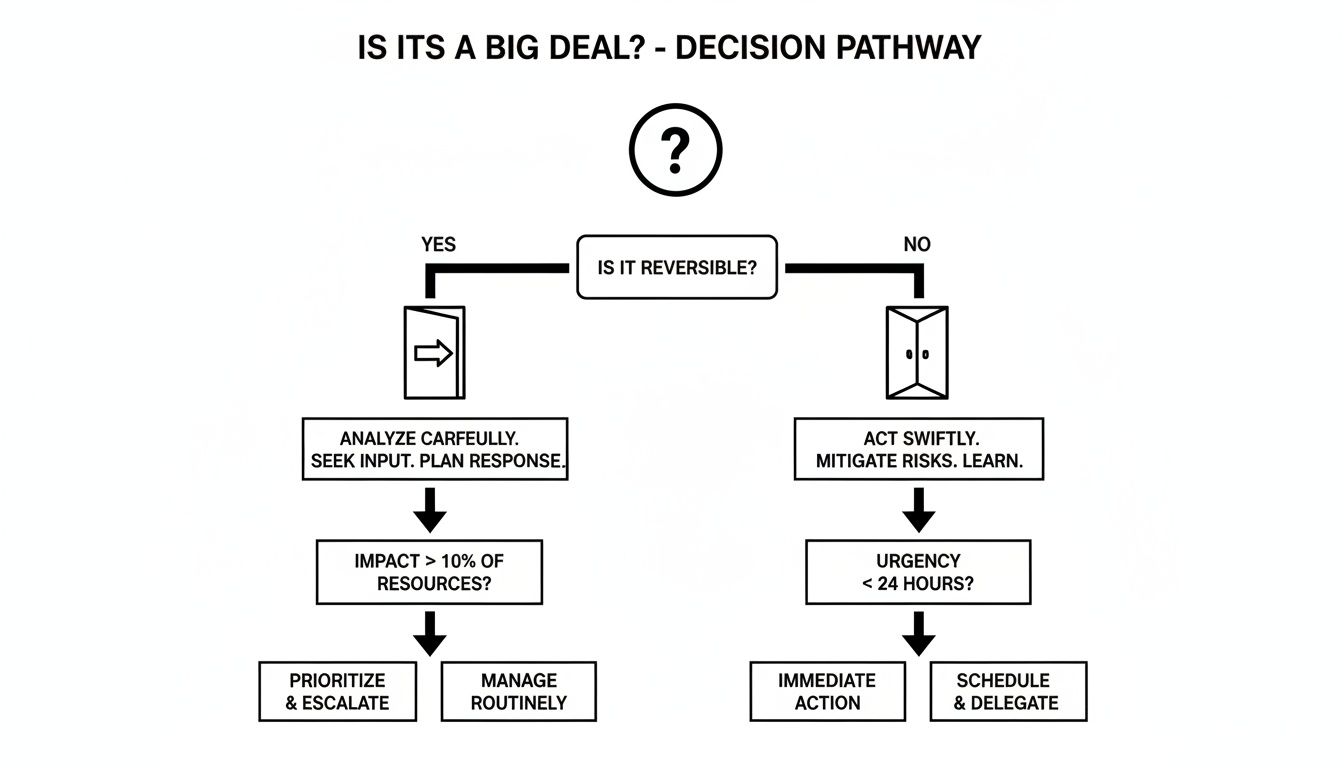
This kind of quick mental check is invaluable. It helps you reserve your heavy-duty analytical power for the decisions that actually deserve it.
Embrace “Good Enough” with Satisficing
Perfectionism is pure fuel for analysis paralysis. We get stuck hunting for a mythical “perfect” option that, let’s be honest, probably doesn’t exist. The antidote to this is a concept called satisficing—a mashup of “satisfy” and “suffice.” It’s about picking the first option that meets your minimum essential criteria, not searching endlessly for the absolute best.
Think about choosing a new laptop. A “maximizer” would get lost for weeks comparing every last spec, reading hundreds of reviews, and still have nagging doubts. A “satisficer,” on the other hand, starts by defining their core needs.
- Non-negotiables:
- Minimum 16GB of RAM for smooth multitasking.
- Battery that lasts at least 8 hours.
- Stays under a $1,200 budget.
The very first laptop they find that ticks those three boxes is the one they buy. They’ve just saved themselves dozens of hours and a ton of mental energy, and they still walk away with a machine that does exactly what they need it to do.
Key Insight: Satisficing isn’t about lowering your standards. It’s about being brutally honest about what your standards really are, and then acting decisively once they’re met.
Build a Criteria-Based Scorecard
For bigger, more complex decisions with lots of moving parts, trying to weigh everything in your head is a recipe for disaster. A criteria-based scorecard is a simple but powerful tool for offloading that mental work onto paper, transforming a subjective mess into an objective comparison.
The real magic here is that it forces you to define what’s important before you even start looking at the options. Let’s say you’re an entrepreneur choosing a payment processor for your e-commerce site.
- List Your Criteria: First, you’d list the factors that matter most.
- Transaction Fees
- Ease of Integration
- Quality of Customer Support
- International Payment Options
- Assign Weights: Not all criteria are created equal. You decide transaction fees are the absolute top priority, so you give it more weight.
- Transaction Fees (Weight: 5)
- Ease of Integration (Weight: 4)
- Customer Support (Weight: 3)
- International Payments (Weight: 2)
- Score Each Option: Now, you research three different processors (let’s call them A, B, and C) and score each one from 1 to 5 for every single criterion.
- Calculate the Winner: Finally, you do the simple math: multiply each score by its weight and add it all up. The processor with the highest total is your data-driven winner.
This simple exercise strips emotion and bias out of the process. It gives you a clear, logical reason for your final choice, which is fantastic for quieting that “what if” voice that keeps you stuck. You’ve turned a complicated decision into basic arithmetic.
Decision-Making Technique Comparison
To make it even easier, here’s a quick-reference guide to help you pick the right tool for the job. Each technique shines in different scenarios.
| Technique | Best For | Key Benefit |
|---|---|---|
| Timeboxing | Quick, low-stakes decisions or when you have too much information. | Forces rapid action and prevents over-researching. |
| Satisficing | Decisions with many “good enough” options (e.g., choosing software, hiring). | Saves immense time and mental energy by avoiding the hunt for perfection. |
| Criteria-Based Scorecard | Complex, high-stakes decisions with multiple competing factors. | Provides an objective, data-driven framework that removes emotion and bias. |
Choosing the right technique is half the battle. Think of this table as your cheat sheet for breaking through indecision quickly and effectively.
Designing an Environment That Encourages Decisiveness
While it’s great to have tools for breaking out of analysis paralysis in the moment, the real win is preventing it from happening in the first place. This requires a shift from being reactive to being proactive. You can actually design your daily environment—both what’s around you and what’s in your head—to make decisiveness your default setting.
Think of it as building a lifestyle that smooths the path to clear, confident action. It’s about being intentional with the information you consume, planning ahead for common choices, and creating momentum with small, steady wins. The goal is to build a resilient system that stops paralysis before it ever gets a chance to take hold.
Curate Your Information Diet
Just like junk food clogs your arteries, a constant diet of low-quality information clogs your decision-making channels. Information overload is one of the biggest triggers for getting stuck. The only way out is to become a ruthless curator of what you let in.
Instead of trying to read everything, find a small handful of truly trusted sources for different parts of your life. Maybe it’s two or three industry experts for career advice, one go-to tech reviewer for big purchases, and a specific financial advisor you trust for money matters.
- Unsubscribe aggressively. Go through your inbox and social media feeds right now. If an account or newsletter creates more noise than signal, get rid of it.
- Create a “trusted sources” list. Keep a simple note of your go-to experts. When a decision comes up, you’ll know exactly where to look instead of diving into the black hole of an open internet search.
- Set research limits. Before you start digging, decide how many sources you’ll actually check. For a medium-sized decision, maybe it’s just three solid articles or reviews. That’s it.
This deliberate filtering cuts down on the sheer volume of conflicting data you have to sift through, making it so much easier to find clarity and just act.
Adopt a Pre-Mortem Mindset
One of the biggest reasons we overthink is a simple fear of failure. We get paralyzed imagining all the ways things could go wrong. The Pre-Mortem is a brilliant exercise that flips this fear on its head, turning it from a roadblock into a roadmap.
Here’s how it works. Before making a big decision, imagine it’s six months from now and the whole thing has been a complete disaster. Then, work backward—either by yourself or with a team—and list all the reasons why it failed.
A Pre-Mortem isn’t about being negative. It’s a strategic way to drag potential risks out into the light so you can create plans to deal with them before they become real problems. This turns that vague, gut-wrenching anxiety into a concrete, manageable action plan.
For instance, if you’re deciding whether to launch a new product, your Pre-Mortem might spit out risks like “our marketing message was confusing” or “we totally underestimated the customer support demand.” Great. Now you can build specific tasks into your project plan to nail the messaging and staff up support, making the final “go” decision feel far less like a gamble.
Automate Recurring Choices with If-Then Plans
So many of the little decisions we make every day are repeats. What should I work on first? What am I having for lunch? When will I exercise? These tiny choices drain our mental batteries, leaving us with less juice for the decisions that actually matter. You can put these on autopilot with simple If-Then plans.
The structure couldn’t be easier: If [situation X] happens, then I will do [action Y].
- For productivity: If it’s 9 AM on a Monday, then I will immediately start on my most important task for the week. No exceptions.
- For your health: If I feel that afternoon slump coming on, then I will take a 15-minute walk instead of grabbing a candy bar.
- For tech choices: Picking the right gear can be a huge time-sink. You could create a rule like: If my current laptop is slowing down my key tasks, then I will check a guide on the best laptops for productivity and pick one from the top three.
These pre-made decisions wipe out the need for in-the-moment debate, saving your willpower for when you really need it. By building this kind of supportive environment, you create an ecosystem where clear, confident action becomes the path of least resistance.
Common Questions About Overcoming Analysis Paralysis
It’s one thing to read about decision-making strategies, but it’s another thing entirely to use them when you’re actually stuck. Knowing the theory is great, but what do you do in the moment?
This section is for those real-world sticking points. I’ve gathered the most common questions people have when they start trying to break the cycle of overthinking. Think of this as your field guide for when you feel yourself slipping back into old habits.
What’s the Fastest Way to Stop Analysis Paralysis When I Feel It Happening?
The second you feel that familiar dread and overwhelm creeping in, your only job is to break the circuit. You need to interrupt the overthinking loop, and the quickest way to do that is with a hard, immediate constraint.
Grab your phone and set a timer for five minutes. That’s it. In that tiny window, you must make a “good enough” choice and take one tiny action. It could be as simple as adding the item to your cart, drafting a one-sentence email, or just picking a direction and literally taking a step.
For any decision that isn’t permanent, constantly remind yourself it’s a “two-way door.” You can almost always tweak, pivot, or even completely reverse your course later. This simple, forceful action proves a crucial point: movement, not more thinking, is the cure.
How Do I Know If I’m Doing Enough Research or Just Overthinking?
This is a tough one, but there are some tell-tale signs that you’ve drifted from productive research into the weeds of paralysis. You’re probably overthinking if you catch yourself:
- Re-reading the same stuff: You’re clicking on the same articles or staring at the same spreadsheet, but you’re not gaining any new insight.
- Hunting for a unicorn: Your goal has quietly shifted from finding a good option to finding a mythical perfect option with zero flaws.
- Feeling worse, not better: The more you research, the more anxious and confused you get. Good research brings clarity and confidence, not more stress.
- Giving a $10 problem a $1,000 solution: You’ve spent hours agonizing over a decision where the negative impact of a “wrong” choice is incredibly small.
A fantastic rule of thumb here is the 80/20 principle. Once you’ve gathered about 80% of the information you need to make a solid choice, it’s time to act. That last 20% of data rarely changes the final decision, but it’s where 90% of the overthinking happens.
Can Analysis Paralysis Be a Sign of a Deeper Issue Like Anxiety?
Yes, absolutely. While getting stuck on a decision from time to time is perfectly normal, chronic analysis paralysis can often be a symptom of something deeper, like generalized anxiety, perfectionism, or an intense fear of uncertainty.
The strategies we’ve talked about are incredibly effective for managing the behavior itself. But if you find that indecision is consistently derailing your life, causing you real distress, or stopping you from making big life moves, it might be worth talking to a mental health professional. They can help you get to the root of the thought patterns driving the paralysis, which offers a much more sustainable path to feeling confident and in control.
How Can I Apply These Principles to Major Life Decisions?
When you’re facing a huge, “one-way door” decision—think a career change, a big move, or starting a family—you use the same core principles, just with more structure and intention. The goal isn’t to decide faster; it’s to decide better and without getting stuck for months or years.
Here’s a practical way to frame it:
- Define Success First: Before you even look at a single option, get out a notebook and write down exactly what a successful outcome looks like. What are your non-negotiables? What absolutely has to be true for this to be the right move?
- Timebox Your Research in Phases: Don’t just “do research.” Break it down into focused, time-limited sprints. For example:
- Week 1: Go wild with brainstorming. Get every possible option on paper.
- Week 2: Cut the list down to your top three contenders.
- Weeks 3-4: Do a deep dive on only those three. Talk to people who have made similar choices.
- Run a “Pre-Mortem”: This is a powerful exercise. Imagine it’s a year from now and the decision you made was a total disaster. Now, work backward and list all the reasons it failed. This helps you spot real-world risks you can plan for, instead of getting frozen by vague, undefined fear. For more ideas on building this kind of forward-thinking mindset, you might find some inspiration in the best personal growth podcasts out there.
By layering this kind of structure onto a big decision, you can navigate life’s most important choices with clarity, making sure you’ve done your homework without getting lost in the paralysis trap.
If this resonated, go deeper. My book Love, Success, Freedom and Boundaries gives you twelve frameworks for seeing the patterns that shape your life — and changing the ones that aren’t working.
Frequently Asked Questions
What causes analysis paralysis?
Fear of making the wrong choice disguised as thoroughness. When you’re stuck analyzing, you’re usually trying to eliminate risk entirely — which is impossible. The paralysis protects you from the discomfort of uncertainty.
How do I break out of analysis paralysis?
Set a decision deadline and honor it. Most decisions are reversible, and the cost of delay usually exceeds the cost of a suboptimal choice. Decide, act, adjust. That cycle is faster and more informative than endless analysis.
Is analysis paralysis a sign of anxiety?
Often, yes. The need to analyze every option thoroughly can be an anxiety response — a way to feel in control when uncertainty feels threatening. Addressing the underlying anxiety often resolves the paralysis.
Keep Reading
- Reducing Anxiety Naturally: Tips – reducing anxiety naturally
- The 10 Morning Habits of Successful People to Master in 2026
- Overcoming limiting beliefs: A Practical Guide to Growth
Conclusion
Understanding is the first step, but it’s what you do with that understanding that changes things. The ideas in this article aren’t meant to sit in your head — they’re meant to shift how you see your situation and give you something concrete to act on. Start with the one thing that felt most relevant, apply it this week, and notice what changes.
If this resonates, the full framework lives in Love, Success, Freedom and Boundaries.
A practical playbook for raising emotionally resilient kids — and breaking the patterns you didn’t choose to inherit.
