



Summary: Unlock cognitive behavioral therapy techniques for lasting change — a practical breakdown of what matters, what doesn’t, and what to do next.
CBT techniques are some of the most practical tools I’ve encountered in my counseling training. They don’t require you to spend years unpacking your childhood — they give you something you can use today.
Cognitive behavioral therapy techniques aren’t abstract theories—they’re practical, hands-on tools for changing the thinking and behavior patterns that hold you back. At their core, these strategies help you see the direct line connecting your thoughts, feelings, and actions, giving you the power to step in and break cycles that aren’t serving you.
The Foundation of Cognitive Behavioral Therapy
Picture your mind as a machine with three interconnected gears: thoughts, feelings, and behaviors. When one gear turns, the others can’t help but move with it. A negative thought like, “I’m definitely going to mess up this presentation,” immediately turns the next gear, sparking a feeling of anxiety. That anxiety then turns the third gear, leading to an action—like procrastinating or avoiding practice altogether.
Cognitive Behavioral Therapy (CBT) gives you a manual for that machine. It’s built on a simple yet powerful idea: it’s not the events in our lives that upset us, but how we interpret them. By learning to catch and question those interpretations, we can completely change how we feel and what we do next.
This approach is structured and firmly planted in the present. While some therapies explore the distant past to find the “why,” CBT focuses on the “here and now.” It’s less about digging for roots and more about giving you actionable skills to manage today’s challenges effectively.
A Proven Framework for Change
CBT isn’t some new fad. It was developed back in the 1960s by psychiatrist Dr. Aaron T. Beck. He noticed that his patients consistently reported an internal running commentary of automatic negative thoughts that shaped their moods. What started as an observation has since become one of the most well-researched forms of psychotherapy, with its effectiveness backed by over 2,000 studies.
The real strength of CBT lies in its practicality. These aren’t just concepts to ponder; they are skills you can learn, practice, and weave into your daily life to build genuine mental resilience. This guide will walk you through the most effective techniques, giving you a solid foundation for lasting personal growth and well-being.
What This Guide Covers
We’re going to break down the essential strategies you can start using right away. Think of this guide as a progressive journey, moving from core concepts to real-world applications so you understand not just the “what,” but the “how” and “why” behind each tool.
You’ll learn how to:
- Spot and question the automatic negative thoughts and cognitive distortions that pop into your head.
- Use behavioral strategies like activity scheduling and exposure therapy to tackle avoidance and inertia.
- Lean on structured tools like thought records and behavioral experiments to test your beliefs against reality.
- Apply these techniques to everyday situations, from managing stress at work to quieting daily anxiety.
Our goal is to pull back the curtain on CBT and show it for what it is: a set of teachable skills for gaining more clarity and control over your emotional life. By the time you’re done, you’ll have a clear roadmap for replacing unhelpful habits with more constructive ones, putting you firmly in charge of your own mental well-being.
How to Restructure Your Automatic Thoughts
Think of your mind as a garden. Thoughts are constantly sprouting—some are helpful, but others are like weeds. These are your automatic negative thoughts, and if left unchecked, they can quickly choke out the positive feelings you’re trying to grow.
Cognitive restructuring is the process of becoming a mindful gardener. It teaches you to spot these mental weeds, understand why they’re there, and gently replace them with more balanced, helpful thoughts.
The process kicks off with a simple realization: your first reaction isn’t always the truth. It’s just a story your brain tells you, often based on old habits, past experiences, or deeply ingrained beliefs. Many of these stories fall into predictable, unhelpful patterns called cognitive distortions—think of them as flawed lenses that warp how you see the world.
For example, you make a tiny mistake on a report at work and your first thought is, “I’m a complete failure.” That’s black-and-white thinking, where everything is either perfect or a disaster, with no room for nuance.
Or maybe a friend doesn’t text back right away, and your mind jumps to, “They must be mad at me.” That’s a classic case of mind reading, where you assume you know someone else’s intentions without a shred of evidence.
This isn’t about forcing yourself into “positive thinking.” It’s about being more accurate and fair with yourself.
Identifying Your Cognitive Distortions
You can’t pull a weed if you don’t know what it looks like. The first step is learning to spot these thought patterns as they happen. Just becoming familiar with common cognitive distortions gives you the power to catch them in the act, which is the first step to dismantling them.
Here are a few common ones to watch for:
- Catastrophizing: You see a minor setback and immediately expect the worst-case scenario. A typo in an email becomes a sign that you’re about to be fired.
- Overgeneralization: You take a single negative event and spin it into a never-ending cycle of defeat. One bad date means you’ll “always be alone.”
- Personalization: You blame yourself for things that are completely out of your control. You might feel responsible if a team project hits a snag, even when other factors were at play.
Recognizing these patterns is like flipping on a light switch in a dark room. Suddenly, you can see the thought for what it really is—a distorted interpretation, not a cold, hard fact.
Using a Thought Record to Challenge Beliefs
One of the most powerful tools for this job is the Thought Record. Think of it as a worksheet for your mind. It helps you slow down and dissect a negative thought with the calm curiosity of a detective, letting you examine the evidence before jumping to a conclusion.
A Thought Record transforms an overwhelming emotional reaction into a structured, manageable problem. It provides a clear, step-by-step framework to move from automatic belief to balanced perspective.
The process is deceptively simple but incredibly effective. It breaks down a big, messy emotional experience into logical pieces, creating just enough space for you to step in and reshape your response. This simple cycle shows just how connected our inner world is.
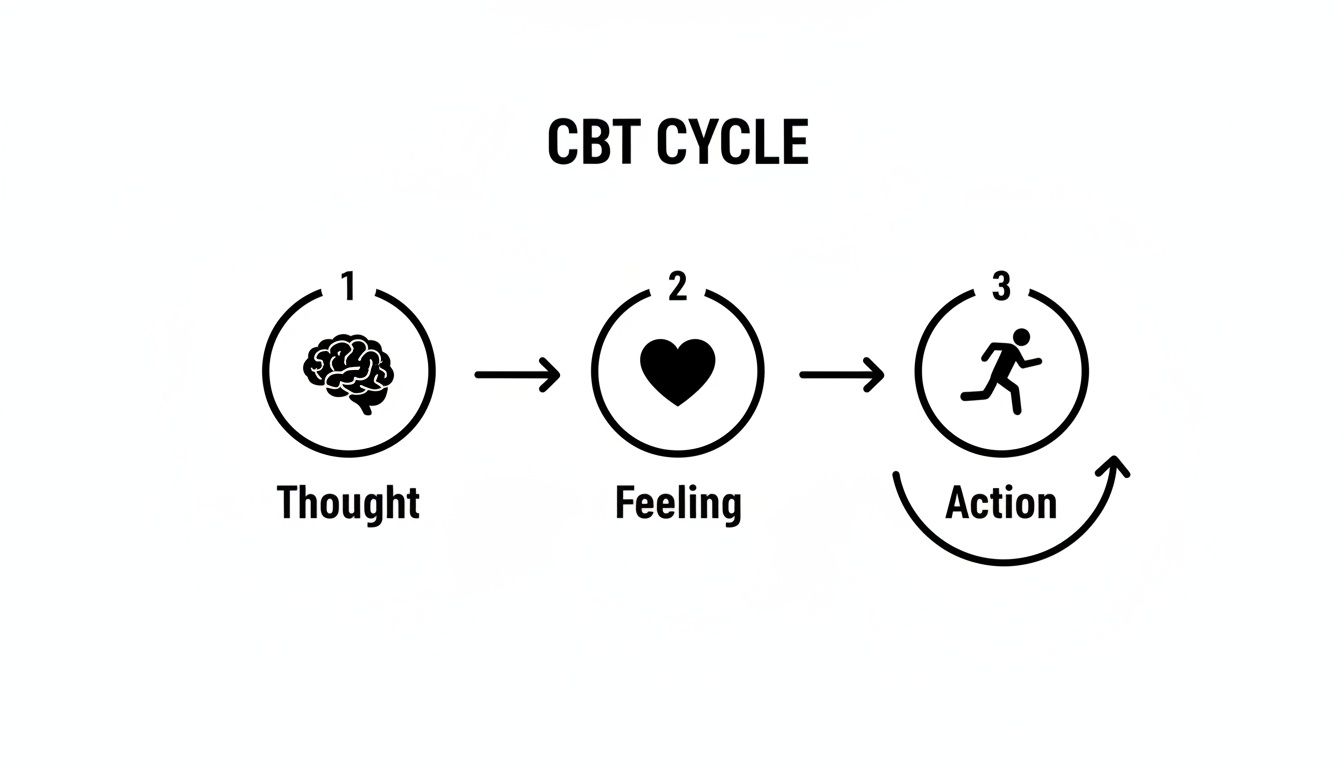
As you can see, a single automatic thought can kick off a powerful chain reaction. This is why learning to intercept that first thought is such a critical skill for changing how you feel and act.
Your Step-by-Step Guide to a Thought Record
Let’s walk through how to use this tool with a real-world example.
1. The Situation: First, just describe what happened. Be factual and specific—no emotion, just the event.
- Example: My manager sent a one-line email that just said, “We need to talk about your project report.”
2. Your Automatic Thoughts and Feelings: Now, write down the very first things that popped into your head and the emotions that came with them. Rate the intensity of the feeling from 0 to 10.
- Example: “I’m in trouble. He hates the report and thinks I’m incompetent.” I felt intense anxiety (9/10) and shame (7/10).
3. The Evidence For Your Thought: Put on your prosecutor hat. What facts actually support this negative thought? It might be tough, but try to find any piece of evidence, no matter how small.
- Example: “The email was very blunt and didn’t have any pleasantries.”
4. The Evidence Against Your Thought: Time to switch roles. Now you’re the defense attorney. What facts or alternative explanations contradict your automatic thought?
- Example: “My manager has always given me positive feedback in the past. He is known for sending very brief emails to everyone. He might just have a simple question or a suggestion.”
5. Create a Balanced Thought: After looking at both sides, your job is to craft a new, more realistic thought that honors all the evidence.
- Example: “While his email was brief, which made me anxious, it’s more likely he just has a quick question or edit. His past feedback has been good, so I don’t have enough information to conclude he thinks I’m incompetent.”
By practicing this consistently, you’re not just filling out a worksheet—you’re training your brain to pause, question, and choose a more balanced path instead of automatically defaulting to a negative one.
Putting Change into Action with Behavioral Techniques
Challenging your thoughts is a huge part of the puzzle, but real, lasting change happens when you start doing things differently. This is where the behavioral side of CBT comes in. It’s all about turning those mental insights into real-world momentum.
These strategies give you concrete ways to break out of the cycles of avoidance, fear, and inactivity that keep so many of us stuck. You stop being a passive observer of your own mind and become an active participant in your progress. Instead of just thinking about why you procrastinate, you take a small, deliberate step to get moving again.

The power of these tools lies in the positive feedback loop they create. When you take a small action and see that the catastrophe you predicted doesn’t happen, you gather powerful, firsthand evidence that directly contradicts those old, unhelpful beliefs.
Jump-Start Your Motivation with Behavioral Activation
When you’re feeling down or anxious, motivation can completely disappear. The very things that might actually help—getting some exercise, calling a friend, tackling a project—can feel like climbing a mountain. Behavioral Activation is the tool designed to break this very specific kind of stalemate.
Think of it like jump-starting a car. You don’t sit around waiting for the engine to magically warm up; you give it a jolt of energy to get things firing. Behavioral Activation does the same for your mood and motivation.
The core idea is refreshingly simple: action precedes motivation. You don’t wait to feel like it; you just do it. You start by scheduling small, achievable activities, no matter how you feel. The goal isn’t an instant mood boost, but simply to get the flywheel spinning. The good feelings will follow.
Gradual Steps to Overcome Fear with Exposure Therapy
Some fears feel like insurmountable walls. It could be public speaking, navigating a social event, or even just making a simple phone call. Our natural instinct is to back away and avoid the discomfort. Exposure Therapy provides a structured, surprisingly gentle way to dismantle that wall, one brick at a time.
The whole point is to approach what scares you gradually, through a series of manageable steps. To do this, you create what’s called a fear ladder (or an exposure hierarchy), where you list situations related to your fear, starting with the least scary and working your way up to the most intimidating.
Exposure therapy isn’t about throwing yourself into the deep end. It’s about systematically and safely teaching your brain that the situations you fear are not as dangerous as it believes.
For instance, someone with a fear of public speaking might build a ladder that looks like this:
- Step 1: Writing down a few ideas for a presentation, all by yourself.
- Step 2: Practicing the presentation out loud in an empty room.
- Step 3: Recording yourself giving the talk and watching it back.
- Step 4: Presenting to a single trusted friend or family member.
- Step 5: Speaking up for just one minute in a low-stakes team meeting.
By starting at the bottom and only moving up when you feel reasonably comfortable, you build confidence and slowly desensitize your nervous system. Each step proves you can handle it, which makes the next one feel far less daunting.
Test Your Beliefs with Behavioral Experiments
So many of our deepest anxieties are rooted in negative predictions. We worry that if we speak up, we’ll be shot down. If we ask for help, we’ll be seen as incompetent. Behavioral Experiments turn you into a scientist, allowing you to actually test these predictions out in the real world.
While Exposure Therapy focuses on reducing fear, behavioral experiments are more about gathering data to challenge a specific negative thought. You pinpoint a nagging belief, make a prediction based on it, and then design a small, low-risk experiment to see what really happens.
Let’s walk through an example for someone who believes, “If I share my opinion, people will think it’s stupid”:
- Prediction: “If I contribute one idea in tomorrow’s brainstorming session, my colleagues will ignore it or criticize it.”
- The Experiment: “During the meeting, I will share one relevant, thought-out idea when the opportunity arises.”
- The Result: You share the idea. A colleague actually builds on it, and your manager thanks you for the contribution.
This direct experience delivers powerful, undeniable evidence that your original belief might not be so accurate after all. The point isn’t to be “right” or “wrong,” but to gather more objective data than your anxiety is feeding you. These hands-on methods have a long track record of success. In fact, behavioral techniques like these have shown 50-75% improvement rates in trials for anxiety, a testament to their structured effectiveness since their development in the 1960s. You can explore more on the history of these proven methods and see the extensive research for yourself.
Choosing the Right Behavioral Technique
Not sure which approach to start with? Each technique shines in different situations. This table can help you match the right tool to your specific challenge.
| Technique | Best For… | Example Application |
|---|---|---|
| Behavioral Activation | Overcoming low motivation, inertia, and the behavioral shutdown associated with depression. | Scheduling a 15-minute walk, even when you don’t feel like it, to break a cycle of inactivity. |
| Exposure Therapy | Systematically facing and reducing phobias, social anxiety, and other fear-based avoidance. | If you fear flying, you might start by looking at pictures of planes, then watching videos, then visiting an airport. |
| Behavioral Experiments | Directly challenging and testing specific negative predictions or unhelpful “core beliefs.” | Believing “I’m bad at networking,” you experiment by aiming to have one two-minute conversation at an event and see what happens. |
Ultimately, the best technique is the one that addresses the core mechanism keeping you stuck. If avoidance is the problem, Exposure is your tool. If a specific negative belief is paralyzing you, an Experiment is in order. And if you simply can’t get started, Behavioral Activation is the key.
Applying CBT Techniques in Your Daily Routine
Lasting change isn’t about grand gestures; it happens when you start weaving these CBT skills into the fabric of your everyday life. This is where the rubber meets the road—moving from just understanding the concepts to actually using them. The good news is that integrating these techniques doesn’t require carving out huge chunks of time. It’s about small, consistent actions.
You can turn a frustrating commute into a moment to question a hot thought, or use a five-minute gap between meetings to do a quick breathing exercise. By folding these tools into your existing routine, they stop being homework and start being your go-to mental toolkit, ready whenever you need them.

Tackle Challenges with Problem-Solving Therapy
Let’s be real—sometimes our anxiety isn’t just a distorted thought. It’s a genuine, concrete problem staring us in the face. When you’re up against a massive challenge at work or home, feeling stuck is completely normal. That’s where Problem-Solving Therapy, a key part of CBT, comes in. It provides a simple, five-step framework to get you unstuck.
Think of it as your roadmap from “I’m totally overwhelmed” to “Okay, here’s what I’ll do first.” It helps you shift out of that spinning-your-wheels feeling and into clear, productive action.
Here’s how the five-step process works:
- Clearly Define the Problem: First, you have to know exactly what you’re up against. “My workload is stressful” is too vague. Get specific: “I have three major project deadlines in the next two weeks and not enough time to complete them all to my usual standard.” That’s a problem you can solve.
- Brainstorm All Possible Solutions: Let the ideas fly. Don’t censor yourself—just get everything down on paper, no matter how wild it seems. Could you ask for an extension? Delegate a piece of it? Maybe even (gasp) intentionally lower your standards for one project?
- Evaluate the Pros and Cons: Now you can be the critic. Go through your list and think through the likely outcomes for each option. What are the short-term benefits and long-term consequences?
- Choose a Solution and Create a Plan: Pick the idea that feels the most workable and break it down into tiny, actionable steps. What’s the very first, smallest thing you need to do?
- Implement and Review: Time to take action. Once you’ve tried your plan, take a step back and see how it went. If it didn’t quite work, no big deal. Just head back to your list and try a different approach.
This structured method can turn a mountain of stress into a manageable series of molehills.
Calm Your Nervous System with Relaxation Techniques
Your mind and body are constantly in conversation. When your thoughts are racing, your body listens, responding with a clenched jaw, tight shoulders, or a pounding heart. Relaxation techniques are a powerful way to intervene in that conversation. By calming your body, you send a clear message back to your brain: “We’re safe. You can power down.”
Two of the most effective and easy-to-learn techniques rooted in CBT are Diaphragmatic Breathing and Progressive Muscle Relaxation.
Diaphragmatic breathing, often called “belly breathing,” is like a direct line to your body’s calming system. It stimulates the vagus nerve, which flips the switch on your parasympathetic nervous system—your natural “rest and digest” mode. This process actively slows your heart rate and lowers your blood pressure.
This isn’t just about “taking a deep breath.” It’s a physiological reset button you can hit anytime, anywhere. Progressive Muscle Relaxation works in a similar way by having you systematically tense and then release different muscle groups. This simple exercise teaches you to notice where you’re holding tension so you can consciously let it go.
These powerful behavioral strategies have deep roots. The behavioral side of CBT traces back to the early 1900s, gaining significant traction in the 1940s to treat trauma in WWII veterans. If you’d like to dive deeper, you can explore the history behind these enduring techniques to understand their long-standing impact.
And if you’re looking for more ways to build mental resilience, check out our curated list of the best personal growth podcasts to support you on your journey.
Using CBT to Navigate Workplace Challenges
The modern workplace can be a real pressure cooker. Between tight deadlines, tricky team dynamics, and the constant push to perform, it’s the perfect breeding ground for negative thought patterns to settle in. But the great thing about cognitive behavioral therapy is that its tools aren’t just for a therapist’s office—they’re incredibly practical for everyday professional life.
Think of these techniques as a way to build a mental toolkit. By applying them to common workplace stressors, you can shift from feeling anxious and reactive to being proactive and in control. It’s about creating a mindset that actually supports your career, instead of one that accidentally sabotages it.
Dismantling Imposter Syndrome Before a Presentation
Picture this: you have a huge presentation coming up. But instead of feeling confident, your stomach is in knots. That familiar voice of imposter syndrome kicks in, whispering, “Everyone will realize I don’t know what I’m talking about, and this will be a disaster.” That single thought is powerful enough to spark intense anxiety and make you want to procrastinate until the last possible second.
This is a prime moment to pull out a Thought Record.
- Situation: I have to get ready for a big team presentation.
- Automatic Thought: “They’ll think I’m a complete fraud.”
- Evidence For: “I feel really nervous, and a couple of my slides still feel a bit shaky.”
- Evidence Against: “They picked me to lead this project for a reason. I’ve gotten good feedback on my work in the past. My manager even saw the outline and gave it the green light.”
- Balanced Thought: “Okay, I’m nervous because this is a big deal, but I know this topic inside and out. The anxiety is just a feeling, not a fact. I have what it takes to do a good job.”
See what happens? This quick exercise doesn’t make the nerves vanish, but it reframes the story from one of certain failure to a challenge you can absolutely handle.
Using a thought record at work isn’t about getting rid of nervousness entirely. It’s about stopping normal performance anxiety from spiraling into a toxic belief that you’re fundamentally incompetent.
Breaking the Procrastination Cycle with Behavioral Activation
Here’s another all-too-common scenario. You’re staring down a massive project, and you feel totally paralyzed. It’s so huge and intimidating that you find yourself tidying your desk or answering old emails—anything to avoid starting. This is the classic avoidance loop that Behavioral Activation is designed to snap.
The trick is to stop waiting for motivation to magically appear. Instead, you schedule one tiny, ridiculously easy first step. Your goal isn’t to conquer the whole project; it’s simply to get the ball rolling.
- The overwhelming task: Draft the entire project proposal.
- Your scheduled action: Open a new document. Write only the project title and the first section heading. Close the document.
That’s it. This tiny win creates a little spark of momentum. The next day, maybe you schedule just 15 minutes to jot down a few bullet points for that first section. By breaking the beast of a task into bite-sized pieces and focusing only on the very next step, you sidestep that feeling of being overwhelmed and start building real progress.
Navigating Difficult Conversations with Problem-Solving
Finally, let’s say you need to have an awkward chat with a coworker about a recurring issue. You keep putting it off, picturing a tense, confrontational disaster. The Problem-Solving Therapy framework offers a clear roadmap to get you through it.
- Define the Problem, Specifically: “My colleague keeps missing their deadlines for our shared tasks. This forces me to scramble to finish my own work on time.”
- Brainstorm All Possible Solutions (No Bad Ideas): I could talk to them directly. I could ask our manager to step in. I could try to reorganize our workflow. I could just suffer in silence (probably not the best one).
- Weigh the Pros and Cons: Talking to them directly feels like the best first move. It’s direct, respectful, and gives us a chance to solve it without escalating.
- Create a Step-by-Step Plan: “Okay, tomorrow I’ll ask for 10 minutes of their time. I’ll start on a positive note, then calmly explain how the missed deadlines affect my work, using ‘I’ statements like, ‘I feel rushed when…’”
- Do It and See What Happens: Have the conversation and assess how it went. If it didn’t work, you can go back to your list and try another approach.
By turning a vague fear into a concrete, actionable plan, you give yourself the tools and the confidence to handle tough situations at work with skill.
Knowing When to Seek Professional Guidance
While you can accomplish a lot with the CBT techniques we’ve covered, it’s crucial to know when self-help isn’t enough. Think of these tools like a great first-aid kit. They’re fantastic for handling the day-to-day bumps and bruises of life, but for deeper wounds, you need a doctor.
Knowing the difference is a huge part of taking care of yourself. Self-directed strategies can be game-changers for managing mild stress, navigating a tough week at work, or kicking a bad habit. But if what you’re feeling is severe, relentless, or getting in the way of your life—at work, at home, in your relationships—that’s a signal to call in a professional.
Signs It Is Time to Connect with a Therapist
Reaching out for help is a sign of strength, not weakness. Keep an eye out for these signs that it might be time to find a therapist:
- Persistent Symptoms: You’ve been trying to manage your anxiety or low mood, but nothing seems to stick, and it’s still disrupting your daily life.
- Overwhelming Emotions: You feel like you’re constantly treading water, and your emotions are just too big to handle on your own.
- Past Trauma: Unresolved issues from the past are still showing up and affecting how you feel and act today.
- Lack of Progress: You’ve given these techniques a fair shot, but you feel stuck or can’t seem to get them to work on your biggest challenges.
A qualified therapist does more than just hand you a worksheet. They create a personalized roadmap, act as a supportive partner, and provide a safe space to work through the stuff that’s just too hard to face alone.
Working with a professional can be the missing piece, especially when you need a strategy that’s tailored specifically to you. If you’re considering this step, learning about the benefits of personal growth counseling can show you how a therapeutic partnership builds lasting change and resilience.
A good therapist will help you apply these CBT tools with a level of precision you just can’t get on your own, making sure you get the right support for your unique situation.
Got Questions About CBT? We’ve Got Answers
As you start digging into cognitive behavioral therapy, it’s totally normal to have a few questions. Getting a handle on how these tools actually work in practice is the key to feeling confident enough to use them. Let’s tackle some of the most common questions to clear things up and get you started on the right foot.
The idea here is to give you simple, direct answers that connect the dots between knowing what a technique is and knowing how to make it work for you.
How Long Until I Start Feeling Better?
The timeline is different for everyone, but a lot of people start to feel small, positive changes within just a few weeks of consistent effort. CBT is designed to be a relatively short-term approach focused on creating real-world change, which is different from some older therapies that might take years.
For example, you might successfully reframe a negative thought the very first time you use a thought record. That’s a win! Building those deeper, more lasting changes in your overall mood and gut-reaction behaviors, however, usually takes a few months of practice.
The secret to making self-guided cognitive behavioral therapy techniques work is consistency. Think of it like exercise. The more often you practice catching your thoughts or scheduling positive activities, the stronger those new mental muscles become.
In a formal therapy setting, a standard course of CBT usually runs somewhere between 12 and 20 sessions. If you’re going it alone, it’s best to think of it like learning a new instrument. A little bit of practice every day will get you much further than one long, intense session every once in a while.
Can I Really Do This By Myself?
Yes, absolutely. The techniques we’ve covered in this guide are built to be powerful tools you can use on your own. For tackling everyday stress, beating procrastination, or managing mild anxiety, applying these strategies independently can make a huge difference. They offer a structured way for you to become your own mental health coach.
That said, it’s crucial to know when to call in a professional. If you’re dealing with more significant challenges—like deep-seated trauma, depression that makes it hard to get through the day, or completely overwhelming anxiety—working with a qualified therapist is the best and safest approach. A professional can provide personalized guidance that a guide just can’t, helping you navigate complex issues safely.
How Is CBT Different From Regular Talk Therapy?
The biggest difference boils down to focus and structure. Traditional talk therapy often involves a more open-ended exploration of your past, digging into the roots of why you feel the way you do today. It’s an incredibly valuable process for building deep self-awareness.
CBT, on the other hand, is a bit different. It’s:
- Highly Structured: Sessions are typically focused and have a clear agenda. You’re there to work on specific goals.
- Present-Focused: The main priority is solving problems you’re facing in the “here and now,” not spending years analyzing your childhood.
- Action-Oriented: CBT is an active therapy. You’ll get practical “homework” to do between sessions, like filling out thought records or trying behavioral experiments.
Here’s an analogy: traditional therapy can be like studying history to understand how the present came to be. CBT is more like a hands-on training course that gives you the skills to drive more effectively on the road ahead.
If this resonated, go deeper. My book Love, Success, Freedom and Boundaries gives you twelve frameworks for seeing the patterns that shape your life — and changing the ones that aren’t working.
Frequently Asked Questions
What are the most effective CBT techniques?
The most impactful techniques include cognitive restructuring (challenging distorted thoughts), behavioral activation (doing things that counter depression even when you don’t feel like it), and exposure (gradually facing what you avoid). All three work by breaking the loop between thought, feeling, and behavior.
Can I practice CBT on my own?
You can use basic CBT tools independently — like thought records, behavioral experiments, and activity scheduling. For deeper patterns or clinical issues, working with a trained therapist significantly increases effectiveness.
How quickly does CBT work?
CBT is one of the fastest evidence-based therapies. Many people notice shifts within 6-12 sessions. But the speed depends on the issue, your willingness to do the homework between sessions, and how deeply the patterns are entrenched.
Keep Reading
- Behavioral Strengths of a Child: What Your Child’s Worst Behavior Is Really Telling You
- Manipulative Child Behavior Symptoms: What You’re Really Seeing
- Two Different Kids: When Your Child Is Fine at School and Falling Apart at Home
Conclusion
Understanding is the first step, but it’s what you do with that understanding that changes things. The ideas in this article aren’t meant to sit in your head — they’re meant to shift how you see your situation and give you something concrete to act on. Start with the one thing that felt most relevant, apply it this week, and notice what changes.
If this resonates, the full framework lives in Love, Success, Freedom and Boundaries.
A practical playbook for raising emotionally resilient kids — and breaking the patterns you didn’t choose to inherit.
